
Square Bamboo Napkin Holder Tray with Front Cutout
Source a square bamboo napkin holder tray with an open top and front cutout for folded table napkins. Confirm size, finish, packaging, MOQ and OEM options.
Description
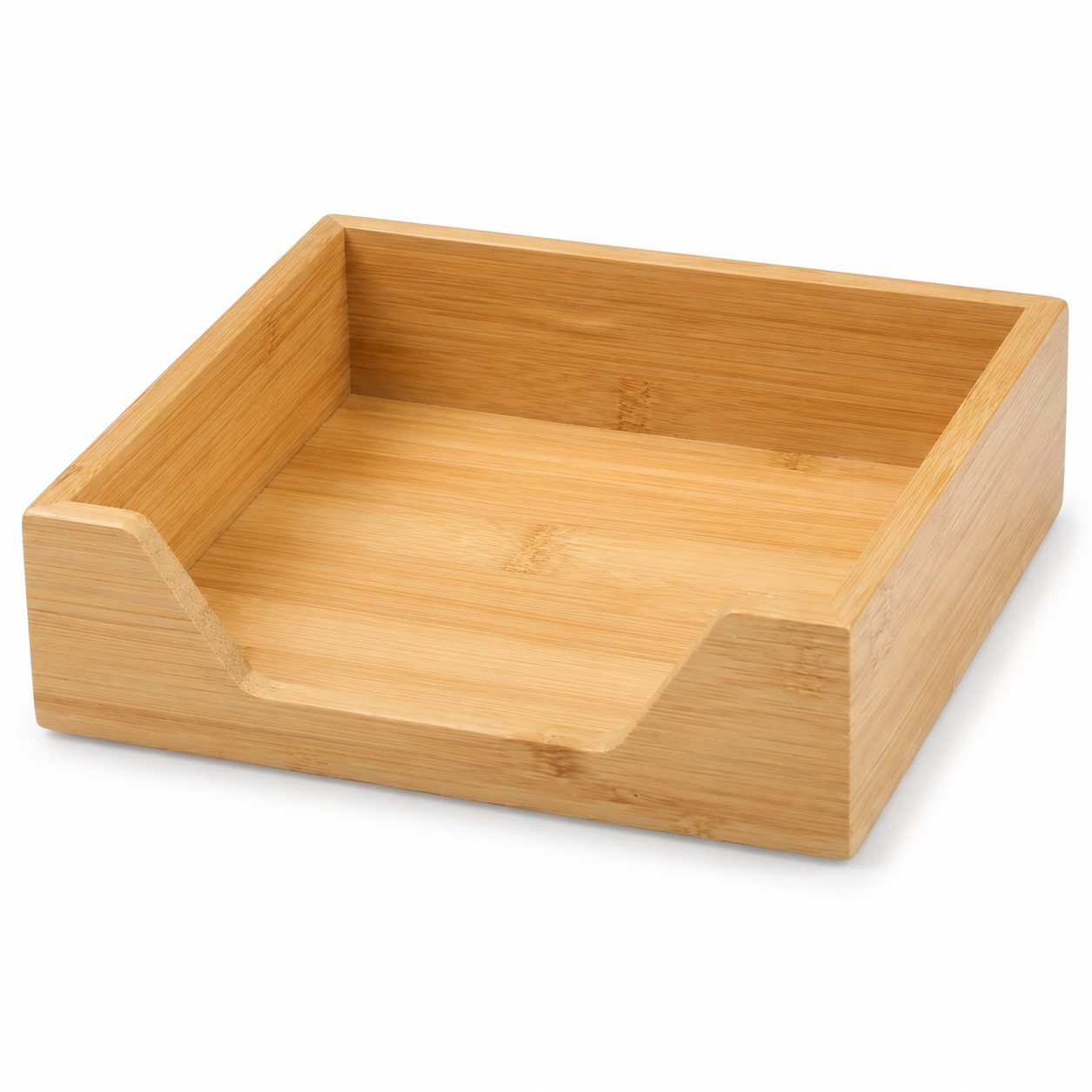
Present folded paper napkins in a low-profile tabletop organizer. This bamboo napkin holder tray has a square, open-top form with raised side and rear walls. The front wall includes a broad lowered center cutout with symmetrical sloping shoulders, exposing the edge of a horizontal napkin stack. It has no lid, weighted arm, divider or adjustment mechanism. Exact dimensions, bamboo construction, capacity, compatible napkin formats, finish, base treatment, care method and packaging must follow the approved BOM, drawing and pre-production sample.

The current copy and one gallery graphic include reference dimensions and broad fit statements. Verify them against the production sample before quotation or publication. Napkin fit depends on folded width, depth, paper thickness, embossing, stack height and retrieval clearance.
The product can support tableware, hospitality and household-organization programs. Buyers comparing adjacent formats may review our rectangular bamboo guest towel tray and woven water hyacinth tissue box cover. These are separate products: the first is a rectangular vanity or guest-towel tray, while the second encloses a tissue box.
Visible Structure and Access Design
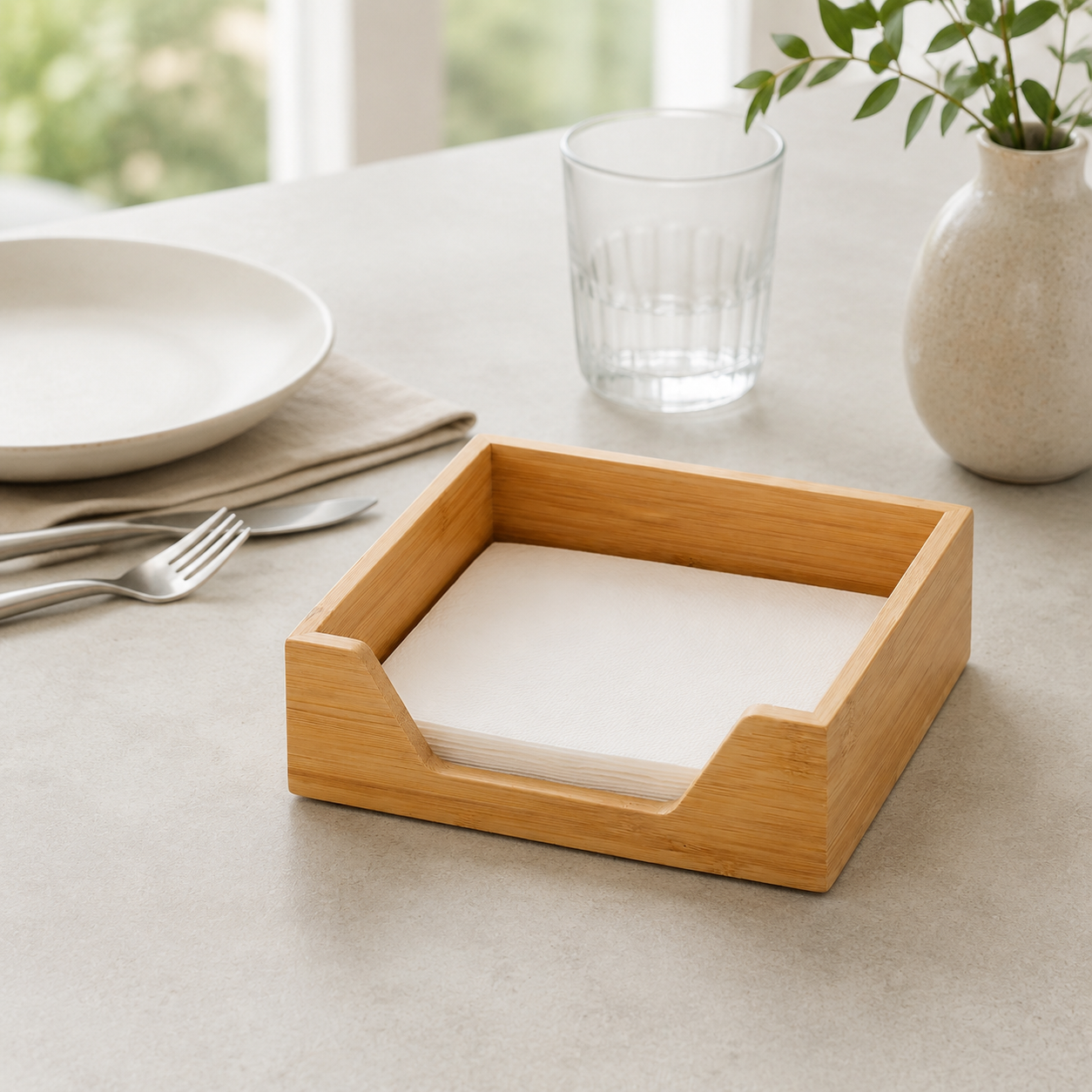
The clean product image shows a shallow square enclosure with a flat internal platform, four corner sections and continuous side walls. The side and rear walls rise above a stack of folded paper napkins. At the front, the central wall section is lower, while both front corners remain higher. This opening exposes the napkin edges and creates a place for fingers to reach the stack.
The open top supports straightforward refilling and makes the printed napkin face visible. There is no lid, weighted arm or upright spring shown. That means capacity and dispensing behavior are governed by the internal footprint, wall height, cutout geometry and paper characteristics. Lightweight paper may behave differently in moving air, so outdoor suitability should not be assumed without testing.
Components to Confirm
- One assembled base and surrounding wall structure.
- Side, rear and front-cutout dimensions on a controlled drawing.
- Material layers, joints, adhesives and any separate base panel.
- Any feet, pads, liners or inserts included with the selected version.
- Retail packaging, label and care instruction listed on the packing specification.
Napkins, towels, cosmetics and decorative objects shown in lifestyle images are display props unless separately listed and quoted.
Reference Specification for Quotation
| Specification Item | Current Reference | Required Approval |
|---|---|---|
| Product type | Horizontal tabletop napkin holder | Confirm target napkin category and sales channel |
| Form | Square open-top tray with raised walls | Approve external and internal geometry |
| Front access | Lowered center cutout shown | Confirm cutout width, depth, profile and edge standard |
| Main material | Bamboo appearance and current product positioning | Confirm species, grade, lamination, joint and base construction |
| Dimensions | Gallery graphic provides a reference only | Approve current drawing and tolerances before publication |
| Napkin fit | Square folded paper napkins shown | Validate using the buyer's napkin matrix |
| Capacity | No count confirmed | Define by paper type, thickness and stack height |
| Finish and color | Light bamboo tone shown | Approve finish system, appearance range and care method |
| Packaging | Not established | Approve surface protection, artwork and carton plan |
Napkin Fit and Capacity Planning
“Dinner napkin,” “guest napkin,” “cocktail napkin” and “paper hand towel” can describe different folded formats. Names alone are not enough for compatibility. Buyers should measure the folded width, folded depth, compressed thickness per sheet, edge profile and package count of each target product. Embossed, layered or heavily printed paper may create a taller stack than a thinner napkin with the same folded dimensions.
Build a napkin matrix for the planned retail claim. The internal platform should provide enough clearance for refilling without allowing the stack to shift excessively. The surrounding walls should support the sides without covering too much of the printed face. The front cutout should expose a usable edge at both a full and a partly depleted stack.
Suggested Compatibility Review
- Record the folded dimensions and compressed stack height of each target napkin.
- Measure the production sample's internal platform and wall geometry.
- Load the proposed retail quantity without compressing the paper unnaturally.
- Remove napkins repeatedly from full, half-full and low stack conditions.
- Check for edge snagging, corner damage, excessive movement and access difficulty.
- Approve a supported fit statement and reference stack for inspection.
If textile guest towels are part of the program, test them separately. Fabric thickness, seams and folding behavior differ from paper. Do not extend a paper-napkin capacity result to cloth items without validation. The dining-table scene below is illustrative; plain napkins and tableware are props, and their number does not establish a rated capacity.

Tabletop, Hospitality and Secondary Uses
The visible configuration is suitable for evaluation on dining tables, buffet counters, café service points, restaurant tables, hospitality rooms, kitchen counters and bathroom vanities. The final application depends on the approved finish, care method, napkin format and local operating requirements. Buyers should specify whether the product is intended for household, commercial or promotional use so packaging and inspection can match the channel.
One gallery image presents the empty holder as a shallow organizer for packaged cosmetics. That demonstrates a possible secondary open-tray use, but it does not establish compatibility with liquids, heat, chemicals or heavy objects. If the product will be marketed beyond napkin storage, list the intended items and test conditions in a separate brief. Keeping “napkin holder” as the primary identity protects search relevance and reduces confusing capacity claims.
Placement and Care Considerations
The holder should sit on a level surface with adequate distance from unsupported edges. Moisture, spills, cleaning agents and direct heat may affect the approved material or finish. Care instructions must be developed from the verified build and exposure tests. Do not copy cleaning statements from an unrelated bamboo item.
OEM and ODM Development
OEM projects can begin with the visible square format and a buyer's napkin matrix, branding and packaging requirements. Reviewable elements may include internal footprint, wall height, front-cutout profile, corner shape, finish color, logo position and retail presentation. ODM development can start from the target napkin format, use environment, retail price architecture and merchandising channel, followed by sample and fit review.
Changing the internal size may affect material use, carton dimensions and appearance. A deeper cutout can improve access but may reduce front support. Taller walls may hold a larger stack while covering more of the napkin design. Treat each approved version as a controlled product with its own item number, BOM, drawing, test plan, artwork and sample. Learn more about our development scope on the About our factory page.
Private-Label Presentation
Branding may be reviewed on the front wall, side, base underside, paper band, insert, label, sleeve or box. The selected method must suit the confirmed finish. Buyers should provide vector artwork, brand colors, placement dimensions, barcode data, languages, warnings and legal copy. Approve a physical sample when mark quality or position is commercially important.
Packaging for Retail and Export
Packaging should protect the wall corners, front cutout, internal platform and finished faces. The open cavity may allow an insert or protective component, but the pack design should not press the walls outward. If products are nested for shipping, nesting clearance and surface contact require specific evaluation rather than assumption.
Possible unit packs include a band, wrap, bag, insert, sleeve or box selected after the shipping method is known. Validate the complete pack and master carton for the required retail, wholesale or parcel route. Confirm barcode placement, country-of-origin wording, care text, carton quantity and shipping marks before printing.
Quality Control Framework
A pre-production sample should establish dimensions, color, finish, wall geometry and napkin fit. Inspection can cover material identity, moisture parameters where relevant, joint quality, base flatness, squareness, wall height, internal footprint, cutout position, edge profile, surface condition, color range, marking, cleanliness and packaging. Critical internal dimensions may require a dedicated fixture.
Functional checks need written methods and acceptance limits. Depending on the approved product, they may cover napkin loading and retrieval, base movement on a defined surface, joint loading, finish exposure, cleaning cycles and packaging tests. Use a named reference napkin or dimensional block for fit inspection. Lifestyle photography and general marketing language are not measurable standards.
RFQ Checklist
- Forecast and order quantity by item, finish and destination.
- Napkin matrix with folded width, depth, thickness and target stack count.
- Required internal and external dimensions with tolerances.
- Front cutout, wall height, corner and base requirements.
- Bamboo construction, finish, color and appearance standard.
- Intended placement, secondary uses and functional tests.
- Logo artwork, retail copy, languages and barcode files.
- Unit packaging, carton, shipping marks and distribution route.
- Destination-market documents and inspection plan.
Complete inputs allow the supplier to separate image references from confirmed specifications and prepare a comparable quotation. Visit our bamboo and wooden products homepage, then use the contact page to send your napkin matrix and project files.
Frequently Asked Questions
1. What napkin sizes fit this holder?
Compatibility is not universal. Confirm folded width, depth, paper thickness and stack height using the buyer's reference napkins and an approved sample.
2. What are the holder dimensions?
A gallery graphic shows a reference size, but the current production dimensions must be verified on a controlled drawing before publication or ordering.
3. How many napkins does it hold?
Capacity varies by layers, embossing, compressed thickness and desired stack height. Define the claim with a named reference napkin.
4. Does the front cutout help with removal?
The cutout visibly exposes the napkin edges. Its practical access should be confirmed at full, partial and low stack conditions.
5. Can it hold cloth guest towels?
That use can be evaluated separately. Fabric dimensions, seams, thickness and folding behavior require their own fit and capacity test.
6. Are the napkins included?
No paper products are assumed included. Only components listed on the signed packing specification form part of the order.
7. Can dimensions, finish and branding be customized?
They can be reviewed for OEM or ODM work. Feasibility and commercial conditions depend on the requested construction and order plan.
8. How should the holder be cleaned?
Care instructions depend on the verified bamboo construction, joints and finish. Finalize cleaning and drying guidance after sample testing.
Request a Confirmed Napkin-Holder Quotation
Send your reference napkins, required dimensions, stack target, material and finish requirements, branding files, packaging brief, quantity and destination. We can review the bamboo napkin holder tray, identify open development points and prepare a project-specific sample and quotation plan. Contact us to discuss your OEM or ODM tabletop-accessory program.


Reviews
There are no reviews yet.