


The EU Packaging and Packaging Waste Regulation, Regulation (EU) 2025/40, now applies generally. It controls packaging placed on the EU market, not every bamboo or wooden product.
A bamboo serving tray sold for home use is normally the product; its sleeve, carton, insert, label, master case, pallet and wrap may be packaging. A food container filled at a takeaway counter can perform a service-packaging function, while a gift box may be sales packaging. Classification depends on function and supply—not material name alone.
This guide translates the main PPWR requirements into a supplier–buyer workflow for EU orders. It covers Article 5, packaging bills of materials, test evidence, recyclability, minimisation, labels, extended producer responsibility and records. It does not replace legal advice, and it does not make a packaging design “PPWR certified.”
Status note — 24 August 2026: PPWR has applied generally since 12 August 2026, while important labelling and technical measures are still being prepared. Document assumptions and keep artwork and specifications under change control.
1. Classify the Product and Every Packaging Level
Start with what the customer receives, what is discarded, and what remains useful throughout the product's life. Do not classify by invoice description alone.
| Bamboo or wood export scenario | Likely starting point for review |
|---|---|
| Bamboo tray, coaster, placemat or cutlery organiser sold empty | Generally a product; its sleeve, carton, insert and transport materials are packaging. |
| Bamboo bowl designed to be filled at the point of sale | It may be service packaging. |
| Bamboo box containing a branded gift set | It may be sales packaging; assess whether it has an independent continuing use. |
| Carton, protectors, pallet, straps and wrap used for shipment | Typical grouped, transport or e-commerce packaging components. |
Also separate PPWR from product rules. A food-contact bamboo tray can require evidence under EU food-contact legislation even when the tray itself is not packaging. Conversely, a coating applied to the product is not automatically a packaging component. A label attached to the product can be packaging, and inks, varnishes, laminates or adhesives used on the carton remain relevant to the packaging assessment.
Create a packaging map covering sales, grouped, transport and e-commerce packaging. Give every unit a controlled identifier: for example, EU-TRAY-SET-CARTON-V03. That identifier should connect the drawing, bill of materials, test evidence, artwork and order history.
2. Allocate PPWR Roles Before the Purchase Order
“Supplier,” “manufacturer,” “importer” and “producer” are not interchangeable PPWR terms.
- The packaging manufacturer manufactures packaging, or has it designed or manufactured and markets it under its name or trademark, subject to the detailed definition.
- A packaging or material supplier provides the manufacturer with information needed to demonstrate conformity.
- The EU importer places third-country packaging on the market and verifies the required conformity assessment, file, marking and documents.
- A distributor performs specified checks and acts with due care.
- The EPR producer is determined separately by the sales route and first supply in a Member State. It may be the EU importer in a conventional B2B transaction, while a non-EU direct seller can fall within the definition.
If an importer or distributor places packaging under its own name or trademark, or changes it in a way that may affect compliance, manufacturer obligations can shift to that business. The contract should identify the design owner, PPWR manufacturer, declaration signatory, file holder and EPR party. An exporter can support these tasks without claiming a legal role it does not hold.
3. Build a Packaging BOM and Evidence File
A statement such as “paper box with no plastic” is not a usable technical file. Build a packaging bill of materials, or BOM, for each approved version.
Record at least:
- identifier, drawing revision, function and supplier;
- material grade, component weight, dimensions and packing configuration;
- recycled-content data and calculation basis, where relevant;
- inks, coatings, laminates, adhesives, tapes, labels and barriers;
- food-contact or other contact-sensitive status;
- proposed recycling stream and destination-market packaging category;
- declarations, specifications and relevant test reports;
- destination Member States, sales channel, approval date and affected orders.
Annex VII requires a packaging description, intended use, design information, applicable requirements, specifications and supporting analysis or test reports. A useful report identifies the sample and revision, method, laboratory, date, result, relevant detection limits and requirement assessed. Testing should be risk based: formulation data may support a low-risk component, while a coated food-contact wrapper may justify targeted testing. Confirm that any reused report still represents production.
4. Control PPWR Article 5 Substance Risks
PPWR Article 5 requires substances of concern in packaging or packaging components to be minimised. It also limits the sum of lead, cadmium, mercury and hexavalent chromium resulting from substances in packaging or packaging components to 100 mg/kg, subject to the Regulation's provisions and other applicable EU chemical rules.
From 12 August 2026, food-contact packaging cannot be placed on the market at or above the PPWR PFAS limits, where another EU act has not already prohibited those substances:
| Measurement | PPWR limit |
|---|---|
| Any PFAS measured by targeted analysis, excluding polymeric PFAS from quantification | 25 ppb |
| Sum of targeted PFAS, where applicable after precursor degradation, excluding polymeric PFAS | 250 ppb |
| PFAS including polymeric PFAS | 50 ppm |
For bamboo and wood programmes, the natural substrate is only one part of the risk assessment. Ask about water- or grease-resistant treatments, printing inks, lacquers, stain-resistant coatings, hot-melt glue, pressure-sensitive label adhesive and laminated barriers. If the bamboo item is the product rather than packaging, evaluate its coating under the applicable product or food-contact rules; do not cite a carton test as proof for the product.
Avoid undefined claims such as “chemical free” or “PFAS free.” A defensible claim identifies its scope, packaging version, analytical method and evidence. The Commission's 2026 PPWR guidance recommends a stepwise approach to PFAS testing and explains the role of total-fluorine information in enforcement.
5. Design for Recyclability Without Guessing Future Criteria
Article 6 requires packaging placed on the market to be recyclable. Detailed design-for-recycling assessment and grades phase in later: from 2030, or later where the Regulation's secondary-act timing clause applies, packaging will need to meet design-for-recycling criteria and achieve grade A, B or C; the recycled-at-scale element follows later, and grade C generally ceases to qualify from 2038.
For today's design decisions:
- select the intended recycling stream before choosing coatings and labels;
- reduce inseparable multi-material structures where protection does not require them;
- document how tapes, adhesives, inks and barriers affect sorting;
- require material-level data rather than “eco packaging” language;
- keep a change window while detailed criteria develop.
A narrow exemption exists for certain lightweight-wood sales packaging, but businesses should not assume that every wooden or bamboo package qualifies. Bamboo fibre mixed with polymer, laminated bamboo veneer, solid bamboo and paper made partly from bamboo are materially different. Record the actual composition and confirm the applicable packaging category with the EU operator responsible for conformity and EPR.
6. Prove Minimisation and Protection Together
From 1 January 2030, manufacturers or importers must ensure that packaging weight and volume are reduced to the minimum necessary for functionality. Annex IV requires the assessment to explain the calculated minimum, production-batch variation and the design requirement that prevents further reduction for each relevant performance criterion.
For grouped, transport and e-commerce packaging, a maximum 50% empty-space ratio also applies from 1 January 2030 or three years after the relevant implementing act enters into force, whichever is later.
Removing protection without validation can increase breakage, returns and total waste. For bamboo trays, organisers and tableware, document why corner protection, surface tissue, moisture control or separation between nested units is necessary. Useful evidence can include transit-test results, compression or drop-test records, humidity experience, damage data and packing trials. Record rejected alternatives as well as the final design.
7. Keep PPWR Labelling Under Version Control
PPWR introduces harmonised labels for material composition and sorting, reusable packaging and certain voluntary recycled- or bio-based-content information. The material-composition label is scheduled from 12 August 2028 or 24 months after the relevant implementing acts enter into force, whichever is later. As of the fact-check date, the Commission says it is still preparing the labelling implementing act.
Do not print guessed icons across two years of inventory. Reserve artwork space, name the artwork owner, set an approval deadline and identify who pays for changes after a legal update.
Separate those harmonised labels from traceability information already required under the Regulation. Manufacturers must provide a type, batch, serial number or other identification element and their required contact details on the packaging, data carrier or accompanying document as allowed. Importers also have contact-information duties. Your artwork checklist should therefore cover legal identity, traceability, sorting information, product labelling and language requirements as separate controlled fields.
8. Treat PPWR EPR as a Country and Route Question
PPWR EPR is not completed by one EU-wide registration number. Producers must register in each Member State where the Regulation regards them as first making packaging or packaged products available, or where they unpack packaged products without being end users. National procedures, producer-responsibility organisations, reporting and fees still matter.
Map who sells the goods, whether the customer is an importer or end user, where the packaging is first made available and whether sales go directly across borders. The contract should name the EPR producer and the party that registers, reports weights and pays fees.
A classic shipment to one EU importer may allocate producer responsibility differently from direct-to-consumer sales into several Member States. Do not place an EPR number from one country on a multi-country file and assume it covers the rest.
9. Use a Buyer-Ready RFQ Checklist
An EU buyer should add the following fields before requesting a packaging quotation:
- product SKU and possible product-versus-packaging issue;
- destination countries, sales channel and packaging levels;
- artwork owner, brand and proposed manufacturer, importer and EPR producer;
- restricted substances and contact-sensitive status;
- protection, humidity and transit-test requirements;
- BOM, component weights, tolerances and full treatment specifications;
- required declarations, test reports and claim evidence;
- labels, languages, barcodes and reserved artwork area;
- technical-file, EU declaration and EPR-data responsibilities;
- change-notification, re-approval, retention and authority-response contacts.
This list improves quotation quality because the supplier can see which protection, material and documentation requirements take priority.
10. Run a Controlled 10-Step PPWR Compliance Workflow
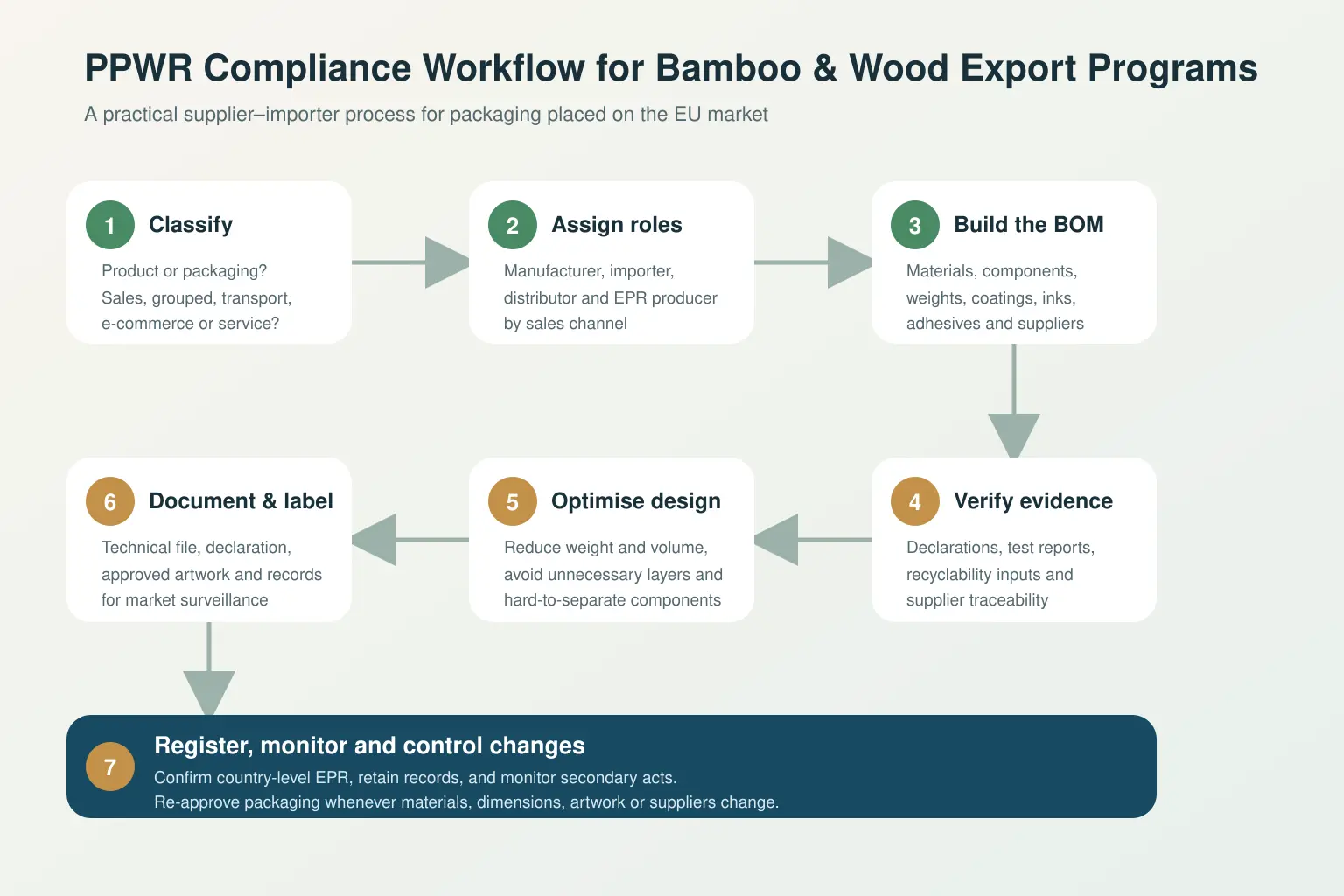
- Map the route. Record destination Member States, customer type and sales channel.
- Classify each item. Separate the product from sales, grouped, transport, service and e-commerce packaging.
- Assign legal roles. Identify the packaging manufacturer, supplier, importer, distributor and EPR producer.
- Freeze the packaging version. Give every component, drawing and artwork a controlled identifier.
- Complete the BOM. Capture composition, weights, dimensions, coatings, adhesives, labels and plastic parts.
- Assess risks and evidence. Check Article 5, contact-sensitive packaging rules, buyer restrictions and evidence gaps; commission appropriate testing where justified.
- Evaluate circularity. Review recyclability, recycled plastic content where relevant, minimisation, empty space, reuse and the developing 2030 criteria.
- Prepare labels and EPR data. Keep artwork changeable and map reporting categories country by country.
- Assemble and approve the file. Complete the conformity assessment, technical documentation and EU declaration through the legally responsible parties before placement on the market.
- Retain, monitor and re-assess. Link approved evidence to orders, control supplier changes and review Commission acts, standards and national EPR rules.
Retention and the 10-day response rule
Manufacturers must keep the technical documentation and EU declaration of conformity for five years after single-use packaging is placed on the market and ten years for reusable packaging. Importers must keep a copy of the declaration and ensure the technical documentation can be made available for the same periods.
After a reasoned request from a national authority, manufacturers and importers must provide the information and documentation needed to demonstrate conformity; the relevant documents must be made available within 10 days of receiving the request. An authorised representative has a corresponding document-availability obligation within its mandate.
Ten days is too short to reconstruct an unidentified carton from old emails. Store the approved BOM, declarations, reports, drawings, artwork, supplier identities and shipment references in one searchable record. Give one person ownership of authority requests and test retrieval at least once before the first EU shipment.
Environmental Claims: Say Only What the File Proves
PPWR does not create one universal “PPWR certificate.” Compliance is demonstrated against applicable requirements through the conformity assessment, technical documentation and EU declaration of conformity. Supplier certificates or laboratory reports can support that file, but none should be presented as blanket proof for every packaging revision and destination obligation.
Apply the same discipline to “recyclable,” “compostable,” “biodegradable,” “plastic free,” “reusable,” “natural” and “PFAS free.” Define the packaging component and market, keep the evidence, and review other EU rules governing environmental claims. “Made with bamboo” describes a source material; it does not by itself prove recyclability, compostability, low chemical risk or PPWR compliance.
Frequently Asked Questions
Does PPWR apply to a bamboo serving tray?
If the tray is sold empty as a household product, it is generally the product rather than packaging. Its carton, sleeve, label and transport materials can be packaging. If a similar item is designed to be filled at the point of sale or supplied containing another product, its classification may change.
Is bamboo packaging automatically recyclable?
No. Recyclability depends on the complete packaging design, collection and sorting stream, components and applicable assessment criteria. Coatings, polymer binders, labels and adhesives can matter.
Who is responsible: the exporter or the EU importer?
Responsibilities depend on the legal role and transaction. The packaging manufacturer prepares the conformity file and declaration; the importer performs specified verification and record duties. Suppliers must provide supporting information. EPR producer responsibility is determined separately by the sales route and Member State.
Does every packaging component need a laboratory test?
The Regulation requires adequate evidence, not the same test programme for every component. Use a documented risk assessment, reliable supplier information and targeted testing appropriate to the material, contact use, formulation and claim.
Can we use “PPWR certified” on a quotation?
Avoid an unsupported blanket claim. State the exact packaging version, requirement assessed, documents available and any assumptions or pending specifications.
Should we print the new EU sorting label now?
Use only applicable final specifications. The Commission was still preparing the relevant implementing act on the fact-check date, so keep artwork controlled and allow for a later update.
Prepare the Packaging File Before Production
For background dates and definitions, read our complete EU PPWR Regulation 2025/40 guide. Track secondary acts and implementation changes in the EU PPWR news and timeline.
Fujian Xianxu Bamboo & Wood Co., Ltd. can support buyer-specified retail and export packaging for custom bamboo and wooden product programmes through its China and Vietnam manufacturing network. Learn more about our manufacturing business. For an EU quotation, send the product specification, destination Member State, sales route, order quantity, packing configuration and buyer document list through our contact page. We can review available packaging data and production options with you; the responsible EU economic operator should confirm the legal classification, conformity and national EPR obligations.
This article is a practical business overview, not legal advice. PPWR secondary acts and national EPR procedures continue to develop. Verify the current official text, Commission guidance and destination-country requirements for each packaging programme.