


The Packaging and Packaging Waste Regulation (PPWR) is the European Union's new framework for reducing packaging waste and making packaging safer, more recyclable and more circular. Its official legal name is Regulation (EU) 2025/40.
The PPWR was published in the Official Journal on 22 January 2025, entered into force on 11 February 2025 and has applied generally since 12 August 2026. Those dates are not interchangeable. Entry into force made the Regulation part of EU law; the general application date is when most of its provisions began to apply. Many technical obligations still phase in later, especially in 2028, 2030, 2035, 2038 and 2040.
For importers, manufacturers, brand owners and packaging suppliers, the practical message is simple: PPWR compliance is not one new logo or one certificate. It is a system covering packaging composition, substances, recyclability, recycled plastic content, minimisation, labelling, reuse, extended producer responsibility and waste management.
Current-status note — 24 August 2026: the PPWR now applies generally, but the European Commission is still preparing important implementing and delegated measures, including parts of the harmonised labelling system and the recycled-plastic-content package. A business should therefore manage PPWR as a controlled compliance programme, not as a one-time artwork change.
PPWR at a Glance
| Question | Short answer |
|---|---|
| What does PPWR mean? | Packaging and Packaging Waste Regulation. |
| What is the law number? | Regulation (EU) 2025/40. |
| Is PPWR a directive? | No. It is a regulation and is directly applicable across EU Member States. |
| When was it published? | 22 January 2025. |
| What is the PPWR entry into force date? | 11 February 2025. |
| When did it generally start to apply? | 12 August 2026. |
| What did it replace? | Directive 94/62/EC on packaging and packaging waste, generally repealed from 12 August 2026, subject to transitional provisions. |
| What packaging is covered? | In principle, all packaging and packaging waste, regardless of material or origin, with specific exclusions and derogations. |
| Are all 2030 rules already fully specified? | No. Several methods, standards and secondary acts are still scheduled or under preparation. |
PPWR Meaning: Regulation, Not Directive
Searches for “PPWR directive” are common because the previous EU framework was the Packaging and Packaging Waste Directive, usually called the PPWD. The PPWR is different.
A directive requires Member States to transpose its objectives into national law. A regulation is directly applicable. The PPWR therefore aims to create more consistent packaging rules across the EU single market, although national authorities still enforce the law and national extended producer responsibility systems remain commercially important.
The official title is:
Regulation (EU) 2025/40 of the European Parliament and of the Council of 19 December 2024 on packaging and packaging waste, amending Regulation (EU) 2019/1020 and Directive (EU) 2019/904, and repealing Directive 94/62/EC.
The authoritative text and downloadable PPWR PDF are available on EUR-Lex. Use the EUR-Lex version rather than an undated third-party summary when making compliance decisions.
Which Packaging and Businesses Are in Scope?
The Regulation covers packaging placed on the EU market and packaging waste, regardless of whether it comes from industry, retail, distribution, offices, services or households. The material can be plastic, paper, cardboard, glass, metal, wood, cork, textile, ceramic or another material.
PPWR distinguishes several packaging functions:
- Sales packaging contains or presents a sales unit to the end user.
- Grouped packaging groups sales units for sale, stocking or distribution.
- Transport packaging facilitates handling and transport and protects products from damage.
- E-commerce packaging is transport packaging used to deliver distance-sales orders to an end user.
- Service packaging is designed to be filled at the point of sale, such as certain takeaway containers.
Economic roles include manufacturers, suppliers, importers, distributors, authorised representatives, final distributors and fulfilment service providers. A separate definition of producer determines many EPR obligations.
A product is not automatically packaging
This distinction matters for bamboo and wooden goods. A bamboo serving tray, placemat, coaster or drawer organiser sold for normal use is generally a product, not packaging merely because it can hold something. The carton, sleeve, insert, film, label, master case, pallet wrap and transport crate used to supply that product can be packaging.
An item can fall within PPWR when it performs a packaging function. For example, a bamboo gift box sold containing another product may be sales packaging, while an empty decorative storage box sold for its own continuing use may be the product. Classification depends on design, intended use and how the item is supplied—not simply on its material or marketing name.
Entry into Force, Application Date and Transition Period
The PPWR timeline includes three different concepts:
- Publication: 22 January 2025 in the Official Journal.
- Entry into force: 11 February 2025, twenty days after publication.
- General application: 12 August 2026, eighteen months after entry into force.
The transition is not a universal grace period lasting until 2030. Some requirements apply from August 2026, while others have their own dates or depend on future Commission acts.
For example, the Article 5 PFAS limits for food-contact packaging apply to packaging placed on the market from 12 August 2026. The Commission's June 2026 guidance says there is no stock-exhaustion period for packaging produced before that date but placed on the market afterward. Packaging placed on the market before the date may remain there and does not have to be withdrawn solely for that reason.
Labelling follows another schedule. The material-composition sorting label is due from 12 August 2028 or 24 months after the relevant implementing acts enter into force, whichever is later. This is why businesses should avoid guessing the final EU pictograms before the Commission specifications are legally settled.
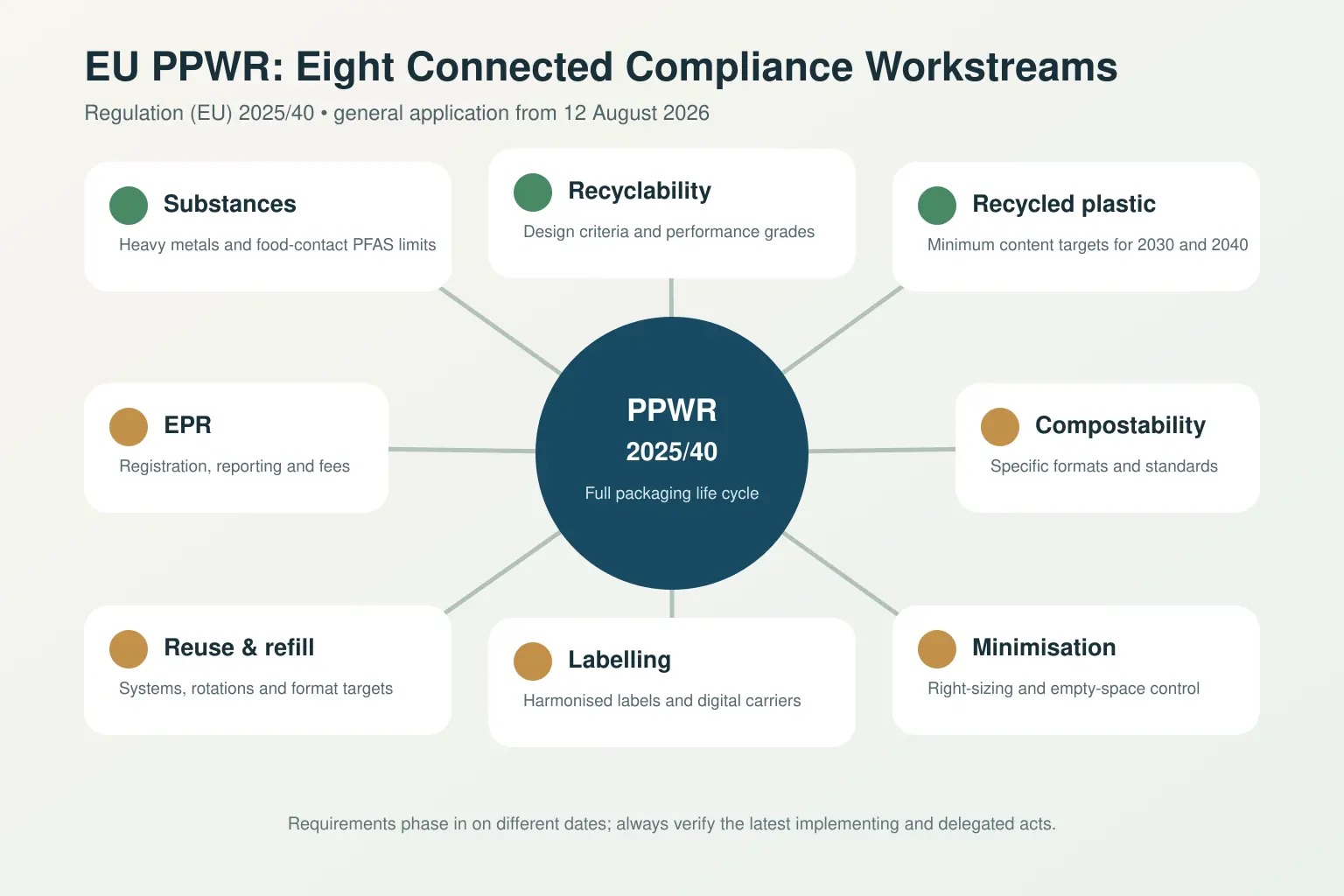
Key PPWR Requirements
1. Article 5: substances in packaging
Article 5 requires substances of concern in packaging to be minimised. It also carries forward a limit for four heavy metals: the sum of lead, cadmium, mercury and hexavalent chromium resulting from substances in packaging or packaging components must not exceed 100 mg/kg, subject to the Regulation's provisions and other applicable EU chemical rules.
From 12 August 2026, food-contact packaging cannot be placed on the market when PFAS concentrations reach or exceed these PPWR limits, to the extent another EU act has not already prohibited them:
| PFAS measurement | Limit |
|---|---|
| Any PFAS measured by targeted analysis, excluding polymeric PFAS from quantification | 25 ppb |
| Sum of PFAS measured by targeted analysis, where applicable after precursor degradation, excluding polymeric PFAS | 250 ppb |
| PFAS including polymeric PFAS | 50 ppm |
The 2026 Commission guidance recommends a stepwise testing approach and explains how total fluorine information can support enforcement. Packaging suppliers should not convert this into a generic “PFAS-free” marketing claim without a defined scope, suitable test method and supporting evidence.
2. Recyclable packaging and performance grades
Article 6 states that all packaging placed on the market must be recyclable. The Commission's 2026 guidance explains that this basic requirement applies from 12 August 2026, while detailed design-for-recycling assessment depends on delegated criteria.
The staged framework is:
- From 1 January 2030, or 24 months after the relevant delegated acts enter into force if later, packaging must satisfy design-for-recycling requirements and achieve grade A, B or C.
- The recycled-at-scale element phases in from 2035, subject to the date of the implementing methodology.
- From 1 January 2038, packaging generally must achieve grade A or B; grade C is no longer enough.
The Regulation contains targeted exemptions. One concerns sales packaging made from lightweight wood, cork, textile, rubber, ceramic or porcelain. Businesses should not assume every bamboo or wooden package fits that narrow exemption. In addition, exemption from the recyclability requirement does not automatically remove EPR fee obligations.
3. Minimum recycled content in plastic packaging
Article 7 sets post-consumer recycled-content targets for plastic parts of packaging. The 2030 deadline is 1 January 2030 or three years after the calculation-and-verification implementing act enters into force, whichever is later.
| Plastic packaging category | 2030 minimum | 2040 minimum |
|---|---|---|
| Contact-sensitive, mainly PET, excluding single-use beverage bottles | 30% | 50% |
| Contact-sensitive, non-PET, excluding single-use beverage bottles | 10% | 25% |
| Single-use plastic beverage bottles | 30% | 65% |
| Other plastic packaging | 35% | 65% |
Exemptions and calculation rules matter. A buyer should check the final methodology, the exact packaging category and whether a derogation applies before inserting a percentage into a supplier specification.
4. Compostable packaging
PPWR does not say that all bio-based or biodegradable packaging should be compostable. Article 9 identifies specific formats and enables limited national requirements under defined conditions. Other biodegradable packaging must generally be designed for material recycling by 12 February 2028 without harming other recycling streams.
“Made from bamboo,” “plant based,” “biodegradable” and “compostable” are not interchangeable claims. Each describes a different characteristic and may require separate technical evidence.
5. Packaging minimisation and empty space
By 1 January 2030, manufacturers or importers must ensure that packaging weight and volume are reduced to the minimum necessary for functionality. Packaging that increases perceived product volume through false bottoms, unnecessary layers or similar features is restricted, subject to limited exceptions.
Grouped, transport and e-commerce packaging will also face a maximum 50% empty-space ratio from 1 January 2030 or three years after the calculation implementing act enters into force, whichever is later. The responsible economic operator is the person using or filling that packaging.
Protection remains a legitimate function. Right-sizing should be validated against damage rates, stacking, moisture exposure, handling and product safety rather than achieved by removing protection blindly.
6. Harmonised PPWR labelling requirements
The PPWR introduces harmonised labels for material composition and consumer sorting, as well as requirements for reusable packaging and digital information. Important dates include:
- Material-composition labels: from 12 August 2028 or 24 months after the relevant implementing acts enter into force, whichever is later.
- Reusable-packaging labels: from 12 February 2029 or 30 months after the relevant act enters into force, whichever is later.
- Labels for recycled or bio-based plastic content: voluntary, but when used they must follow harmonised specifications once applicable.
As of 24 August 2026, the Commission's live implementation page still states that it is preparing the packaging-labelling implementing act. Packaging artwork should therefore use version control and a reserved change window instead of presenting unofficial mock-ups as final EU labels.
7. Reuse and refill targets
From 1 January 2030, economic operators using listed transport packaging or sales packaging used for transport within the EU must generally ensure that at least 40% of such packaging, in total, is reusable within a reuse system. They should endeavour to reach at least 70% by 2040.
Other, stricter requirements apply to certain transport movements within one company, between linked or partner enterprises, or within one Member State. In 2026, the Commission adopted the first PPWR delegated decision, exempting certain operators using pallet wrappings and straps from the 100% reuse requirements for those formats. That exemption does not erase the overall 40% target.
Reuse is not proved by calling a carton “reusable.” The packaging must be designed for repeated rotations and operate within a system that supports collection, tracking, inspection and reconditioning.
8. Extended producer responsibility
PPWR strengthens EPR registration, reporting and financing rules. Producers must register in each Member State where they make packaging or packaged products available for the first time, or where they unpack packaged products without being the end user, when the Regulation's definition applies. A producer cannot lawfully perform those activities in a Member State if it—or its relevant representative—is not registered there.
EPR responsibility depends on the transaction route. In a conventional B2B import, the EU importer may be the relevant producer. A third-country company selling directly to EU end users can itself fall within the producer definition and may need local EPR representation. National registers, producer-responsibility organisations, fee structures and reporting procedures therefore still need country-by-country review.
PPWR Targets for 2030 and Beyond
Not every headline target is a direct packaging-manufacturer obligation. Some apply to Member States; others apply to defined economic operators.
| Date | Selected milestone |
|---|---|
| 2028 | Harmonised labels begin to phase in; Commission due to establish design-for-recycling criteria. |
| 2030 | Design-for-recycling grades, recycled-plastic-content targets, minimisation and many reuse or format restrictions begin, subject to later-date clauses. |
| 2030 | Member States must reduce packaging waste per capita by at least 5% versus 2018 and recycle at least 70% by weight of all packaging waste; material target includes 30% for wood. |
| 2035 | Packaging-waste reduction reaches at least 10%; recycled-at-scale requirements phase in. |
| 2038 | Packaging generally needs recyclability grade A or B. |
| 2040 | Packaging-waste reduction reaches at least 15%; higher plastic recycled-content targets and indicative reuse ambitions apply. |
What PPWR Means for Importers and Export Suppliers
PPWR shifts packaging conversations upstream. Buyers increasingly need material and component data before order confirmation, not after the shipment has left the factory. A practical sourcing brief should cover:
- packaging function and level;
- material composition and component weights;
- coatings, inks, adhesives, labels and plastic parts;
- dimensions, packed-product dimensions and empty-space assumptions;
- supplier declarations and relevant test reports;
- artwork ownership and change-control process;
- sales route and destination Member States;
- which party handles EPR registration, reporting and fees;
- data needed for the technical file and EU declaration of conformity.
For bamboo and wooden household products, packaging can often be simplified through right-sized corrugated cartons, paper sleeves, molded-pulp or folded-card inserts and reduced plastic. The correct design still depends on surface protection, moisture, impact and retail requirements.
Read the related PPWR compliance checklist for bamboo and wood product packaging for a practical supplier–buyer workflow, and use the EU PPWR news and timeline to monitor implementation changes.
Frequently Asked Questions
What is PPWR?
PPWR is the EU Packaging and Packaging Waste Regulation. It governs packaging sustainability, composition, labelling, waste prevention, reuse, EPR and related waste-management measures across the packaging life cycle.
Is PPWR a directive?
No. Regulation (EU) 2025/40 replaced the previous directive-based framework. It is directly applicable, while national enforcement and EPR systems still matter.
What is the PPWR entry into force date?
11 February 2025. The general application date is 12 August 2026.
What does “EU PPWR 2025/40” mean?
It identifies the Regulation as the fortieth EU legal act of its type published in 2025. The act itself was signed on 19 December 2024 and published in January 2025.
Where can I download the PPWR regulation PDF?
Use the official EUR-Lex record for Regulation (EU) 2025/40, which provides the authentic Official Journal formats.
Does PPWR apply to companies outside the EU?
It applies to packaging placed on the EU market. A non-EU manufacturer can have documentation duties through the supply chain, while the EU importer verifies conformity. A non-EU seller supplying EU end users directly may also become the EPR producer under the Regulation's definitions.
Is there a PPWR transition period until 2030?
No single universal transition lasts until 2030. The Regulation generally applies from August 2026, and individual requirements have separate staged dates or depend on secondary acts.
Can packaging be marketed as “PPWR certified”?
PPWR does not create one universal product certificate. A more defensible approach is to identify the exact requirement, packaging version, evidence and responsible economic operator.
Plan Packaging Before the Purchase Order
Fujian Xianxu Bamboo & Wood Co., Ltd. supports buyer-specified retail and export packaging for custom bamboo and wooden product programmes through its China and Vietnam manufacturing network. Learn more about our manufacturing business, or send the destination market, product specification, order quantity and proposed packing method through our contact page so packaging options and documentation inputs can be reviewed early.
This article is a practical business overview, not legal advice. PPWR secondary acts and national EPR procedures continue to develop; verify the current official text, Commission guidance and destination-country requirements for each programme.