

Wooden Magnetic Knife Block with Utensil Holder
Source this wooden magnetic knife block with utensil holder for countertop storage. Confirm material, size, finish, packaging, MOQ and OEM options.
Description
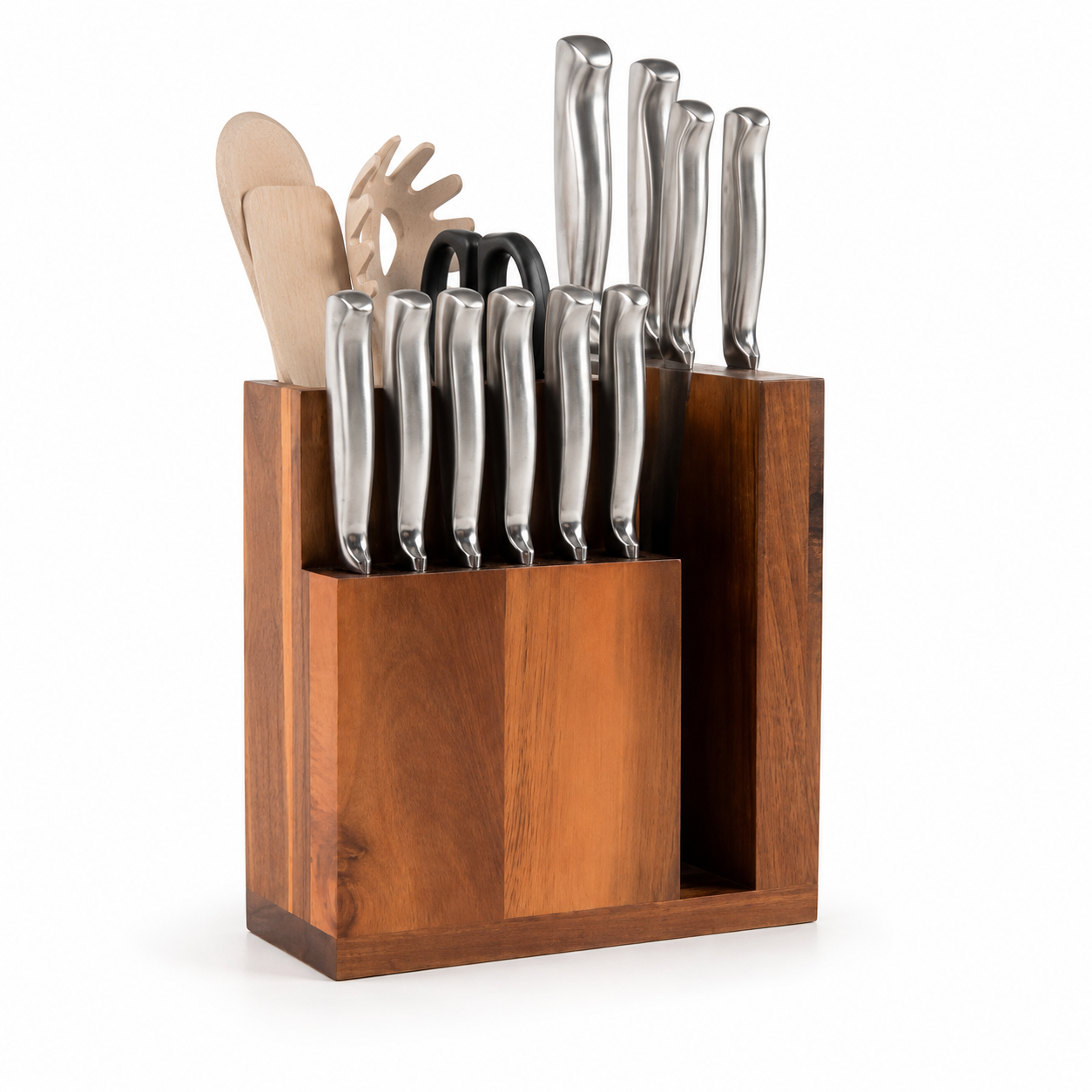
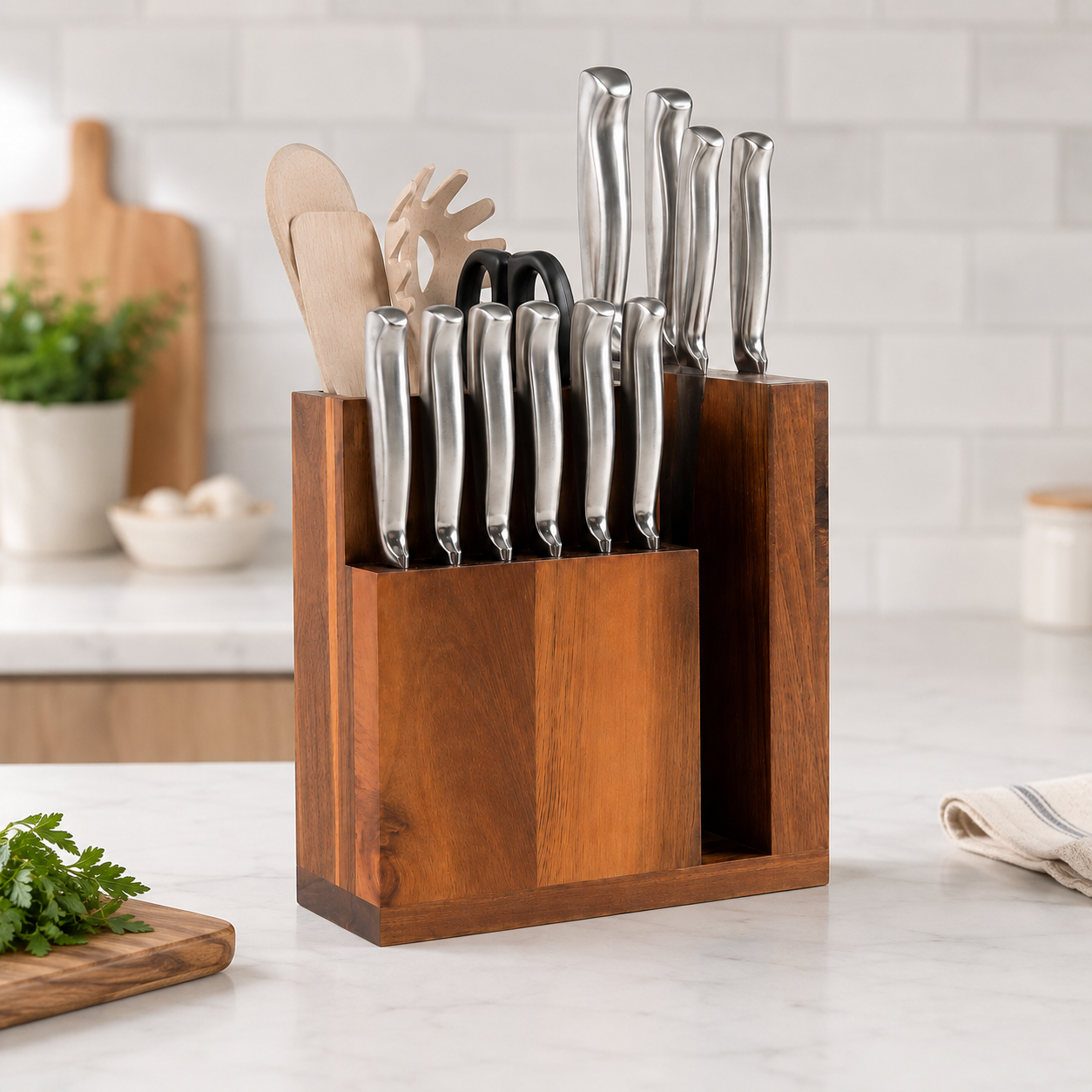
Organize knives and cooking tools in one countertop unit. This wooden magnetic knife block with utensil holder is presented as a combined storage concept for kitchenware brands, importers, retailers and hospitality-supply buyers. The visible design brings together a larger open compartment for utensils or scissors, a front-facing knife-display area intended for magnetic storage, and a side wood panel. Because the original photographs contain material, dimension and performance statements that have not been independently verified, every order should be based on an approved bill of materials, technical drawing and pre-production sample.
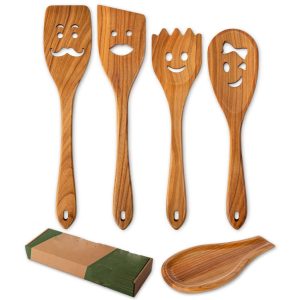
Buyers can source the item as a standalone countertop organizer or compare it with our 3 compartment utensil holder and wooden cooking utensil set. The photographs show the general form only; knives, scissors and utensils are display props unless listed in the approved pack specification.

Wooden Magnetic Knife Block with Utensil Holder Overview
This layout is designed to place frequently used kitchen tools in a single accessible area. The larger open section can be developed for ladles, spatulas, serving spoons, tongs or other long-handled utensils. A smaller position can be reviewed for kitchen scissors, while the broad front face can be engineered as a magnetic knife-display surface if confirmed in the final construction. The side panel helps define the freestanding silhouette and may also provide an additional display face, depending on the approved magnetic layout.
For commercial sourcing, the important point is not the number of objects arranged in a photograph. Knife dimensions, blade materials, handle shapes and tool thicknesses vary widely. Buyers should therefore send a target assortment or actual samples so that the holder can be evaluated against the intended merchandise. Capacity, spacing, balance and magnetic retention must be confirmed with that assortment before a purchase order is released.
Visible Design Elements
- A dark-toned wood-look countertop body with a compact vertical profile.
- A comparatively large open compartment for cooking tools and possible scissor storage.
- A front presentation area shown with knife blades positioned against the wood surface.
- A side wood panel that contributes to the combined storage structure.
- A base footprint intended for countertop placement, subject to stability testing with the approved load.
These observations describe the supplied imagery and do not replace engineering documentation. The material species, panel construction, internal magnets, adhesives, hardware, surface coating, base components and assembly method remain subject to written confirmation.
Wooden Magnetic Knife Block with Utensil Holder Specifications
| Item | Current Reference | Order Requirement |
|---|---|---|
| Product type | Countertop knife and utensil organizer | Confirm final configuration and intended use |
| Main material | Wooden appearance shown | Confirm species, grade and construction in the BOM |
| Knife-storage system | Front magnetic-storage concept shown | Confirm magnet type, location, coverage and validated retention |
| Tool storage | Open compartment with possible scissor position | Confirm internal layout, capacity and included inserts |
| Dimensions | Not confirmed | Approve a dimensioned drawing and tolerances |
| Finish and color | Dark wood tone shown | Approve finish system, color sample and surface standard |
| Base treatment | Not confirmed | Confirm feet, pads or other base components if required |
| Accessories | Display utensils are not assumed included | List every included component on the packing specification |
| Packaging | To be developed | Confirm unit pack, protection, labels and carton requirements |
Configuration and Material Confirmation
The gallery combines product styling with promotional graphics. Some graphics refer to bamboo, others to acacia, and several add feature claims. Those words are not treated as verified product data. Before costing, the supplier and buyer should agree on one product definition: the exact wood or engineered material, moisture specification, lamination or joint construction, magnet arrangement, finish, hardware and bottom treatment.
If a buyer wants alternative configurations, they should be quoted as separate item numbers rather than blended into one description. Options may include a revised utensil-compartment layout, a dedicated scissor insert, one-sided or multiple-face magnetic placement, different surface colors, or private-label packaging. Feasibility depends on tooling, structure, test requirements and order volume. No option is considered standard until it appears on the signed specification.
Knife Compatibility and Safe Use
Magnetic storage performance depends on the complete system: magnet grade and distribution, distance from the external surface, blade material, blade area, product orientation and the movement used to remove a knife. A photograph cannot establish retention strength. During development, test the organizer with the buyer's actual knife assortment and define an acceptance method that covers normal placement, removal and accidental movement.
- Confirm that each intended blade material responds appropriately to the selected magnetic system.
- Check spacing so edges and points do not contact adjacent tools or project beyond the approved boundary.
- Evaluate stability with realistic knives and utensils loaded in expected positions.
- Place and remove knives using the method defined in the approved user instructions.
- Keep the unit and sharp tools away from children and unstable countertop edges.
- Do not market a fixed knife capacity until the target assortment has passed fit and retention checks.
Any consumer warning, care instruction or market-specific compliance statement should be reviewed by the buyer for the destination country. The organizer is a storage product, not a substitute for proper knife handling.
Retail, Brand and Hospitality Applications
The combined format can support several merchandising programs. Kitchenware brands may pair it with an existing knife or utensil collection after compatibility testing. Retailers can develop it as a countertop-organization item, while distributors may position it within a coordinated wood-look storage range. Hospitality and residential-project buyers can also evaluate the form for back-of-house or demonstration kitchens, provided the final specification meets their operating and cleaning requirements.

OEM and ODM Development
OEM work can begin from the reference form, a buyer drawing or an existing merchandise brief. Our product-development team can review practical changes such as overall proportions, compartment geometry, surface color, logo placement, label format and packaging presentation. ODM requests can start with target users, knife assortment, retail channel, price objective and destination market, followed by a manufacturability review.
Branding methods may include an approved mark on the product, a printed insert, sleeve, color box, barcode label or shipping mark. The available method depends on the confirmed material and finish. Buyers should provide vector artwork, color references, placement dimensions, legal copy and barcode data. Approval of an artwork proof does not replace approval of a physical sample when appearance is commercially important.
Learn more about our production and development scope on the About our factory page. For project-specific feasibility, use the contact page to send your brief.
Packaging Development for Export Orders
A vertical organizer with panels, edges and possible internal magnets needs packaging designed around the approved construction. A typical evaluation should cover surface protection, corner and panel protection, control of movement inside the unit pack, accessory separation, moisture management where appropriate, and outer-carton strength. The final solution may use tissue, a bag, molded paper, board dividers, foam or other components selected for the required protection level and market rules.
Validate packaging with the actual pack-out and shipment method. Confirm marks, language, warnings, country-of-origin information and barcodes before printing.
Quality Control Points
Quality requirements should be translated into measurable inspection criteria before production. The control plan may include incoming material verification, moisture checks where relevant, dimensional inspection, joint and assembly review, magnet-placement verification, finish consistency, surface cleanliness, edge condition, compartment fit, base flatness and packaging completeness. Any retention test must identify the test knife or steel coupon, location, orientation, method and acceptance limit.
A pre-production sample establishes the benchmark. Final inspection can compare goods with the approved sample, drawing, BOM, artwork and packing specification. State any required third-party test or inspection in the RFQ.
What to Include in Your RFQ
- Target quantity by item, color and delivery destination.
- Preferred material or a request for material options.
- Required dimensions, tolerances and countertop footprint.
- Knife and utensil assortment, with samples or dimensioned references.
- Required magnetic faces and the proposed retention test.
- Finish, color, logo and private-label artwork requirements.
- Unit packaging, carton, barcode, manual and shipping-mark details.
- Destination-market testing, documentation and inspection requirements.
- Target delivery window and preferred trade terms.
Visit our bamboo and wooden products homepage to review the broader range.
Frequently Asked Questions
1. Is this product confirmed as bamboo or acacia?
No single material should be assumed from the current images or old title. The species, grade and construction must be stated in the approved BOM and purchase documents.
2. Are magnets included in the standard construction?
The imagery presents a magnetic knife-storage concept, but the magnet type, quantity, position and coverage must be confirmed for the selected version.
3. How many knives does the holder store?
Capacity depends on knife size, blade material, handle geometry, spacing and magnetic performance. Send the intended assortment for fit and retention testing.
4. Are the scissors, knives and utensils included?
They are treated as display props unless a signed packing list specifically includes them. Request a component-by-component quotation if a bundled set is required.
5. What are the product dimensions?
Dimensions shown in promotional graphics are not adopted as confirmed specifications. Ask for a current dimensioned drawing and approve tolerances before ordering.
6. Does the base have non-slip feet?
That feature appears in promotional material but is not confirmed here. Define the required base treatment, component material and performance check in the RFQ.
7. Can the color, compartments and packaging be customized?
These elements can be reviewed for OEM or ODM development. Feasibility, sampling, cost and production conditions depend on the requested design and order plan.
8. How should the organizer be cleaned?
Care instructions depend on the approved material, finish, adhesives and assembly. The final manual should follow the verified construction; avoid soaking unless expressly validated.
Request a Confirmed Sample and Quotation
Build your sourcing decision around verified specifications, not image text. Send the intended knife and utensil assortment, material preference, target dimensions, branding files, packaging brief, quantity and destination market. We can then review the wooden magnetic knife block with utensil holder, identify open engineering points and prepare a project-specific quotation. Contact us to request a confirmed drawing, sample plan and OEM or ODM proposal.
Reviews
There are no reviews yet.