

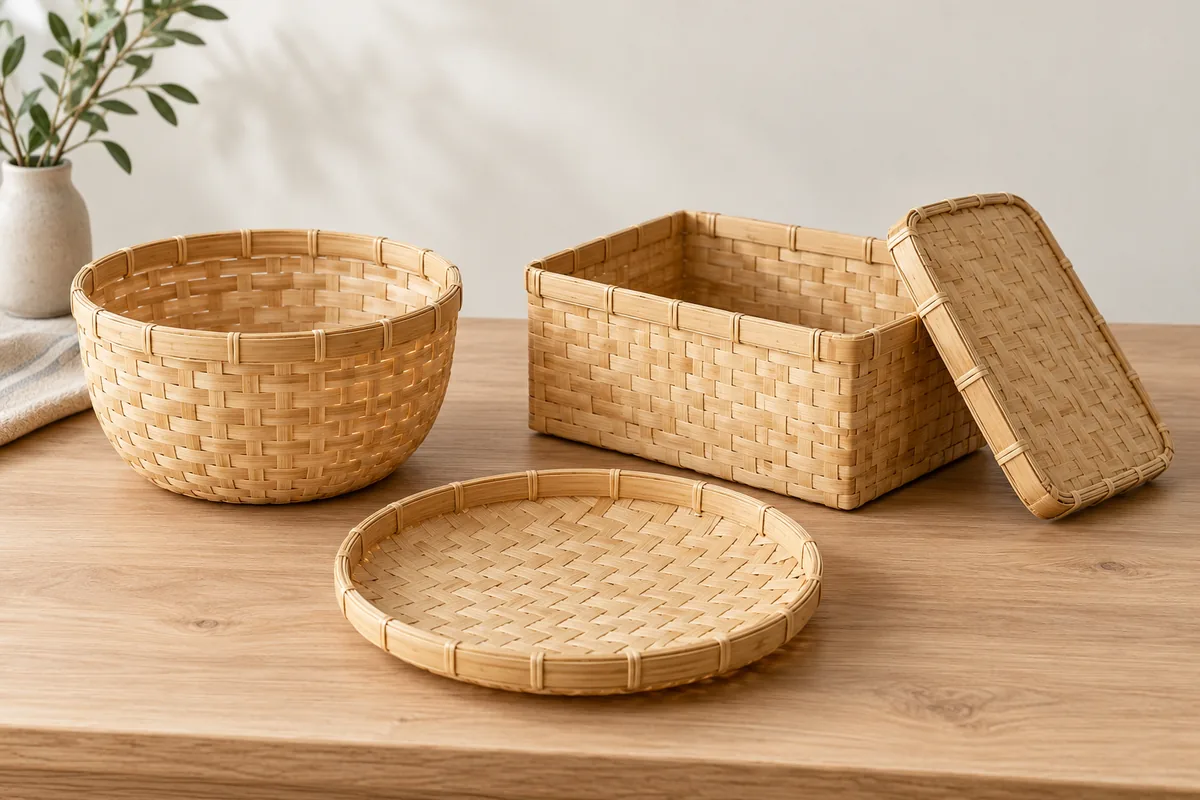
A bamboo basket is a woven container made wholly or partly from prepared bamboo strips. Depending on its construction, it can organize dry household items, present food, hold a gift or carry a small load. The useful question is not simply whether a basket looks attractive: it is whether its opening, base, handles and finish suit the job you have in mind.
Start with that job, then choose the form. A shallow serving basket makes its contents easy to reach; a deep storage basket keeps loose belongings together. A purpose-built cooking basket has a different role again. Comparing these details helps you buy a woven bamboo basket that fits your routine rather than one that only fits a photograph.
Choose a basket by its main use
| Main use | Useful design | Detail to verify |
|---|---|---|
| Dry household storage | Rectangular or round deep basket | Usable inner dimensions and lid clearance |
| Table serving | Shallow basket or tray | Intended food contact and removable serving insert |
| Gifts and shopping | Basket with accessible opening and handles | Handle attachment and stated carrying suitability |
| Wall decoration | Light shallow basket | Secure mounting points and wall fixings |
| Plant display | Basket around a separate pot | Space for pot, saucer and removal |
A single basket can serve more than one purpose, but a change of use needs a fresh check. A basket that held laundry is not automatically suitable for bread. A decorative planter basket should not be assumed to tolerate wet soil, and a lid that hides clutter does not necessarily seal out moisture or pests.
Read the weave and construction
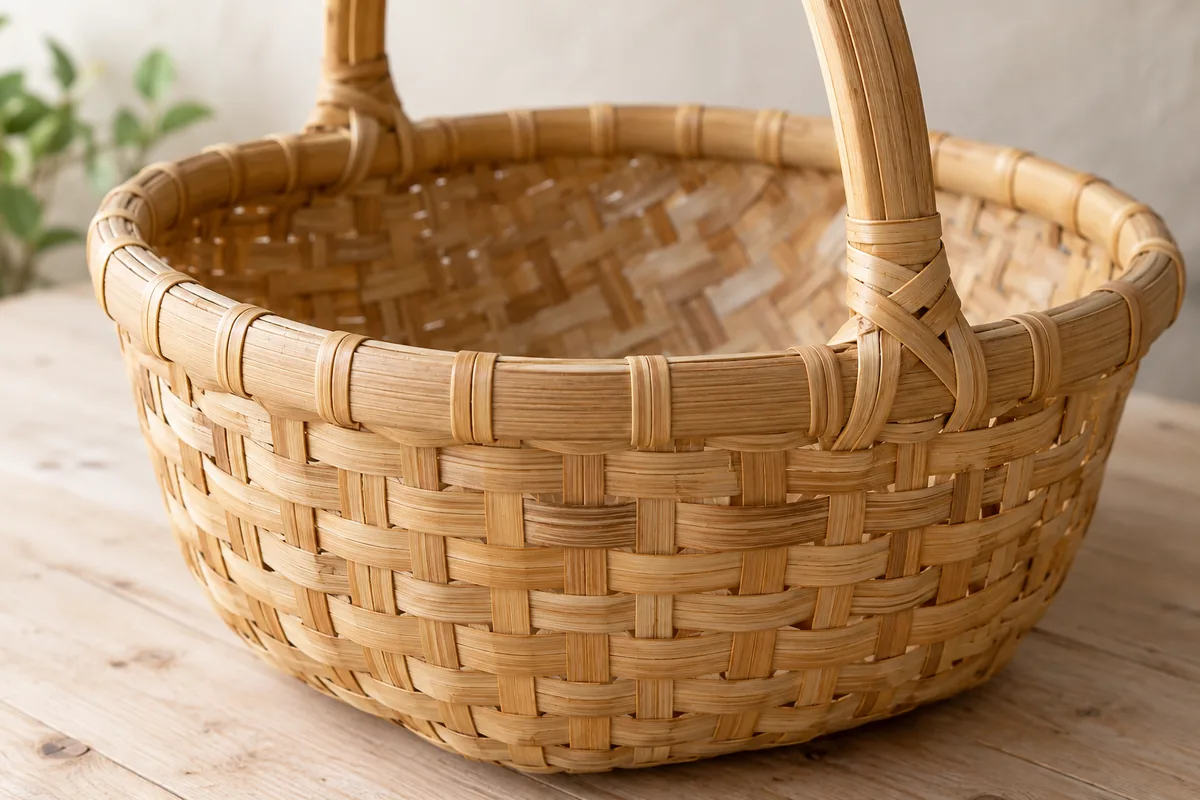
Look closely at the base, rim and places where handles join the body. The weave should support the intended contents without obvious broken strips, sharp ends or loose sections. Inspect the underside as well as the front: uneven support can make a basket rock on a shelf even when the visible sides appear tidy.
A more open weave makes contents easier to see and may suit larger items. A closer weave is more useful for small loose belongings. Neither appearance proves a particular load capacity. If carrying weight matters, ask the seller what the finished basket is designed to hold and whether that information applies to the handles as well as the base.
Check what the material description includes
“Bamboo woven basket” may describe the main body while the rim, bindings or handles use another material. “Basket with bamboo lid” may mean only the lid is bamboo. Request a component description when matching material, texture or care requirements is important. Photographs should show the actual product rather than a similar basket in a styled room.
Natural color can vary between strips and between batches. Painted, stained or coated baskets need their own care information. A pale finish is not proof of an untreated surface, and a natural material name does not establish food suitability, responsible sourcing or a particular service life.
Measure the space and the contents
For shelf storage, measure the available width, depth and height, then allow room to lift or slide the basket out. Include any handle and lid in the outer measurements. A tapered basket may have a generous opening but a much smaller base, which matters when you want to fit rigid boxes inside.
For serving or gifting, measure the largest item first. A flat round bamboo basket can look wide yet lack enough usable space once its sloping sides are considered. Ask for internal dimensions and a clear overhead photograph when the fit will be close.
Make maintenance part of the choice
Choose a basket you can empty, inspect and clean according to its instructions. Removable liners can simplify use, but they need to dry before being returned. For ordinary dry storage, keep the basket away from persistent damp and check its base occasionally rather than waiting until marks or odors appear.
Before ordering, confirm what comes in the package: the basket, lid, liner, handles and any illustrated accessories may be separate items. Then compare the delivered cost and return conditions. A well-described, appropriately sized basket is usually easier to assess than a listing built around broad claims.
Try a simple contents test
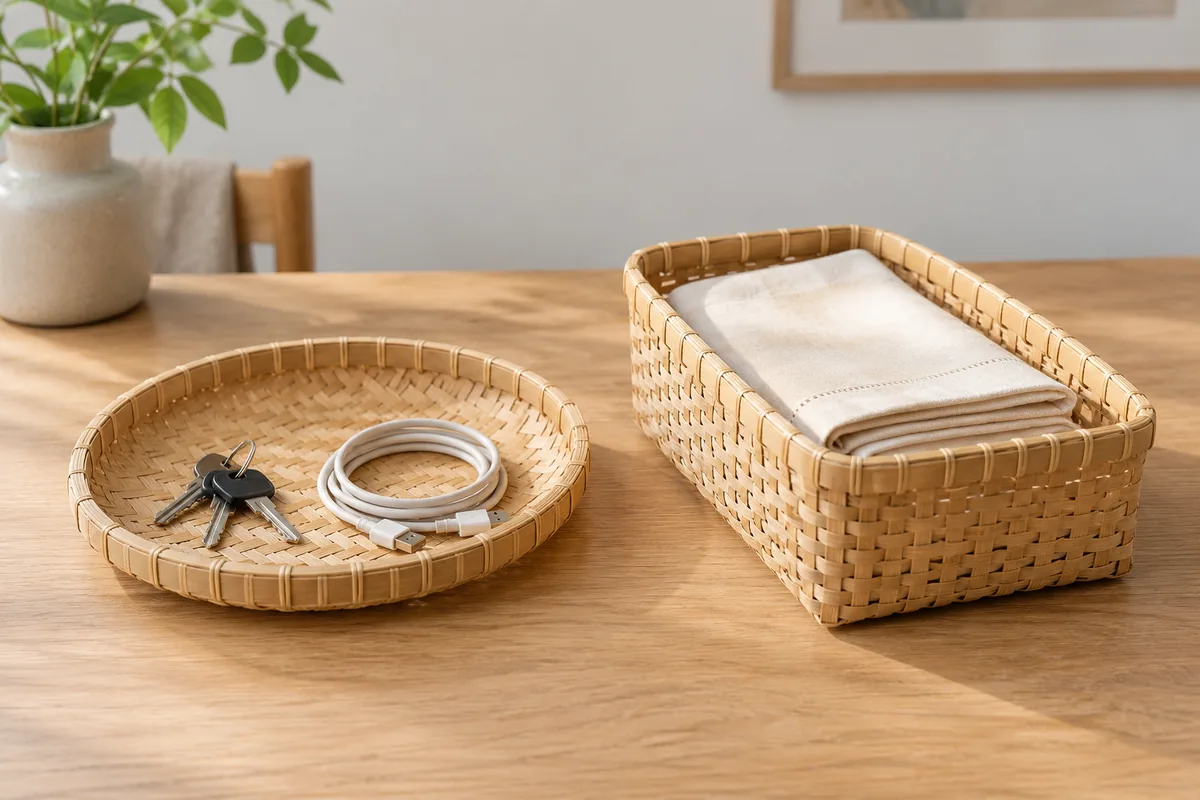
Before choosing a set, gather the items that will share each basket. For example, keep spare table linens in one group and everyday keys or chargers in another. Lay each group in a box with a similar usable footprint, then try retrieving the item you need most often. This reveals whether a deep basket, shallow tray or divided arrangement will work better.
For a retail assortment, assign each design one clear role and photograph it with realistic contents. A small, purposeful range is easier to compare than several nearly identical baskets described only as small, medium and large.
Frequently asked questions
What are bamboo baskets used for?
Common uses include dry storage, serving, gifts, decoration and carrying. Choose a model designed for the intended task; cooking and direct food contact need specific confirmation.
Are all baskets made from bamboo woven in the same way?
No. Strip width, spacing, shape, bindings and reinforcement differ. Examine the finished construction and usable dimensions instead of treating the material name as a complete specification.
Should I choose a bamboo basket with a lid?
Choose a lid when you want to conceal contents or reduce settling dust. Choose an open basket when quick access matters. Check how the lid opens within the available space.
What information should I ask for before buying?
Request internal and external dimensions, component materials, intended use, care instructions and package contents. Add carrying guidance if the basket will regularly leave its shelf.
Related bamboo basket guides
- Bamboo Storage Baskets with Lids: A Room-by-Room Guide
- Bamboo Basket Sizes and Shapes: How to Find the Right Fit
- Bamboo vs Cane vs Wicker Baskets: How to Read the Materials
- Buying Bamboo Baskets Online: Prices, Suppliers and Wholesale Checks
Discuss a wholesale basket specification
Planning a bamboo basket range? Share your reference design, dimensions, intended use, quantity, packaging and destination market through our project inquiry page. Confirm the proposed construction and sample before agreeing on a production order.