

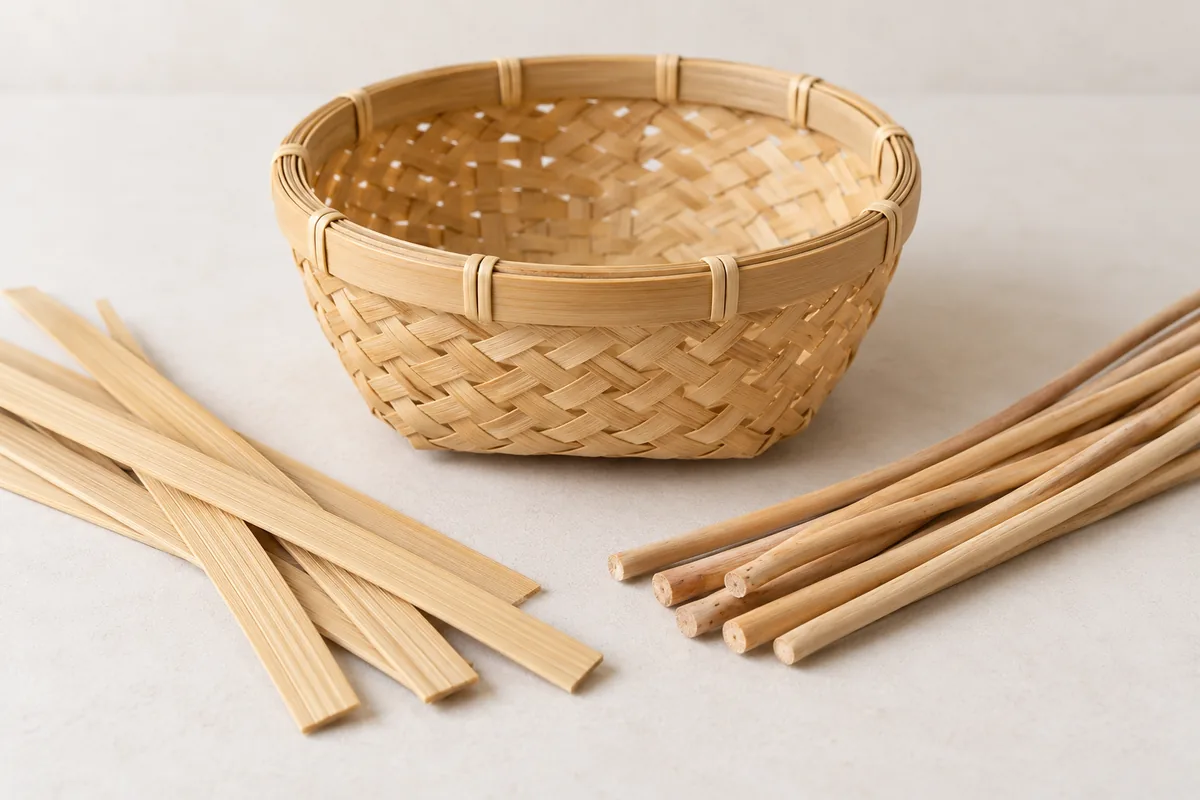
Bamboo, cane and wicker appear together in basket listings, but they do not tell you the same thing. Bamboo names a material. Cane can refer to material used in weaving, often associated with rattan. Wicker describes woven work and does not, by itself, identify a single plant. Understanding these descriptions makes it easier to compare baskets that look similar online.
The most useful product information separates the body, frame, rim, handle, lid and liner. A bamboo basket with rattan bindings can be accurately described as a mixed-material product. A fabric storage box with a bamboo lid is a different construction, even if both appear in a search for bamboo baskets.
What bamboo tells you about a basket
In a woven bamboo basket, prepared strips form all or part of the body. Look for a clear view of their width, spacing and edges. Flat split strips can create a different surface from round cane, but photographs alone cannot reliably authenticate a material. A finish or dye can also make identification harder.
Terms such as “bamboo stick basket” and “bamboo wood basket” may be broad seller descriptions. Ask whether the product uses woven strips, rigid slats, a separate frame or a combination. The answer helps explain its flexibility, usable space and cleaning requirements more clearly than a short search label.
How cane and rattan relate
Rattans are climbing palms whose stems provide cane used for baskets and other woven goods. Kew describes that relationship in its research on rattans in trade. A listing that says “cane basket” therefore deserves a more precise material description when you specifically want bamboo.
Do not assume a bamboo cane basket is made entirely from one material. The seller may mean a bamboo body with cane bindings, or may be using the terms loosely. Request a close photograph and written component list, particularly when replacing an existing basket or ordering a coordinated set.
Why wicker does not identify one material
The Smithsonian's wicker basket record describes woven work using materials that can include rattan, willow and bamboo. The practical implication for buyers is simple: a wicker description needs a material description alongside it.
“Bamboo wicker basket” can be a reasonable description of woven bamboo work, but “wicker basket” alone is incomplete for a material-specific purchase. Likewise, a woven appearance does not establish that the product contains natural bamboo. Confirm the actual components rather than selecting by texture or color alone.
Compare the product descriptions
| Listing term | What it may describe | Question to ask |
|---|---|---|
| Woven bamboo basket | Bamboo in the woven body | Are the rim and handles also bamboo? |
| Cane basket with lid | Cane construction with a separate cover | Which plant material is used in each part? |
| Bamboo wicker basket | Woven work made with bamboo | Are there other structural materials? |
| Storage basket with bamboo lid | Bamboo cover over a different body | What is the basket body made from? |
| Bamboo frame basket | Bamboo support with another infill | What forms the base and sides? |
Look beyond the material name
Two baskets made from the same material can behave differently because their shape, strip thickness and reinforcement differ. Inspect how a handle attaches, how the base sits and whether the lid fits comfortably. Use the manufacturer's stated suitability when a basket must carry weight or meet a specific use requirement.
Finish also matters. A painted white basket may need different cleaning from an uncoated natural basket. Ask whether the surface is painted, stained or coated, and whether the instructions cover the whole item. A removable fabric liner should have its own washing guidance.
Ask for evidence behind broader claims
Material identification and sourcing are separate questions. If responsible sourcing is part of your purchase criteria, request the relevant supplier information or verifiable documentation. Do the same for direct food contact. A bamboo label alone does not answer either question.
For an online order, save the written description and check it against the delivered item. For a wholesale order, use an approved sample and a component specification so that later batches can be compared consistently. This reduces disputes over vague terms such as “natural woven basket” without requiring every supplier to use identical marketing language.
Turn the description into a component record
For a repeat order, record each visible part separately: woven body, rim, base, lid, bindings and handle. Add the stated material and finish beside each part. An example description might specify a bamboo body and lid, rattan bindings and a cotton liner; that is a mixed-material basket, even when bamboo provides its main appearance.
Compare the written record with the approved sample. If the supplier proposes a substitute binding, liner or coating, ask how the change affects appearance and care before accepting it. Keep material identity, decorative style and intended use as separate purchasing decisions.
Frequently asked questions
Is wicker the same as bamboo?
No. Wicker describes woven work that can use different materials. Bamboo is one possible material, so check both the construction and the component description.
Does a bamboo lid mean the whole basket is bamboo?
No. The body may be textile, another woven material or a rigid container. Check the body and lid separately before comparing it with an all-bamboo woven basket.
Which is better for storage, bamboo or cane?
Choose by the finished design, dimensions, care instructions and intended contents. The material name alone does not establish load capacity, stability or lid performance.
Can I identify bamboo from a product photo?
A clear close-up helps, but it is not conclusive evidence. Obtain a written material description, especially for mixed-material products, painted finishes and repeat commercial orders.