

Three-Tier Bamboo Water Bottle Rack with Repositionable Dividers
Source a three-tier bamboo water bottle rack with repositionable dividers. Confirm dimensions, bottle compatibility, finish, packaging, MOQ and OEM options.
Description
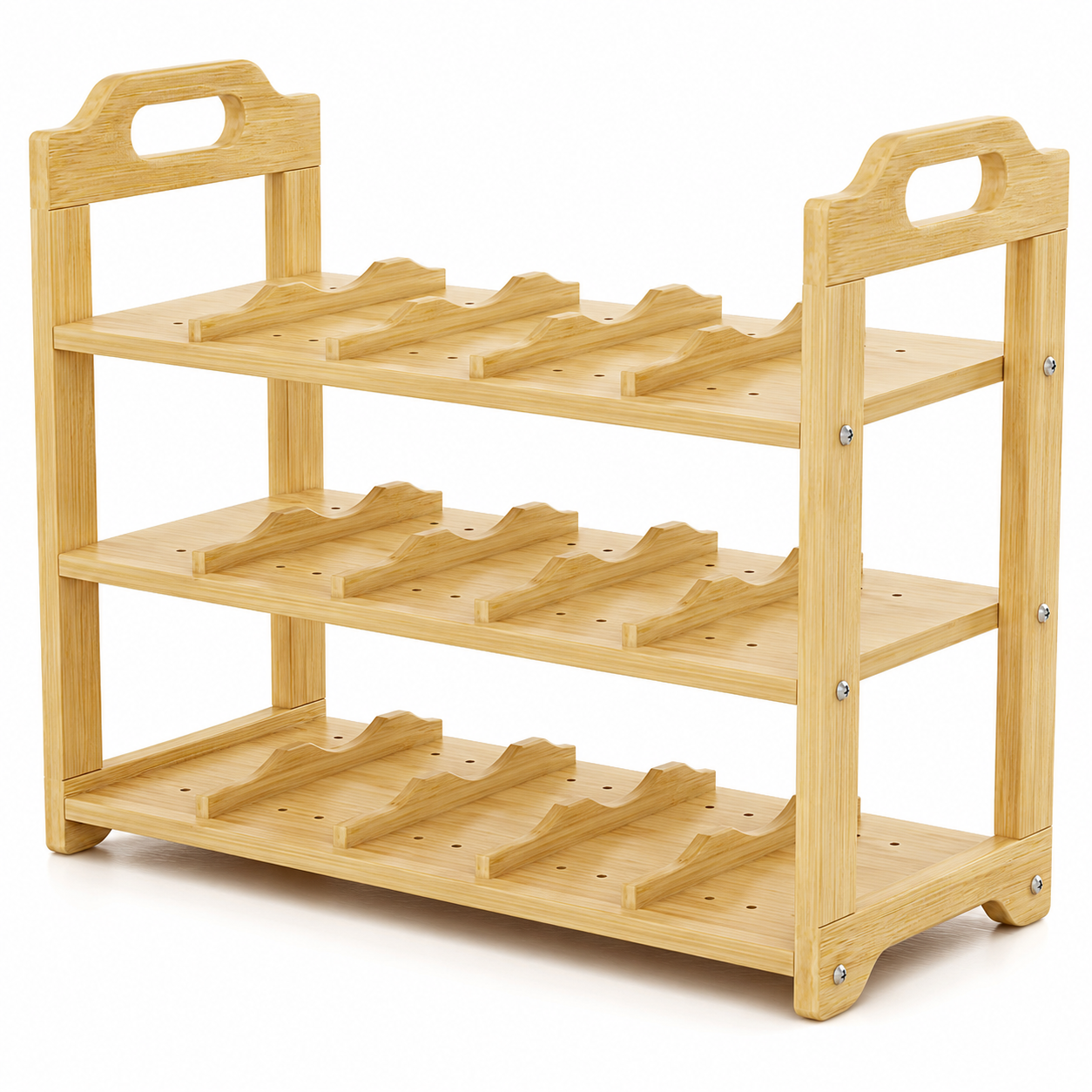
Plan bottle storage around a verified assortment, not a headline capacity. This bamboo water bottle rack is presented as a freestanding three-tier organizer for horizontally stored reusable bottles. The pictured shelves have rows of locating holes and removable curved dividers that can be repositioned laterally to create different bottle lanes. This does not make the shelf height or frame width adjustable. Final capacity, dimensions, bamboo construction, hardware, loading, balance, surface finish, assembly method, bottle compatibility and packaging must follow the approved bill of materials, controlled drawings and pre-production sample.

The format can support retail, hospitality and private-label storage programs after the use environment is reviewed. Buyers needing a wine-specific assortment can compare our dedicated 4-tier bamboo wine rack and freestanding stackable wood wine rack. Those are separate products with different configurations and specifications.
Product Positioning and Visual Reference
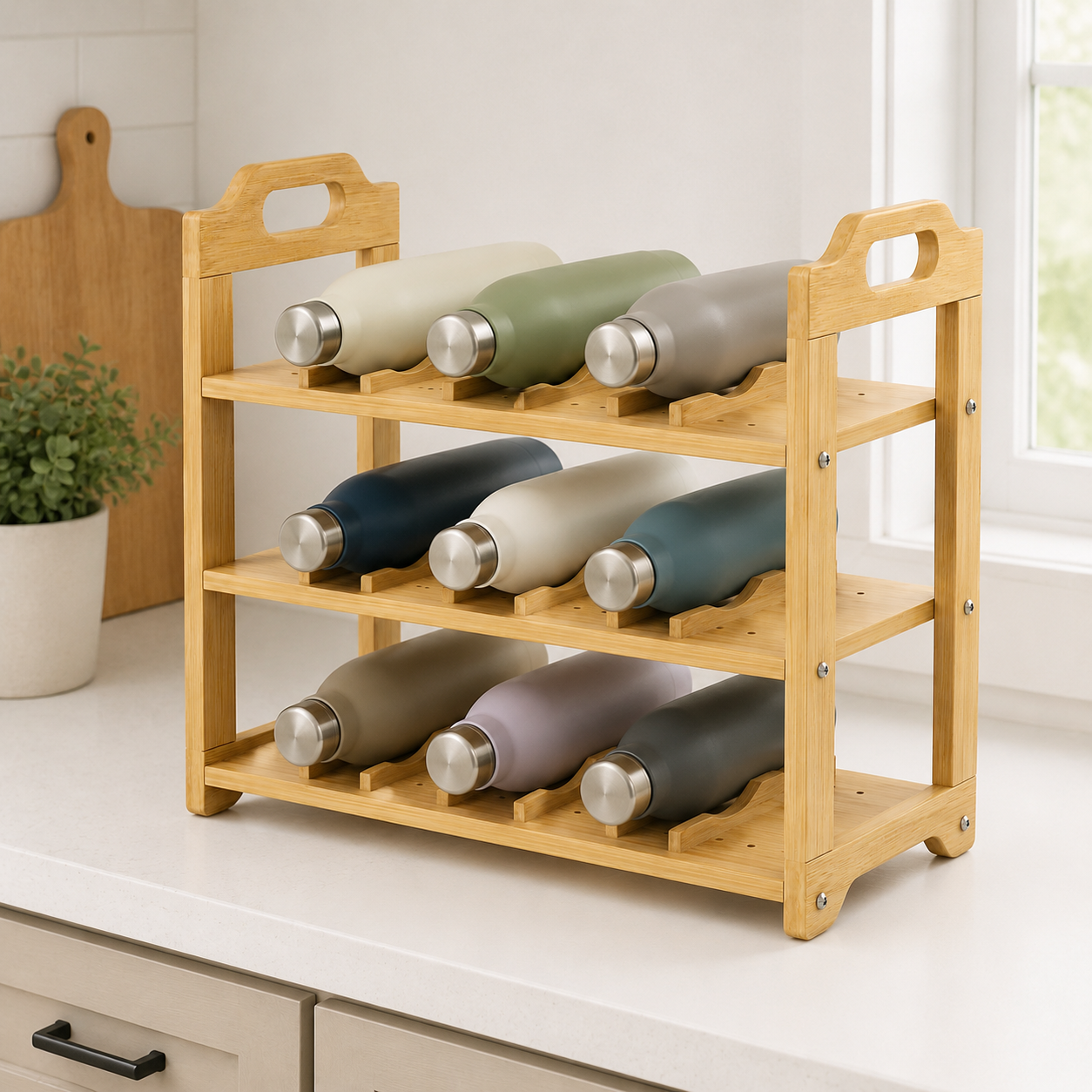
The reference rack uses exactly three fixed horizontal shelves within a freestanding frame. Each shelf shows curved dividers aligned with rows of locating holes. The divider position can therefore be specified for the target bottle assortment, while the pictured shelf height and overall frame width remain fixed. The layout can consolidate multiple containers in a relatively compact footprint, but the visible number of bottles in a photograph is not a universal capacity. Bottle diameter, shoulder shape, length, cap geometry, surface material, fill weight and placement direction can all change fit and loading.
Before quotation, confirm the three-tier version and identify every structural part. The drawing should show side frames, three shelf panels, curved divider rails, locating holes or pins, connectors, fasteners, feet or contact parts, and permitted divider positions. If another level arrangement or a stackable module is offered, it should receive a separate item number or a clearly controlled variant list rather than being mixed into this page.
Visible Structure and Open Specifications
- Three fixed storage shelves in the pictured reference version.
- Removable curved dividers with laterally repositionable locations.
- Exact bottle-rest geometry and the direction in which bottles are loaded.
- Frame, joint, fastener and contact-component construction.
- Assembled footprint, overall height and clearance around stored bottles.
- Whether wall restraint or another installation measure is required.
- Surface finish, care instructions and intended indoor environment.
Reference Specification for Quotation
| Specification Item | Current Position | Required Approval |
|---|---|---|
| Product type | Freestanding three-tier horizontal bottle organizer | Confirm target channel and intended storage environment |
| Level configuration | Three fixed shelves in the visual reference | Approve shelf spacing, included divider count and component arrangement |
| Capacity | Not confirmed | Validate with the buyer's bottle matrix and loading pattern |
| Main material | Bamboo positioning from current title | Confirm species, grade, panel or strip construction and bonding |
| Dimensions | Not confirmed | Approve assembled, component and packed dimensions with tolerances |
| Hardware | Not confirmed | List fasteners, inserts, tools and spare parts in the BOM |
| Working load | No rating established | Define distributed and local test conditions and acceptance limits |
| Finish | Not confirmed | Approve finish system, color range and appearance standard |
| Packaging | To be developed | Approve disassembly state, protection, artwork and carton plan |
Capacity Planning by Bottle Matrix
A useful capacity statement starts with actual containers. Build a bottle matrix covering maximum body and shoulder diameter, overall length, closure size, filled mass and handles. Include the intended wine families and reusable-bottle profiles rather than assuming one universal shape.
Test capacity per level and for the complete rack. Mixed bottle widths and masses can change the usable count. Identify the reference bottle and arrangement used during validation, with separate guidance for water and wine categories.
Recommended Capacity Validation
- Approve the bottle matrix and identify minimum, typical and maximum profiles.
- Place containers in the proposed orientation on every position.
- Check contact points, spacing, retrieval clearance and cap interference.
- Load the rack using the defined distribution and fill condition.
- Evaluate deflection, joint movement, rocking and tip tendency.
- Repeat after the required assembly and use-cycle tests.
No bottle should be included with the organizer unless it appears as a separately quoted component on the packing list. Bottles in the lifestyle image below are display props and do not establish a tested capacity or universal fit.

Bottle Compatibility and Placement
Horizontal storage is not suitable for every container or closure. Buyers should confirm that each intended bottle can be stored in the proposed orientation and environment. Check for leakage risk, pressure warnings, manufacturer storage instructions and the possibility of a bottle rolling during placement or removal. The organizer specification cannot override the bottle manufacturer's directions.
The rack should stand on a level surface with the approved loading sequence. If heavier containers belong on lower positions, state that in the user instructions and test plan. Installation near edges, heat sources, direct water exposure, vibration or frequent impact may require different evaluation. Children should not climb, pull or hang from the structure. Any wall-restraint requirement must be defined by the approved design and destination-market review.
Assembly and Configuration Control
The current page does not establish whether the product ships fully assembled, partly assembled or as a component pack. A controlled assembly drawing should show part numbers, orientation, fastener locations, tightening sequence and any required tool. Parts that appear similar should have clear identification. Instructions should also state how to verify that supports are seated and connections are complete before loading.
For the repositionable dividers, define every approved hole position, minimum lane width, locating-pin engagement and prohibited arrangement. Do not describe the shelves as height-adjustable or the rack as expandable. Repeated divider-placement and assembly checks may be appropriate when the product is intended for customer setup. Packaging should separate hardware and protect finished surfaces from rubbing.
Applications and Merchandising
The organizer can be considered for household beverage storage, pantry organization, break rooms, hospitality back areas, retail displays or specialty bottle collections after compatibility review. Merchandising can focus on vertical use of space, coordinated bamboo appearance and defined bottle categories. Avoid showing an assortment that exceeds the validated count or includes incompatible shapes.
OEM and ODM Development
OEM requests can start from the reference form and a buyer's bottle matrix, dimensions, color and packaging requirements. Reviewable elements may include frame proportions, level spacing, bottle-rest geometry, side-panel shape, finish color, logo placement, hardware pack and retail graphics. ODM projects can begin with the target bottle category, desired footprint, sales channel and price objective, followed by engineering and sample evaluation.
Changes to spacing or capacity can affect frame loading, balance and carton size. A taller configuration may require a different stability plan. A wider cradle may reduce positions per level. Treat each version as a separate controlled product with its own BOM, drawings, tests and artwork. Learn about our product-development scope on the About our factory page.
Private-Label Presentation
Branding can be reviewed on a panel, cross member, label, insert, sleeve or box. Provide vector artwork, colors, placement, barcode data, languages, warnings and legal copy. Approve a physical sample for the final mark.
Packaging for Export and Parcel Distribution
Packaging must reflect the approved shipping state. Component packs need part separation, hardware control, edge protection and an assembly guide. Assembled racks need protection for projections, joints and finished faces. The pack should prevent parts from shifting or rubbing and make accessory counting straightforward during inspection.
Validate the unit pack and master carton for the required route. Confirm quantity, carton data, barcode, country-of-origin wording, warnings and shipping marks before printing. Include retailer standards in the RFQ.
Quality Control Framework
A pre-production sample should establish dimensions, appearance, assembly and bottle fit. Inspection may cover material identity, moisture parameters where relevant, machining, joints, hole position, hardware, finish, edges, level spacing, bottle-rest geometry, base contact, assembled alignment, marking and packaging. Use gauges or templates for critical bottle-contact profiles.
Functional testing requires written fixtures, bottle references, loads, cycles and acceptance limits. Depending on the design, the plan may include static loading, local loading, deflection, joint movement, tip evaluation, repeated assembly, fastener checks, finish exposure and packaging tests. General marketing language cannot replace measurable criteria.
RFQ Checklist
- Forecast and order quantity by configuration, finish and destination.
- Target bottle matrix with dimensions, filled mass and storage instructions.
- Required level arrangement, positions and assembled footprint.
- Material construction, finish and appearance requirements.
- Assembly state, hardware, tool and instruction requirements.
- Load distribution, fit, stability and cycle-test methods.
- Logo artwork, labels, warnings, language and barcode files.
- Unit packaging, carton, pallet and distribution requirements.
- Destination-market documentation and inspection plan.
Complete inputs allow the supplier to separate visual references from confirmed specifications and prepare a comparable quotation. Visit our bamboo and wooden products homepage, then use the contact page to send your bottle matrix and project files.
Frequently Asked Questions
1. How many bottles does the rack hold?
No fixed capacity is stated here. Capacity must be validated with the buyer's bottle matrix, arrangement and approved rack configuration.
2. How many storage levels are included?
The page presents a three-tier reference version. Confirm the final shelf count, spacing and included component list on the controlled drawing and packing list.
3. Can the rack store both water and wine bottles?
It may be evaluated for both categories, but each intended bottle profile and storage orientation must pass fit and loading review.
4. What can be adjusted?
The pictured curved dividers can be repositioned laterally among shelf holes. Shelf height and frame width are not presented as adjustable; approve divider locations, clearances and instructions before production.
5. What are the rack dimensions and load rating?
Neither is confirmed here. Request controlled dimensions and a defined test method with distribution, duration and acceptance limits.
6. Does the rack require assembly?
The shipping state is project dependent. The final packing specification must list parts, hardware, tools and instructions.
7. Can the finish and branding be customized?
They can be reviewed for OEM or ODM work. Feasibility and commercial conditions depend on the approved construction and order plan.
8. How should the rack be used and maintained?
Follow the approved loading sequence, bottle guidance, placement limits and care instructions developed for the verified material and finish.
Request a Confirmed Bottle-Rack Quotation
Send your bottle matrix, desired footprint, divider layout, material and finish requirements, assembly preference, branding files, packaging brief, quantity and destination. We can review the bamboo water bottle rack, identify open engineering points and prepare a project-specific sample and quotation plan. Contact us to discuss your OEM or ODM bottle-storage program.
Reviews
There are no reviews yet.