

5-Compartment Expandable Bamboo Silverware Tray
5-compartment expandable bamboo silverware tray for wholesale sourcing. Confirm specifications and packaging by approved sample, then request an OEM quote.
Description
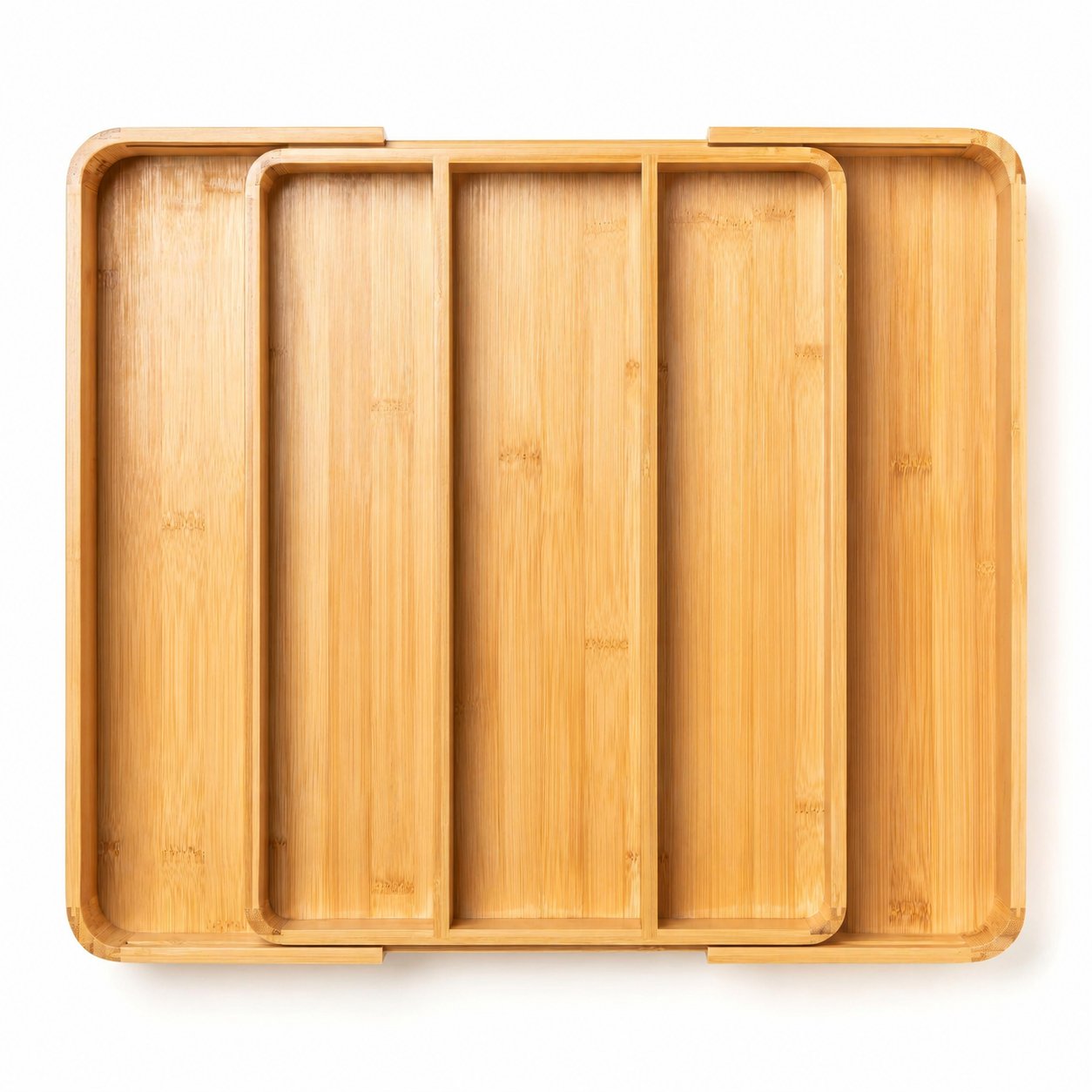
Build a kitchen-storage range around a 5-compartment expandable bamboo silverware tray developed to your approved specification. The pictured design direction combines three divided central zones with two extending side zones, giving importers, wholesalers, retailers and private-label brands a clear space-management story for flatware and compatible utensils. It can be evaluated as a kitchen drawer insert, a retail storage item or the foundation of a coordinated organization program.
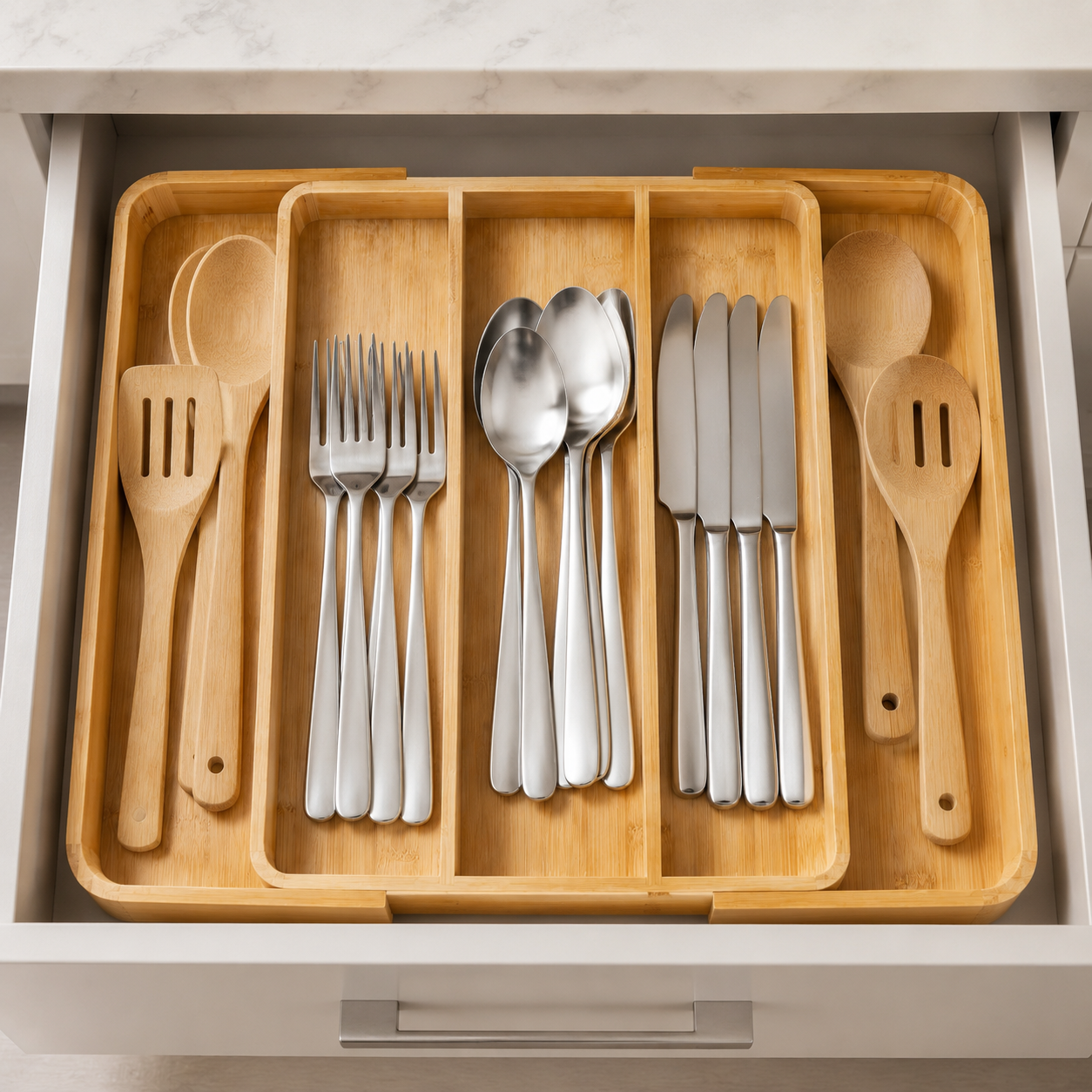
The current image set presents the same five-zone organizer in a clear studio view and a brand-neutral drawer scene. These images help buyers review the layout and merchandising direction; they are not a complete production specification. Confirm the bill of materials (BOM), dimensioned drawing, material structure, coating, adhesive, components, compartment plan, packaging and acceptance sample. MOQ, sample timing, production lead time and commercial terms belong in the project quotation.

5-Compartment Expandable Bamboo Silverware Tray Overview
Viewed from above, the expanded presentation shows three long central zones between two side zones. The side sections can support a broader presentation for suitable utensils, while a more compact position may be considered for a narrower drawer. Exact section boundaries, closed footprint, expanded footprint, internal capacity, movement range and usable dimensions must be read from the final drawing rather than inferred from the photograph.
What the Current Gallery Establishes
- A light bamboo-tone presentation intended for placement inside a drawer
- One expanded layout with three central zones and two side zones
- Side sections and guide rails visible in the studio and drawer images
- A general kitchen-drawer merchandising direction for flatware and utensils
The images do not verify exact bamboo content, panel construction, coating, adhesive, base design, added pads, loading, measurements or packaged accessories. They also do not replace a sample-based fit review. A purchase order should identify the approved drawing revision, BOM revision, appearance sample, logo proof and packaging artwork.
5-Compartment Expandable Bamboo Silverware Tray Specifications
| Product category | Expandable bamboo silverware tray / cutlery and utensil drawer insert |
|---|---|
| Primary layout | Three central zones plus two side zones in the expanded visual reference; final geometry requires drawing and sample approval. |
| Closed and expanded size | To be defined on the dimensioned quotation drawing; no production dimensions are confirmed by the current image set. |
| Internal section sizes | Length, width, depth and divider positions to be confirmed for all five zones. |
| Material and structure | Bamboo product positioning is shown; substrates, bamboo content, panel build, base, joinery, adhesive and every additional component must be stated in the final BOM. |
| Surface and color | Coating system, sheen, color range, grain range and workmanship limits to follow approved samples and written specifications. |
| Extension mechanism | Direction, travel, clearances, stop design and movement acceptance criteria to follow the controlled drawing and signed sample. |
| Base parts or pads | None are confirmed by this page. Any requested component must appear in the BOM, drawing and pack list. |
| Packaging, MOQ and lead time | To be confirmed after configuration, decoration, packing method, order quantity and delivery terms are defined. |
Drawer Measurement Guide
1. Record the clear internal space
Measure the usable inside width, front-to-back length and vertical clearance with the drawer empty. Take readings at the front, middle and back; use the smallest value when walls are not parallel. Cabinet exterior dimensions are not a substitute.
2. Map every obstruction
Note corner radii, screw heads, runners, stops, handle fixings and any raised liner. Also check whether the drawer narrows near its opening. These details can reduce the space available to the organizer or its side extensions.
3. Compare the Approved Closed and Expanded Envelopes
Once the quotation drawing is available, confirm which axis is width and which is length. The closed tray must enter and sit within the drawer; the expanded tray must remain inside its approved travel range. Leave practical clearance for removal and normal drawer movement rather than specifying a forced fit. Do not use measurements from discontinued or unrelated gallery artwork.
4. Validate the intended contents
Measure the longest, widest and thickest utensils planned for each zone. Review handle shapes and stacked height. Before bulk release, test the approved sample inside a representative drawer with the agreed reference contents.
Applications for Retail and Commercial Assortments
In kitchen programs, the organizer can be evaluated for forks, spoons, table knives, serving pieces and compatible cooking utensils. Longer tools require verified internal dimensions; sharp items may need a purpose-designed storage solution. Beyond the kitchen, this layout may sort stationery, craft tools, grooming accessories or small household items, provided the approved materials, section sizes and care instructions suit the proposed use.

For range extensions, compare this five-compartment tray with the separate 7-to-9-compartment expandable bamboo drawer organizer. Buyers developing a storage assortment can also review the expandable bamboo drawer organizer with knife block. Each linked item has its own dimensions, BOM, sample and approval process.
OEM and ODM Development
OEM work can start from the pictured five-compartment design and review dimensions, zone geometry, extension range, appearance, logo location, labeling and packaging. ODM development can examine a revised footprint or layout around your target drawer and utensil set. A change to the number or arrangement of sections creates a distinct development project and should not be assumed to match the pictured item. Feasibility, tooling, unit price, MOQ and schedule depend on the approved brief.
Supply annotated drawings, target dimensions, intended contents, vector artwork, color references, destination market, sales channel and required tests. Production should begin only after the BOM, drawings, decoration proof, packaging artwork, sample and inspection standard carry matching revision control.
Packaging and Distribution Planning
Packaging may be developed around a paper sleeve, printed box, protective wrap, insert or another agreed format. Specify whether the organizer ships closed, how movable sections are retained, and how visible edges and surfaces are separated from abrasion. Confirm unit-pack dimensions, barcode and label placement, instructions, carton quantity, carton marks, gross and net weight, pallet assumptions and any requested transit test. Packaging format, artwork and pack contents are confirmed only in the quotation, artwork proof and approved packing sample.
Quality-Control Framework
Inspection criteria should reference the signed sample and controlled documents. Checks can cover material identity, overall and internal dimensions, extension travel, divider position, alignment, joint condition, edge workmanship, base flatness, coating appearance, color range and logo placement. A functional check should open and close the side sections through the agreed cycle without applying loads beyond the test plan. Pack-out inspection can verify model identity, quantity, components, artwork revision, barcode readability, labels, unit protection and shipping marks. Define sampling level and defect classifications before inspection.
Care Guidance to Finalize
Care instructions must match the approved coating, adhesive and construction. A conservative starting point is to remove contents, wipe with a soft cloth lightly dampened with water and a mild cleaner, remove residue, then allow the tray to dry fully before refilling. Avoid immersion, dishwashers, abrasive tools, prolonged moisture and strong heat unless the order-specific product has been validated for those conditions. Approve the final label during sampling.
RFQ Checklist
- Pictured five-compartment design direction or your own controlled drawing
- Closed and expanded dimensions, tolerances and measurement orientation
- Internal section sizes and intended reference contents
- Material structure, coating, adhesive, components and appearance limits
- Logo artwork, decoration method, labeling and destination market
- Unit packaging, carton requirements, barcode and transit protocol
- Estimated order quantity, target price basis and delivery destination
- Sample deadline, production window, testing and inspection criteria
Frequently Asked Questions
1. What design does the current image set show?
It shows one expanded five-zone tray direction in a studio view and an illustrative kitchen-drawer scene. Controlled documents still govern production.
2. Is the five-compartment count confirmed?
The expanded visual reference shows three central zones and two side zones. Confirm the exact divider plan, usable zones and measurement method on the final drawing and sample.
3. What are the closed and expanded dimensions?
No production dimensions are stated by the current images. Request a dimensioned drawing showing closed size, expanded size, internal measurements, travel and tolerances.
4. Are other colors or layouts available?
Alternative colors or layouts can be reviewed as separate development requests. Availability, appearance limits, tooling, price, MOQ and timing require written confirmation.
5. What materials and surface treatment are supplied?
They are project-specific. Request a BOM identifying panels, base, joinery, adhesive, coating and any added components, then approve representative samples.
6. Can dimensions or the internal layout be customized?
Selected revisions can be evaluated through OEM or ODM development. Tooling, feasibility, MOQ, cost and timing follow the approved brief and quotation.
7. How should buyers confirm drawer fit?
Measure clear internal width, length and height at several points, record obstructions, compare both product envelopes and test an approved sample in a representative drawer.
8. What should be approved before mass production?
Approve the BOM, drawings, materials, appearance, sample, branding, packaging, labels, care text, test plan, inspection criteria, quantity, lead time and quotation.
Request a Specification-Based Quote
Turn the pictured 5-compartment expandable bamboo silverware tray into a purchase-ready project. Visit the homepage, review the company’s development scope on the About page, or contact the sales team. Send your drawer measurements, intended contents, branding files, packaging brief, quantity, destination and requested delivery window to receive a quotation based on confirmed specifications.
Reviews
There are no reviews yet.