

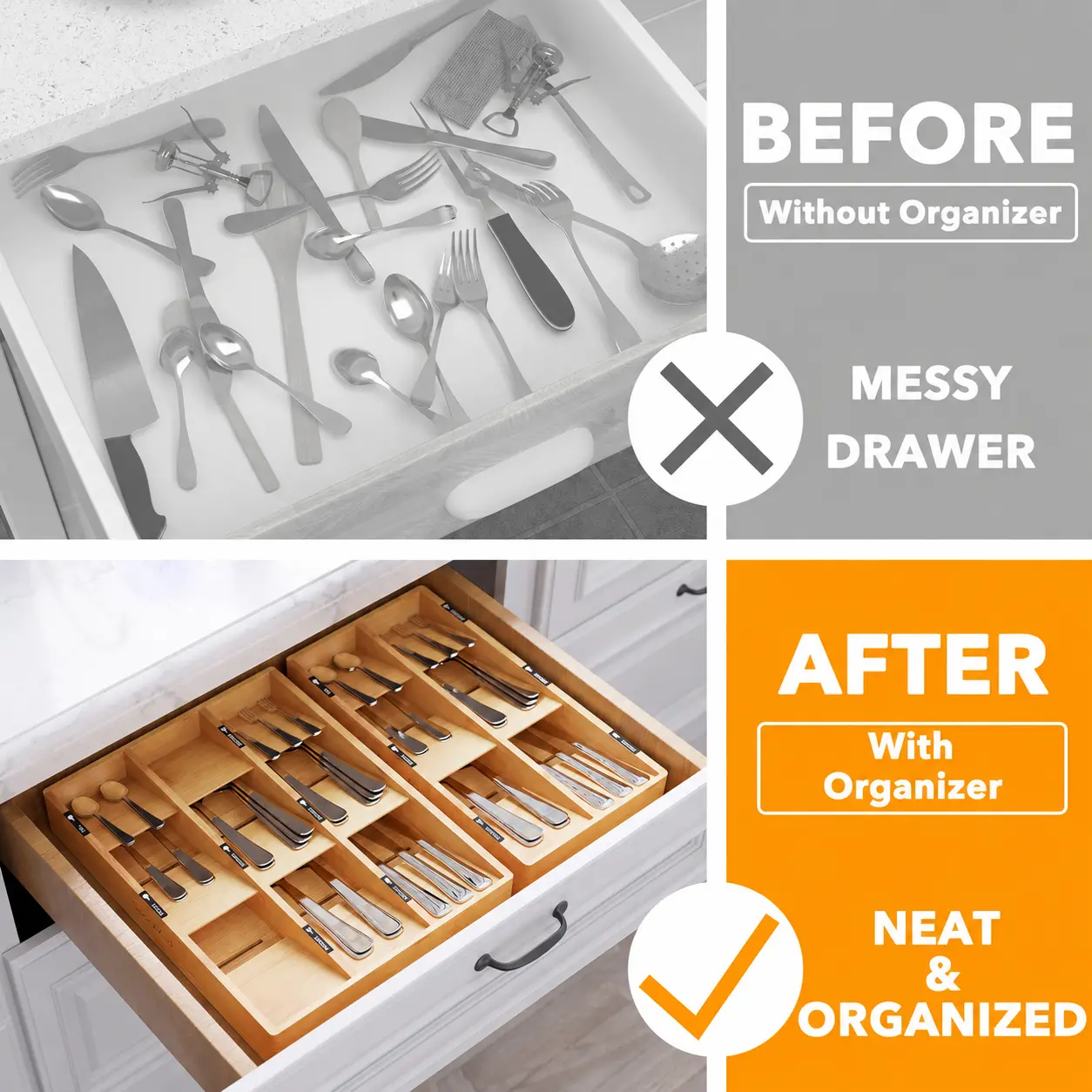
Bamboo Silverware Drawer Organizer with 80 Labels | 9 Compartments
Fixed-size solid bamboo silverware drawer organizer with nine deep compartments and 80 optional classification labels. The 15.6 × 12 × 2.4-inch format gives wholesale and private-label kitchenware buyers a clearly specified, non-expandable storage design.
Description
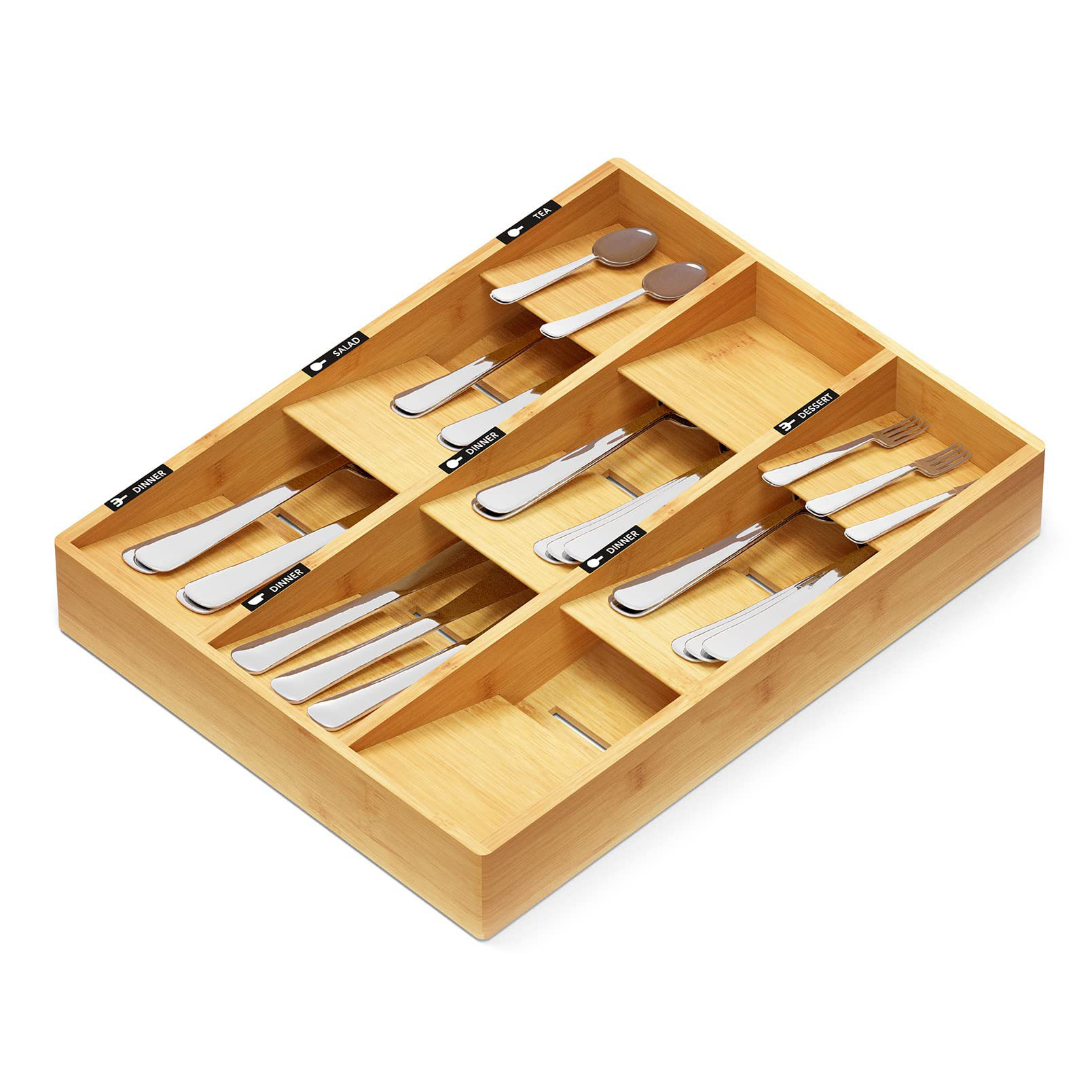
The bamboo silverware drawer organizer with labels combines a fixed 15.6 × 12-inch footprint with nine defined compartments and 80 optional classification labels. Designed for flatware and frequently used kitchen utensils, this solid bamboo organizer gives retailers and private-label buyers a clear product story: a measured drawer fit, deeper storage areas, and a layout that users can identify in their own way.
Unlike adjustable models, this tray does not expand or include a removable knife block. Its strength is a stable, fixed-size layout.
For programs that require adjustable width and integrated knife storage, compare our expandable organizer with removable knife block.
Bamboo Silverware Drawer Organizer with Labels: Specifications
| Product type | Fixed-size bamboo silverware and utensil drawer organizer |
|---|---|
| Overall dimensions | 15.6 in L × 12 in W × 2.4 in H |
| Storage layout | Nine compartments |
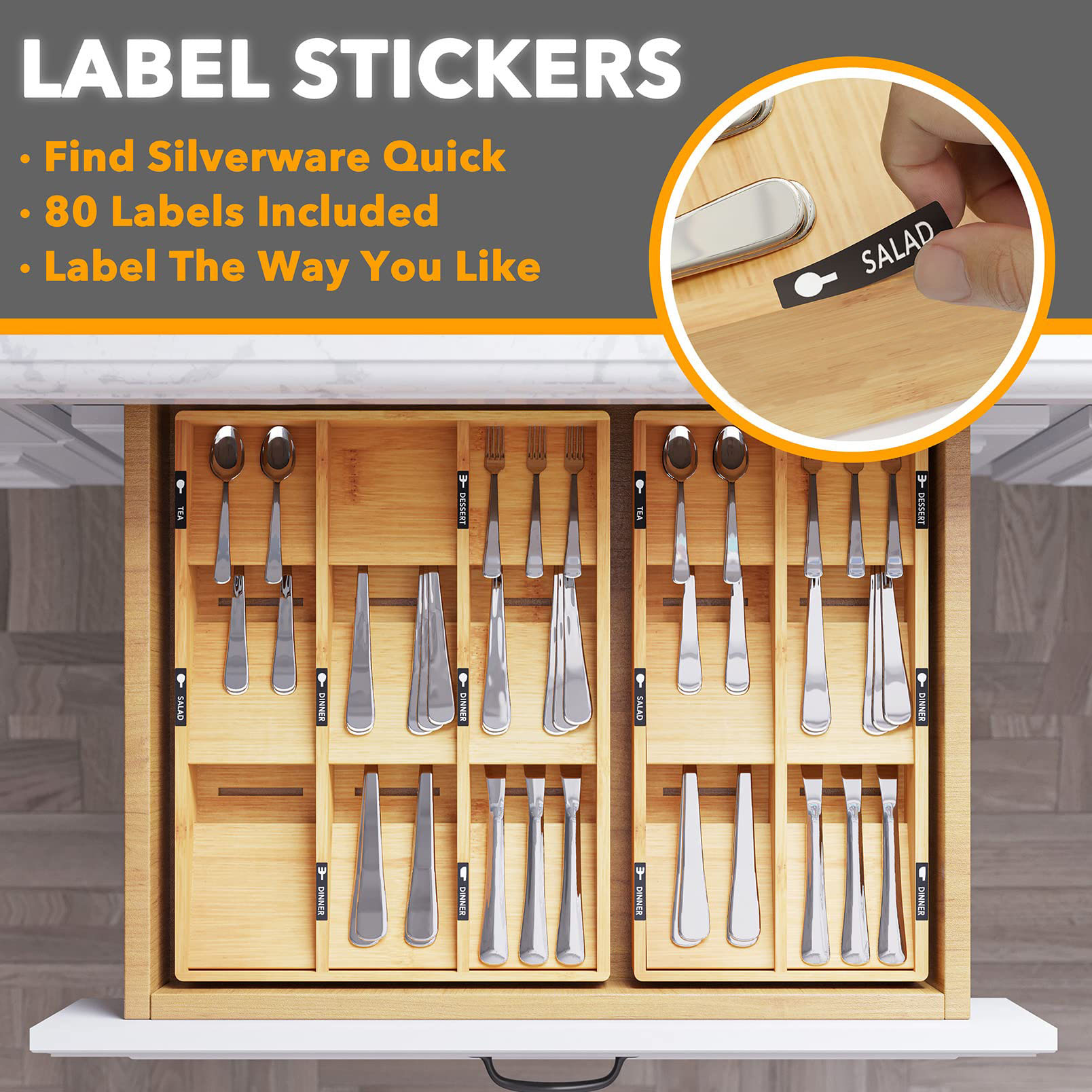
| Labels included | 80 optional classification labels |
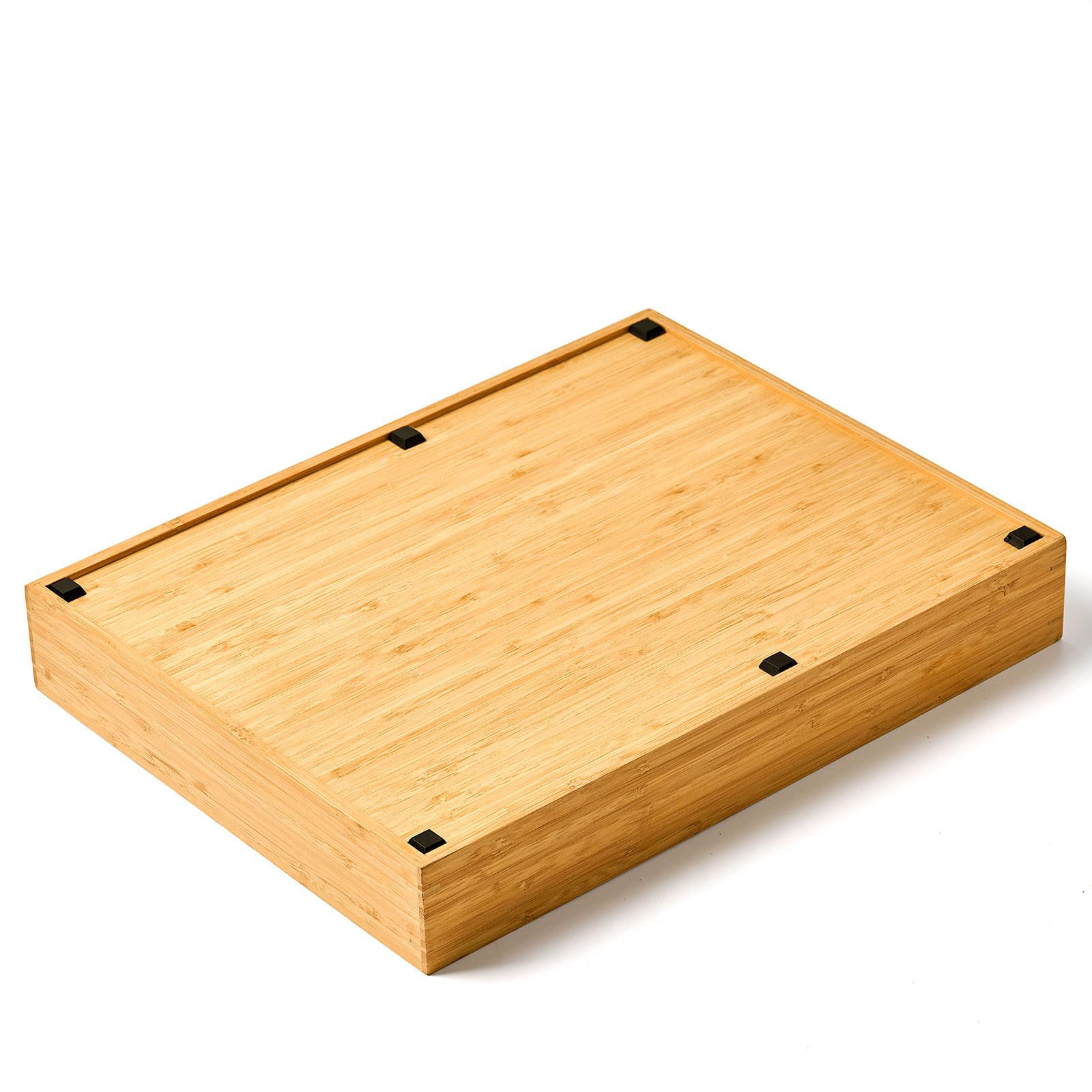
| Construction | Solid bamboo |
| Format | Non-expandable; no removable knife block |
| Buyer model | Wholesale, retail, private-label, and OEM/ODM discussion |
The dimensions above describe this standard model. Production drawings, tolerances, compartment dimensions, label contents, and the approved sample should be confirmed before packaging or online listings are finalized.
Why a Nine-Compartment Layout Matters
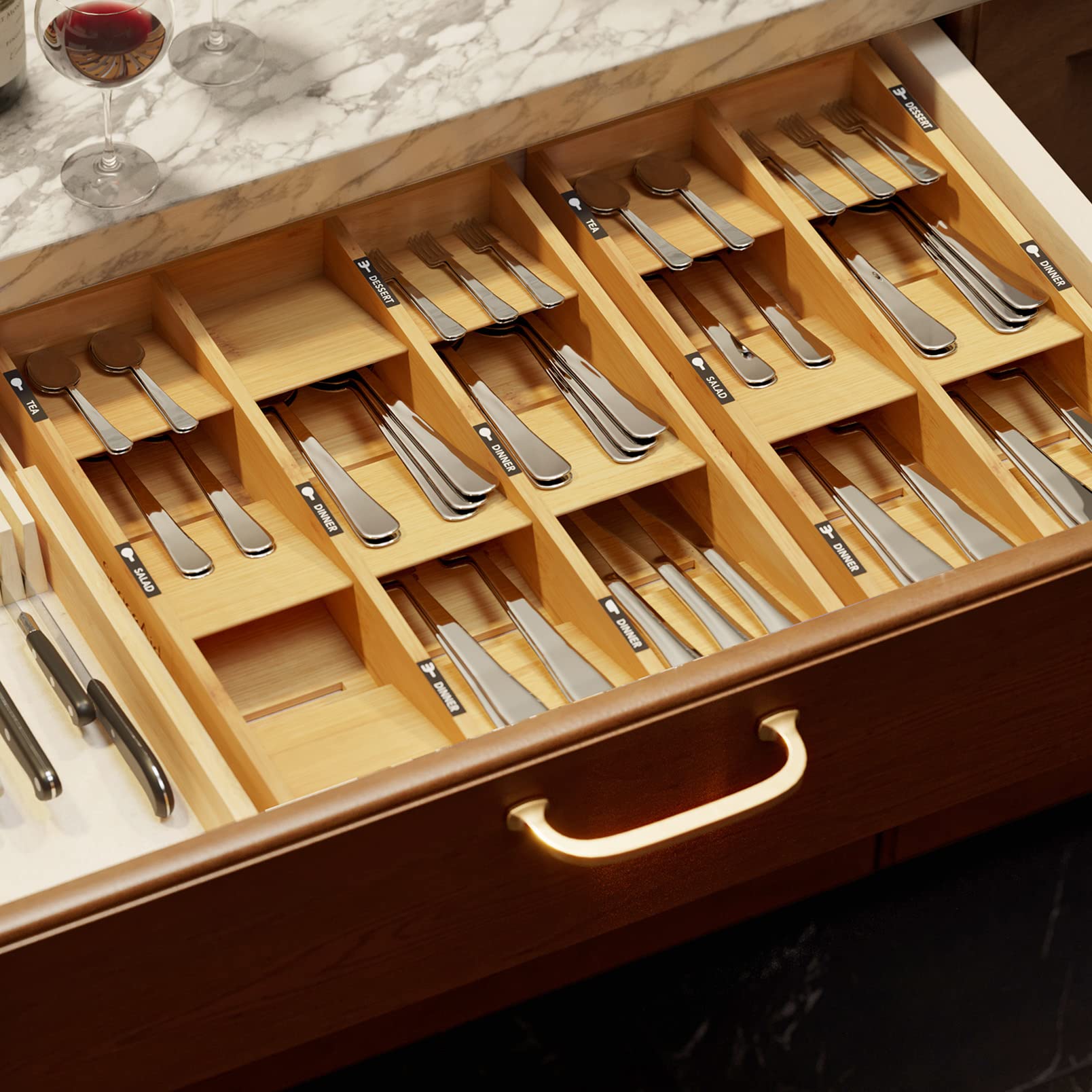
A 9 compartment utensil organizer gives users more sorting choices than a basic fork-and-spoon tray. Long sections can separate table knives, forks, spoons, and serving tools, while smaller areas can hold teaspoons, measuring spoons, clips, openers, or other drawer accessories. The layout helps keep different item types visible instead of stacking them in one large cavity.
Compartment depth is a practical part of this design. Shallower organizers may allow larger utensil handles to sit too high and catch against the drawer opening. At 2.4 inches overall height, this model uses deeper storage areas intended to reduce that problem. Actual results depend on internal compartment depth, utensil size, drawer clearance, and how heavily each section is loaded, so buyers should test the sample with representative items.
Solid Bamboo Construction and Appearance
The tray uses solid bamboo construction, giving it visible grain and a warm material appearance that coordinates with many kitchen and home-organization ranges. Natural variation in color and fiber pattern is expected. Buyers should define an acceptable appearance range while separately controlling cracks, splinters, rough edges, stains, gaps, visible adhesive, and uneven assembly.
“Solid bamboo” describes the main construction, but a complete specification should also identify the surface treatment, bonding materials, printed components, and label material used in the finished product. This supports more accurate testing, labeling, and market documentation.
Measure the Drawer Before Purchase
A fixed organizer provides a predictable footprint but cannot compensate for an incorrectly measured drawer. Customers should measure the clear internal length, width, and height—not the exterior cabinet dimensions. Hinges, drawer slides, curved corners, screw heads, handles, and other obstructions may reduce usable space.
- Empty the drawer and measure the usable interior from front to back.
- Measure the narrowest clear width between any fittings or side obstructions.
- Check vertical clearance from the drawer base to the cabinet rail or opening above.
- Compare those measurements with 15.6 in L × 12 in W × 2.4 in H.
- Allow practical clearance for placing and removing the tray.
Retail packaging and product pages should show all three dimensions prominently. A simple drawer-measuring diagram can reduce fit-related confusion and distinguishes this fixed-size bamboo flatware tray from adjustable models.
Using the 80 Optional Classification Labels
The included label set lets users identify compartments according to their own kitchen. Labels can support categories such as forks, spoons, knives, teaspoons, serving tools, or other utensils represented in the supplied assortment. Because their use is optional, customers may also leave the bamboo tray unlabelled for a clean appearance.

For a labelled cutlery tray program, buyers should review more than the label count. Confirm the exact words or icons, spelling, languages, size, print contrast, placement, release liner, application instructions, and adhesion to the approved surface. If the label sheet is customized, artwork approval should be a separate production checkpoint. Do not promise that labels can be removed or repositioned without marks unless that performance has been verified on the finished tray.
Suitable Sales Channels and Use Scenarios
This organizer can fit several merchandising strategies:
- Kitchenware retailers: a clearly specified drawer solution with visible organization features.
- Home-organization brands: a fixed-format product for coordinated pantry, countertop, and drawer collections.
- Online sellers: a product that can be demonstrated with labelled and unlabelled lifestyle images.
- Wholesalers and distributors: a solid bamboo storage item for kitchen and household accounts.
- Private-label programs: a platform for branded packaging, instruction cards, label graphics, and logo review.
Buyers building a coordinated assortment can explore our bamboo and wooden kitchenware category for related product directions.
Bamboo Silverware Organizer Wholesale and OEM Options
For a bamboo silverware organizer wholesale project, begin with the standard construction and identify which commercial elements need development. Depending on feasibility, OEM/ODM discussions may cover logo placement, surface appearance, label artwork, label languages, retail box or sleeve, instruction card, barcode area, pack count, and master-carton presentation.
Send a structured request containing the destination market, sales channel, forecast quantity, branding files, packaging format, labeling requirements, and inspection expectations. If dimensional or compartment changes are required, treat the result as a revised product rather than assuming the standard model can be changed without affecting tooling, assembly, packing, or price.
Sample Approval
Place representative forks, spoons, table knives, serving tools, and small accessories in the sample. Check whether users can lift items easily, whether handles remain below the available drawer clearance, and whether the nine sections match the intended assortment. Review the label sheet and apply sample labels to confirm appearance and placement before approval.
Quality-Control Checkpoints
- overall length, width, height, and agreed tolerances;
- nine-compartment count, position, and internal measurements;
- divider alignment and assembly consistency;
- smooth edges and surfaces without splinters or sharp points;
- agreed bamboo grain and color range;
- label quantity, artwork, print clarity, and sheet condition;
- logo size, position, and legibility where applicable;
- retail-pack contents, instructions, protection, and carton count.
Inspection criteria should be attached to the approved sample and specification. This separates acceptable natural material variation from defects that affect appearance, handling, or fit.
Cleaning and Everyday Care
Remove utensils and labels as appropriate before a thorough cleaning. Clear crumbs from corners, wipe the organizer with a soft, slightly damp cloth, and dry it promptly before returning it to the drawer. Avoid soaking, standing water, abrasive cleaners, and dishwasher cleaning. Utensils should be dry before storage, and the drawer should be kept clean and ventilated.
Final care instructions must reflect the approved surface treatment, label material, and construction. No waterproof, antibacterial, or dishwasher-safe claim is made for this product.
Manufacturing Support for International B2B Buyers
Fujian Xianxu Bamboo & Wood Co., Ltd. was founded in 2018 and supports OEM/ODM bamboo and wooden product development for importers, wholesalers, retailers, private-label brands, and distributors. With manufacturing in China and Vietnam, our products serve customers across 40+ countries and regions.
Review our company background and Vietnam manufacturing information when evaluating a supply program.
Frequently Asked Questions
Does this bamboo organizer expand?
No. This is a fixed-size 15.6 × 12 × 2.4-inch organizer. It should not be listed as expandable, and customers should measure their drawer before ordering.
How many compartments and labels are included?
The standard design has nine compartments and comes with 80 optional classification labels. Confirm the final label sheet, artwork, and pack contents against the approved order specification.
Does it include a removable knife holder?
No removable knife block is specified for this model. Its nine fixed sections are intended for sorting silverware and assorted kitchen utensils.
Can the labels and packaging be customized?
Label language, artwork, packaging, instructions, and branding can be discussed as part of an OEM/ODM brief. Feasibility and final details require sample and specification approval.
How can I request a B2B quotation?
Provide the target market, forecast quantity, branding, packaging, label content, and inspection requirements. Contact our B2B team to discuss samples and a product specification.


Reviews
There are no reviews yet.