

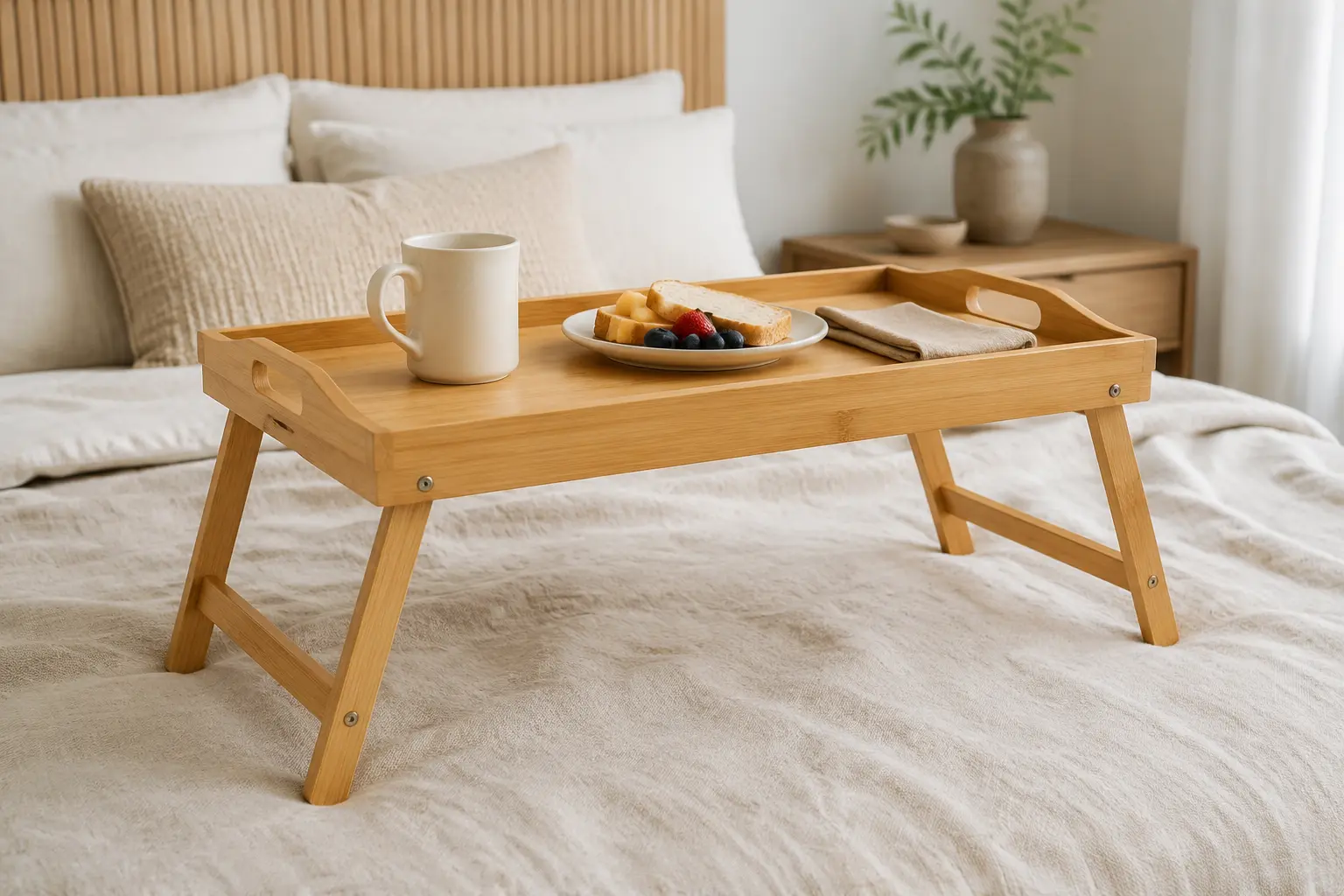
A bamboo breakfast tray, a folding serving tray and a sofa armrest tray may share a natural bamboo appearance, but they solve different problems. One creates leg clearance, another carries food, and a flexible model must fit furniture without pretending to be a universal flat surface. Treating them as one generic “bamboo tray” leads to unclear quotations and inconsistent quality checks.
This B2B guide explains how to specify folding legs, hinges, handles, cup recesses, device slots, sofa-arm fit, testing and retail instructions. It complements our broader bamboo trays wholesale guide.

Four Product Types Hidden Behind Similar Search Terms
Bamboo breakfast tray with folding legs
A breakfast tray usually has a raised rim and two leg frames that fold beneath the top. It may be used on a bed, sofa, floor or another supported surface. The phrase bamboo tray with legs does not define hinge design, open height, clearance or intended load; those details need separate specifications.
Bamboo folding tray for carrying and storage
A bamboo folding tray can mean a legged tray, a tray on a folding stand or a collapsible serving structure. A foldable bamboo tray stores more compactly than a fixed stand, while a removable tray-and-stand set separates for carrying. Define which parts fold, detach or lock.
Bamboo sofa and armrest trays
A bamboo sofa tray may be a flat board, a rigid bridge that spans an armrest, or a flexible mat made from narrow slats on a backing. A search such as “armrest tray bamboo” usually points to the flexible slatted type. A bamboo armchair tray has the same fitting challenge: arm width, curve, fabric compression and user movement vary widely. Product descriptions should specify the tested furniture range rather than claim universal compatibility.
Handled serving and coffee-table trays
A bamboo serving tray with handles is designed for carrying and presentation. It may function as a bamboo coffee table tray, but it gains no leg clearance without a stand. A round bamboo tray with handles also differs from a rectangular folding model. Compare food-focused options in our bamboo food serving tray guide.
Quick Comparison for Assortment Planning
| Format | Primary function | Critical specification | Main inspection risk |
|---|---|---|---|
| Breakfast tray with folding legs | Raised light-duty serving or work surface | Open height, leg clearance and hinge geometry | Rocking, uneven legs or loose hardware |
| Tray with folding stand | Serving plus freestanding presentation | Tray-to-stand location and open footprint | Tray displacement or unstable stand setup |
| Flexible sofa armrest tray | Small surface over a compatible sofa arm | Slat width, backing and suitable arm range | Poor fit on narrow, soft or steeply curved arms |
| Handled serving tray | Carrying and tabletop presentation | Usable area, rim and handle opening | Sharp handle edges, flex or weak corner joints |
“Bamboo tray stand” can mean a complete folding set or the stand alone. A “bamboo seat with tray” is a furniture product with separate safety needs, not a portable serving tray.
Folding Legs, Hinges and Stability
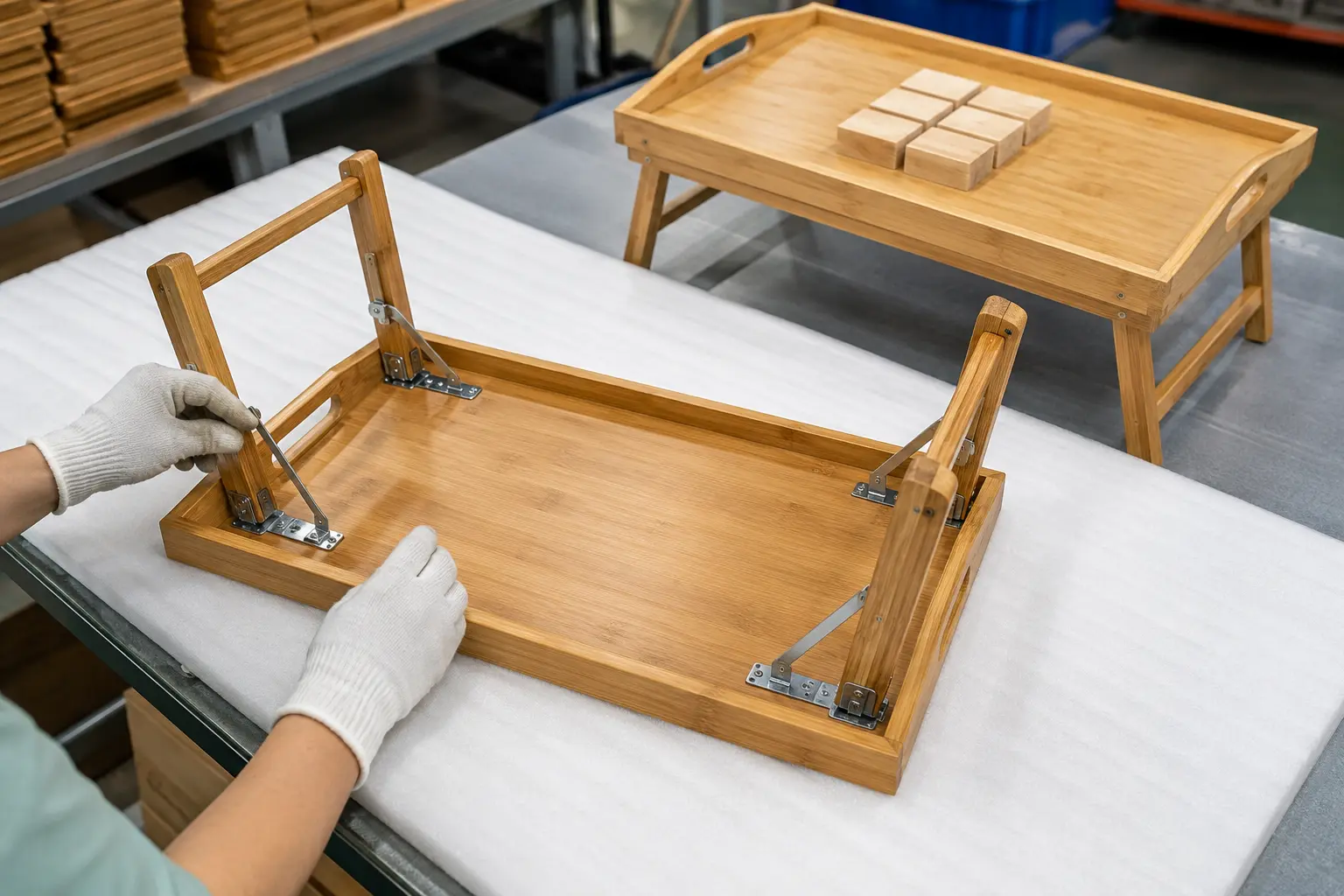
Moving parts define a folding bamboo tray. Common constructions use two U-shaped leg frames attached with screws or metal hinges. Some add braces to limit travel; others rely on leg angle and geometry rather than a positive lock. Each approach needs a usage-specific evaluation.
Specify open leg angle, frame spacing, clearance, folded thickness and any stop or lock. Hinges should move without binding, fasteners should not split the bamboo, and leg ends need even contact. Because soft bedding differs from an inspection table, samples should also be evaluated under representative conditions.
Cycle testing opens and closes the legs for an agreed number of repetitions, followed by checks for looseness, cracking and misalignment. Stability tests should define the surface, load position and acceptance criteria. Request evidence before repeating a supplier load rating in retail copy.
Dimensions and Ergonomics to Put on the Drawing
External length and width are not enough for a breakfast or laptop-style tray. A complete drawing should show the usable top area inside the rim, open height, internal leg clearance, open footprint, folded height, handle opening and product weight. If legs angle outward, the floor-level footprint may be wider than the tray. This affects use, carton size and shelf presentation.
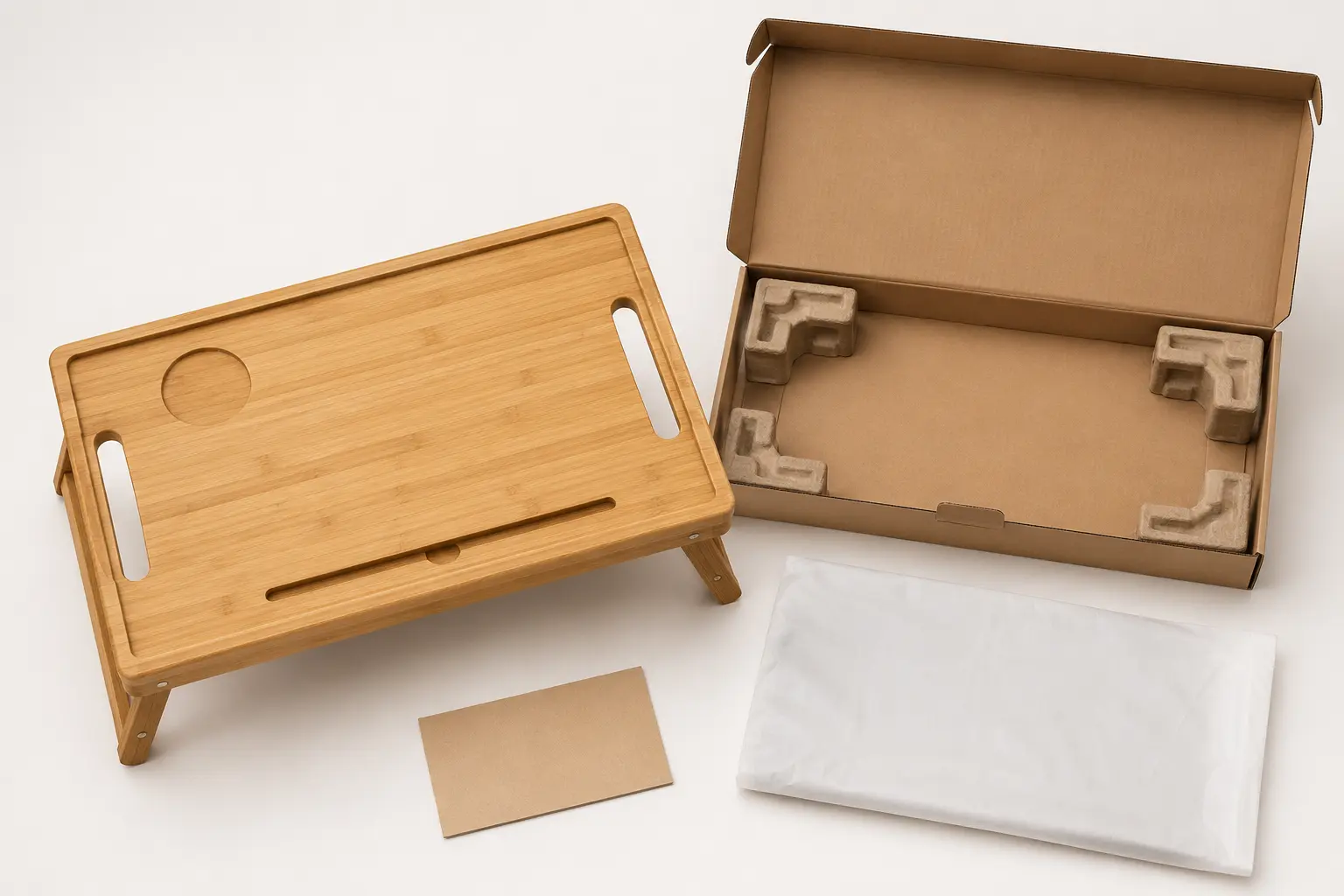
For device use, record the intended device dimensions, slot width, depth and viewing angle. A slot that accepts a bare tablet may not accept its case. Avoid universal compatibility claims. A cup recess is not automatically a secure holder; compare its diameter, depth and location with the intended drinkware.
Shape affects packing and use. Rectangular models maximize practical surface area, while rounded corners reduce visual bulk and can improve handling. Buyers deciding between square, round, long or compact products can reference the bamboo tray sizes and shapes guide.
Handles, Rims, Cup Recesses and Device Slots
Cut-out handles keep the silhouette compact, but their edges need smooth machining. Attached handles create a distinctive “tray with bamboo handles” look while adding joint and fastener inspections. Openings need finger clearance without excessively weakening the side wall.
A raised rim contains small items, yet high walls can interfere with typing. Keep cup recesses away from folding hardware and avoid edge-heavy loading. A long device slot must not weaken the panel or collect liquid. Removable inserts expand functions but add packaging complexity.
Features should follow a real use case. A breakfast tray may justify handles, a cup recess and a device slot; a serving tray may benefit more from uninterrupted space.
How to Specify a Bamboo Sofa or Armrest Tray
Flexible armrest trays are commonly built from narrow bamboo slats connected to fabric, felt or another flexible backing. The slats form a flat central zone and wrap down the sides of a compatible sofa arm. A wider tray may offer more usable area but needs a wider arm and larger carton. Narrow slats follow curves more readily; wider slats create fewer joints but may not conform as smoothly.
Ask for the flat center width, total mat width, total length, slat thickness, backing material and expected furniture range. Evaluate friction and movement on representative upholstery types. Do not claim “non-slip” unless a defined test supports the wording, and do not assume the backing will behave the same on leather, velvet and woven fabric. Very rounded, narrow or heavily padded arms may not provide a sufficiently level surface.
Rigid bridge-style trays need a different brief: internal span, side-panel depth, adjustability and contact protection become critical. Whether flexible or rigid, retail instructions should show suitable arm shapes and remind users to keep hot liquids away from unstable edges.

Bamboo Construction, Finishes and Everyday Care
Bamboo tray components are often made from laminated strips or panels. Panel balance, moisture control, glue-line quality and grain selection influence appearance and dimensional behavior. Hardware, backing fabric, feet and packaging materials should be listed separately; “bamboo tray” does not mean every component is bamboo. Our bamboo tray materials guide compares solid-looking laminated bamboo with woven, fiber and mixed-material formats.
Define finish color, sheen, acceptable grain variation, coating feel and intended exposure. Claims about food contact or chemical compliance should relate to the actual formulation, production process and destination requirements. Dark stains can broaden a collection but may show scratches differently from natural bamboo. Boundary samples are useful for agreeing acceptable color and grain variation.
General care usually means wiping with a soft damp cloth, drying promptly and keeping the tray away from prolonged soaking, dishwashers and intense heat. Hinges and backing materials may need different treatment from the bamboo surface. Moving parts should be dried after spills, and the tray should be stored with the legs folded only after all areas are dry. Final instructions must follow the approved finish and hardware.
Load, Stability and Durability Testing
Testing should reproduce the intended use rather than chase a large headline number. A static distributed load checks how the top and legs respond when weight is centered. An offset load can reveal sensitivity near an edge, but the value and position must be controlled. A carrying test for a handled tray differs from a legged-use test. A sofa-arm tray needs fit and movement checks, not the same load method as a rigid stand.
Agree the test surface, tray configuration, weight, duration, loading rate and post-test inspection. Record permanent deformation, loose fasteners, cracks, wobble and hinge change. A safety factor may be appropriate, but it should be set by the buyer or qualified test plan. Marketing language such as “heavy duty,” “stable” or a specific kilogram rating should appear only when supported by the approved construction and relevant evidence.
Packaging Foldable Trays and Moving Parts
Folded height is a major cost driver because it affects units per carton and dimensional freight. Packaging must keep legs closed, prevent hinges from rubbing the finished top and protect protruding handles and corners. A soft interleaf or protective bag can reduce abrasion; molded-paper or corrugated supports can control movement. Loose instructions or accessories should be secured so they cannot mark the product.
E-commerce packaging may need single-unit parcel testing, while wholesale cartons require suitable stacking strength and pallet planning. Confirm whether retail cartons are shelf-ready, mail-order ready or intended only as inner boxes. If the product has a cup recess or device slot, inserts should not press on thin machined areas. Packaging samples should be tested with the final product, not an earlier prototype of different thickness.
Quality-Control Checklist for Production
- Dimensions: external size, usable area, open height, leg clearance, footprint and folded thickness.
- Appearance: grain and color range, sanding, coating, glue lines, dents, stains and sharp edges.
- Flatness: top-panel condition and rocking on the agreed reference surface.
- Moving parts: hinge travel, leg symmetry, braces, stops, fasteners and cycle-test condition.
- Features: handle smoothness, rim consistency, cup recess and device-slot dimensions.
- Function: carrying test, configured load test or furniture-fit test according to product type.
- Packaging: leg restraint, surface protection, accessory control, barcode placement and carton integrity.
Inspection criteria should be set before mass production and tied to an approved sample. If a design changes—especially hinge, leg thickness, backing or fastener type—relevant tests should be repeated rather than transferred automatically from the earlier version.
Safety and Instruction Wording
Use instructions should be specific and proportionate. A folding tray may require users to open both leg frames fully, verify that braces or stops are engaged, place it on a supported surface and keep weight within a validated limit. Fingers should be kept clear of hinge and folding zones. Hot beverages need extra caution, especially on soft bedding or upholstered furniture.
Do not describe a portable breakfast tray as medical equipment unless it has been designed and assessed for that purpose. Do not imply that a tray is a seat, step, child restraint or support surface. “Bamboo seat with tray” products belong to a different product and safety category. Clear warnings reduce foreseeable misuse without making unsupported claims about safety.
OEM/ODM, Documentation and Sourcing
OEM programs can adjust an existing tray through dimensions, finish, logo, packaging or selected features. ODM development may change leg geometry, hinges, armrest fit or modular inserts and therefore requires prototypes and renewed testing. A practical sequence is concept review, dimensioned drawing, material confirmation, prototype, function tests, packaging sample, pre-production approval and production inspection.
Compliance needs vary by materials, claims and destination. REACH-related screening, food-contact tests or other documents may be relevant, but the required protocol should be confirmed for the exact product. FSC claims are scope-dependent; where requested, verify the supplier certificate, product scope and transaction documentation. The official FSC Chain of Custody overview explains the certified-material tracking framework. BSCI is generally a social-audit framework for a production site, not a product safety certification, so audit status and scope should be checked separately.
Fujian Xianxu Bamboo & Wood Co., Ltd. supports OEM/ODM programs for bamboo and wooden homeware. Learn more through our manufacturer profile, Vietnam factory page and kitchenware collection.
Frequently Asked Questions
What is the difference between a bamboo breakfast tray and a serving tray?
A breakfast tray usually includes folding legs that create clearance above a bed, floor or sofa. A serving tray is primarily carried by its sides or handles and may have no legs. Some products combine both functions, but the specification should cover each one.
Do folding legs automatically lock in place?
No. Some designs use braces or stops, while others rely on hinge geometry and leg angle. Ask the supplier to identify the mechanism and agree how it will be inspected and tested.
How much weight can a bamboo folding tray hold?
There is no universal rating. Capacity depends on panel thickness, span, leg design, hardware, load position and test surface. Use only a rating supported by a defined test on the final approved construction.
Will a bamboo armrest tray fit every sofa?
No. Fit depends on the arm width, curvature, firmness and upholstery. Provide a recommended furniture range and verify samples on representative arms before making compatibility claims.
Can handles, a cup recess and a tablet slot be customized?
Usually, subject to material thickness, structural review, tooling and order requirements. Supply the intended cup and device dimensions so the factory can prototype usable openings rather than rely on generic sizes.
What should buyers include in a quotation request?
Send product type, dimensions, leg or stand construction, feature list, finish, logo method, packaging, target quantity, destination and compliance needs. A drawing and intended-use description make supplier quotations easier to compare.
Request a Custom Bamboo Tray Quotation
For a comparable quotation, tell us whether you need a bamboo breakfast tray, folding stand, handled serving tray or sofa armrest design. Include the open and folded dimensions, intended use, hinge or backing preference, target testing, finish, branding, packaging, quantity and destination. Visit the bamboo and wooden products website or contact our team to discuss sampling and manufacturability.