

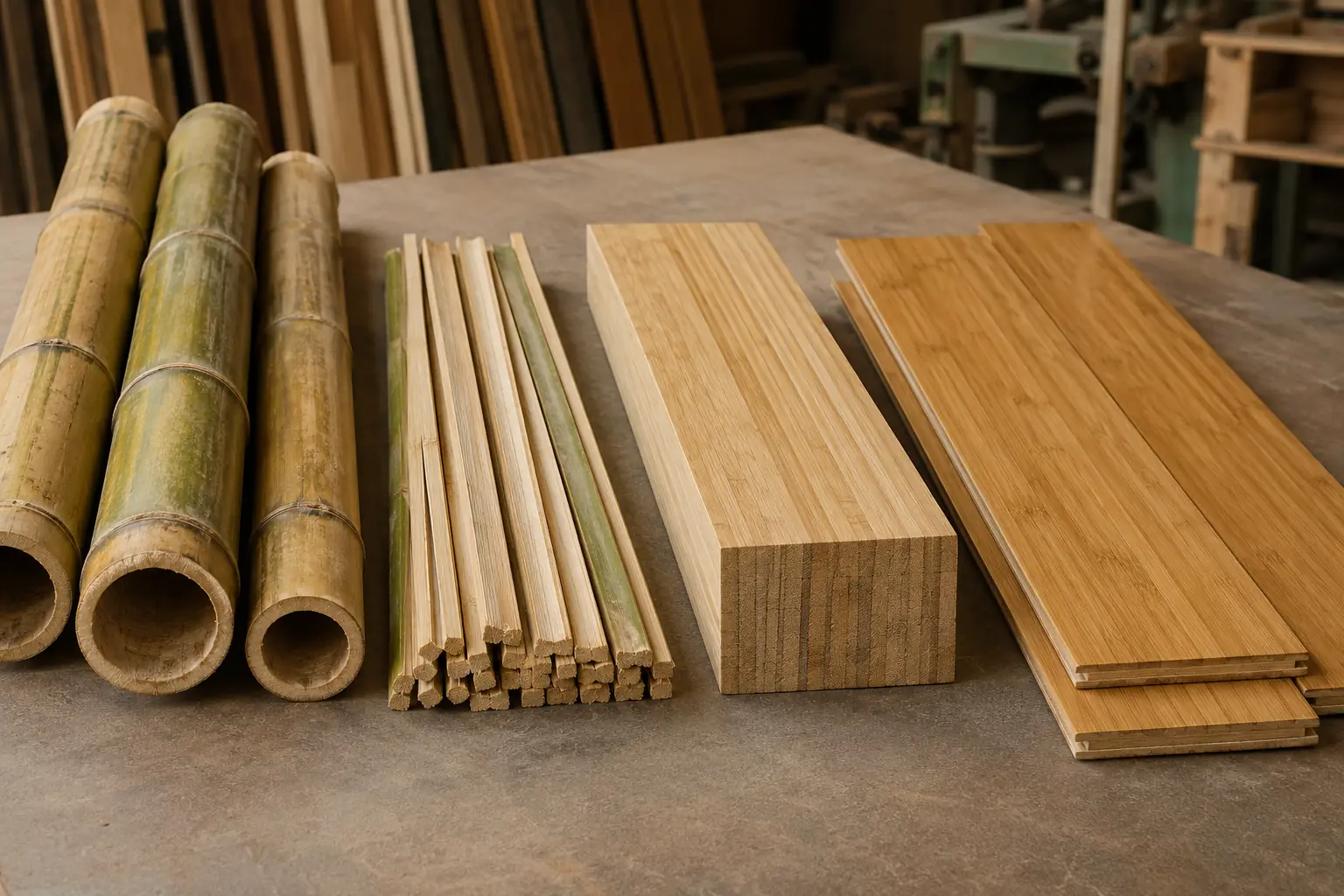
How is bamboo flooring manufactured? A commercial bamboo floor is not normally cut from one solid bamboo pole. Manufacturers divide selected culms into strips or fiber bundles, prepare and dry the material, bond it into a stable blank, condition the blank, machine it into planks, apply the specified finish and inspect the completed product. The exact route changes according to whether the floor is horizontal, vertical, strand-woven or engineered.
This distinction is important for buyers. The phrase “manufactured bamboo flooring” can describe several constructions with different cores, adhesives, densities, profiles and finishing systems. A process description should therefore explain both the common stages and the points where each product type takes a different route.

Manufactured Bamboo Flooring Is an Engineered Material
A bamboo culm is hollow, tapered and divided by nodes. Its curved wall cannot be converted directly into a wide, flat flooring plank. The culm must first be broken down into smaller elements that can be dried, graded and recombined. This is why the market term “solid bamboo flooring” usually refers to a plank made from laminated bamboo strips or compressed bamboo strands—not a single solid section of a pole.
Bamboo flooring and bamboo plywood can share steps such as strip preparation, drying, adhesive application and pressing, but the products are not interchangeable. Flooring adds installation profiles, surface finishing and floor-specific dimensional and performance checks. Our bamboo plywood manufacturers guide covers the panel route separately.
- Horizontal bamboo describes strips arranged with their wider faces visible.
- Vertical bamboo describes strips turned onto their narrow edges before lamination.
- Strand-woven bamboo is a common commercial name for bamboo fiber bundles or crushed strands that are resin-bonded and compressed; it is not literally woven like a textile.
- Engineered bamboo flooring combines a bamboo wear layer with a multi-layer or composite core and a balancing layer.
- Natural, carbonized and stained mainly describe color-development routes, not the structural category by themselves.
How Is Bamboo Flooring Manufactured Step by Step?
Video: Bamboo board production process
This short video shows bamboo board production, including kiln-drying bamboo strips to control moisture content. Watch it alongside the manufacturing steps below.
1. Raw bamboo selection and receiving inspection
Production begins by identifying suitable bamboo by species, maturity range, culm diameter, wall thickness, straightness and visible condition. Receiving inspection can screen for splitting, discoloration, mold, insect damage and other defects. Material should be linked to a lot so later process records and finished planks can be traced back to the incoming batch.
There is no single maturity rule that applies to every bamboo species and flooring process. A buyer should ask the manufacturer to state its raw-material criteria and how those criteria relate to the proposed construction, rather than accepting a universal age claim without evidence.
2. Cross-cutting and splitting
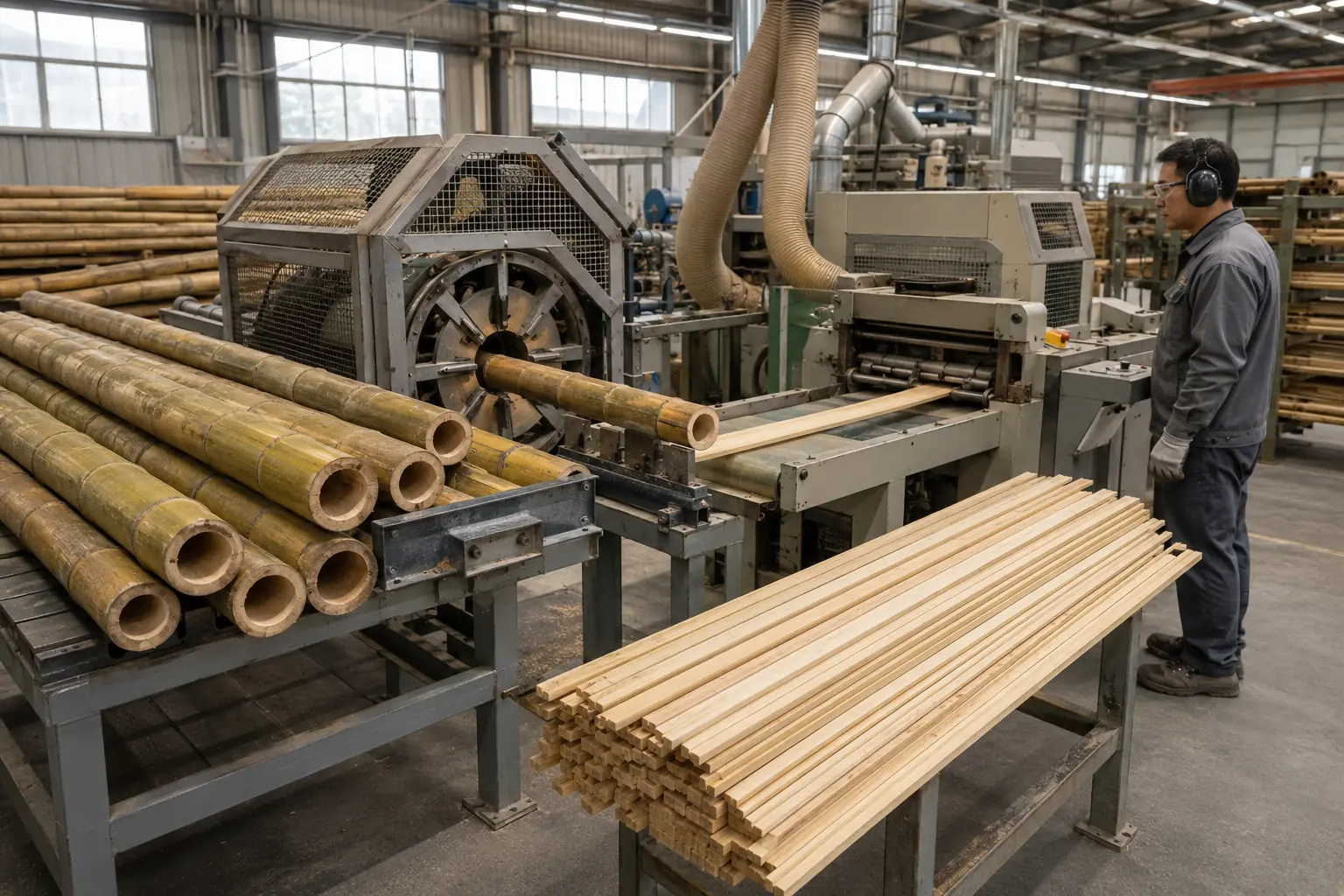
The culms are cut into manageable lengths and split longitudinally. The number and width of the sections depend on the culm and the target product. Node diaphragms and irregular portions are removed or trimmed so the pieces can pass through subsequent equipment consistently.
At this stage, efficient cutting matters because bamboo wall thickness and diameter vary along the culm. Factories must balance usable yield with the dimensional quality required for strips or strands.
3. Removing the outer and inner layers
The hard, waxy outer skin and the softer inner layer are removed or calibrated. Prepared strips are planed into a more regular rectangular section. Consistent width and thickness support even treatment, drying, adhesive application and final lamination. Poor strip geometry can contribute to gaps, weak joints or excessive machining later.
4. Treatment and color development
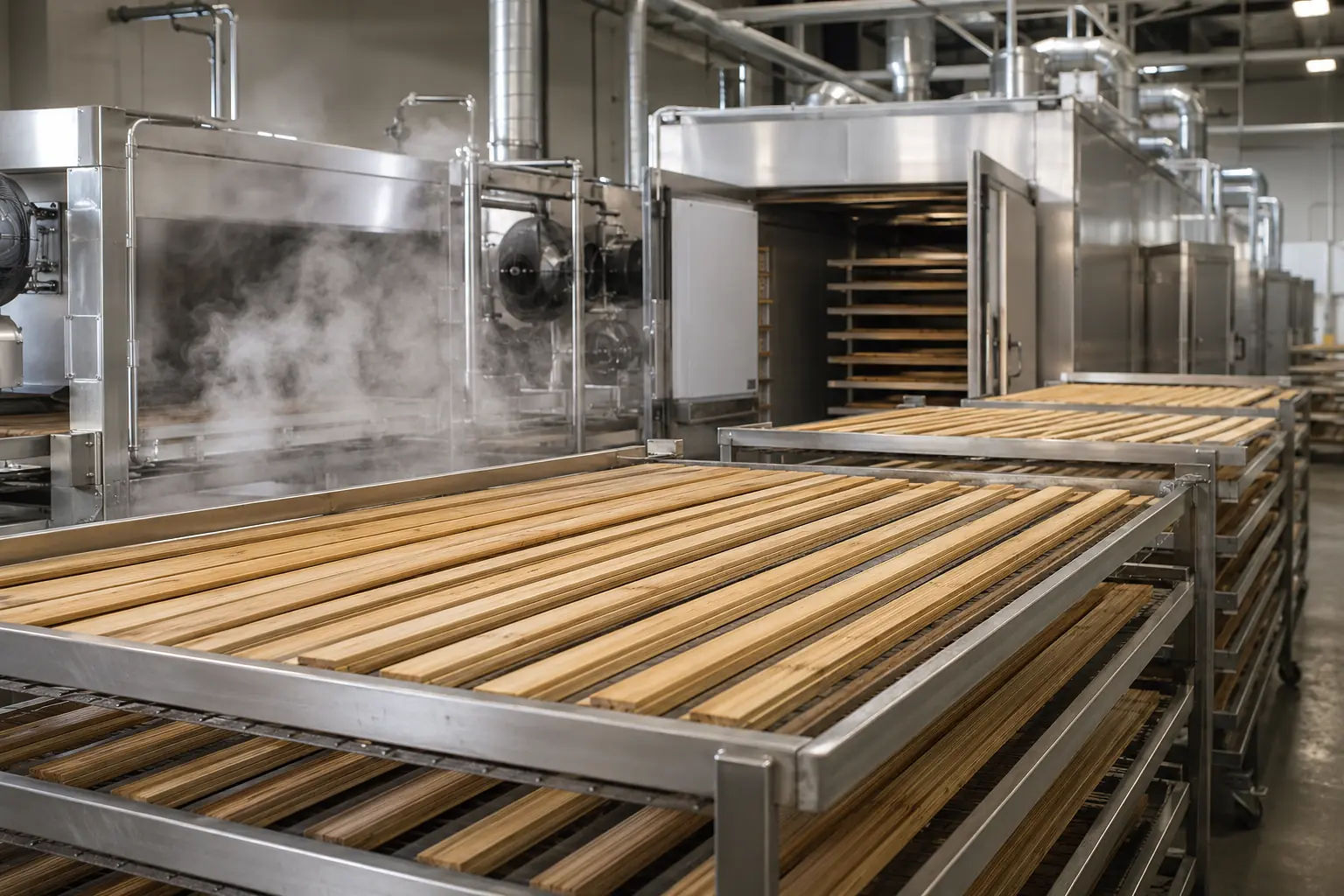
Prepared bamboo may undergo hot-water extraction, boiling, steaming, bleaching or another factory-specific treatment route. The purpose can include removing soluble sugars and starches, cleaning the material or developing a target color. Treatment chemicals and process controls vary; they should not be described as one universal recipe.
Carbonization uses heat and moisture to darken the bamboo through the material rather than adding only a surface stain. Time and temperature affect both color and material properties. It is therefore inaccurate to say that carbonization always makes a floor stronger, harder or more water resistant. Buyers should approve the color range and request product-specific performance data.
5. Controlled drying and conditioning
After wet processing, strips or strands must be dried to a moisture range suitable for the adhesive, construction and expected service environment. Uniformity within a batch is as important as a single average reading. Material that is too wet, too dry or uneven can create problems during bonding, pressing, machining, storage or installation.
A fixed number should not be presented as correct for every manufactured bamboo flooring product. The target and permitted variation belong in the product specification and should reflect the construction, factory process and destination climate. The factory should state where moisture is checked, which instrument or oven method is used and how out-of-range material is handled.
6. Precision milling and grading
For laminated flooring, dried strips are planed to controlled dimensions and graded for color, fiber pattern and defects. Consistent strip geometry helps create a flat blank with reliable glue lines. For strand-woven production, the bamboo is mechanically opened or crushed into long fiber bundles, then dried and graded before resin application.
Grading rules influence the final appearance. Natural variation should be expected, but the acceptable range for color, nodes, streaks and surface features should be documented. A buyer can approve a multi-board range sample rather than one unusually uniform plank.
7. Adhesive application, lay-up and pressing
Adhesive is applied according to the chosen system, and the material is assembled into a lay-up. Control points can include adhesive identity and batch, spread rate, open time, material moisture, press temperature, pressure and cure time. The correct values depend on the resin, product thickness, construction and equipment, so they should be managed as factory process specifications rather than copied from a generic article.
| Flooring route | Material before pressing | How the blank is formed | Important control points |
|---|---|---|---|
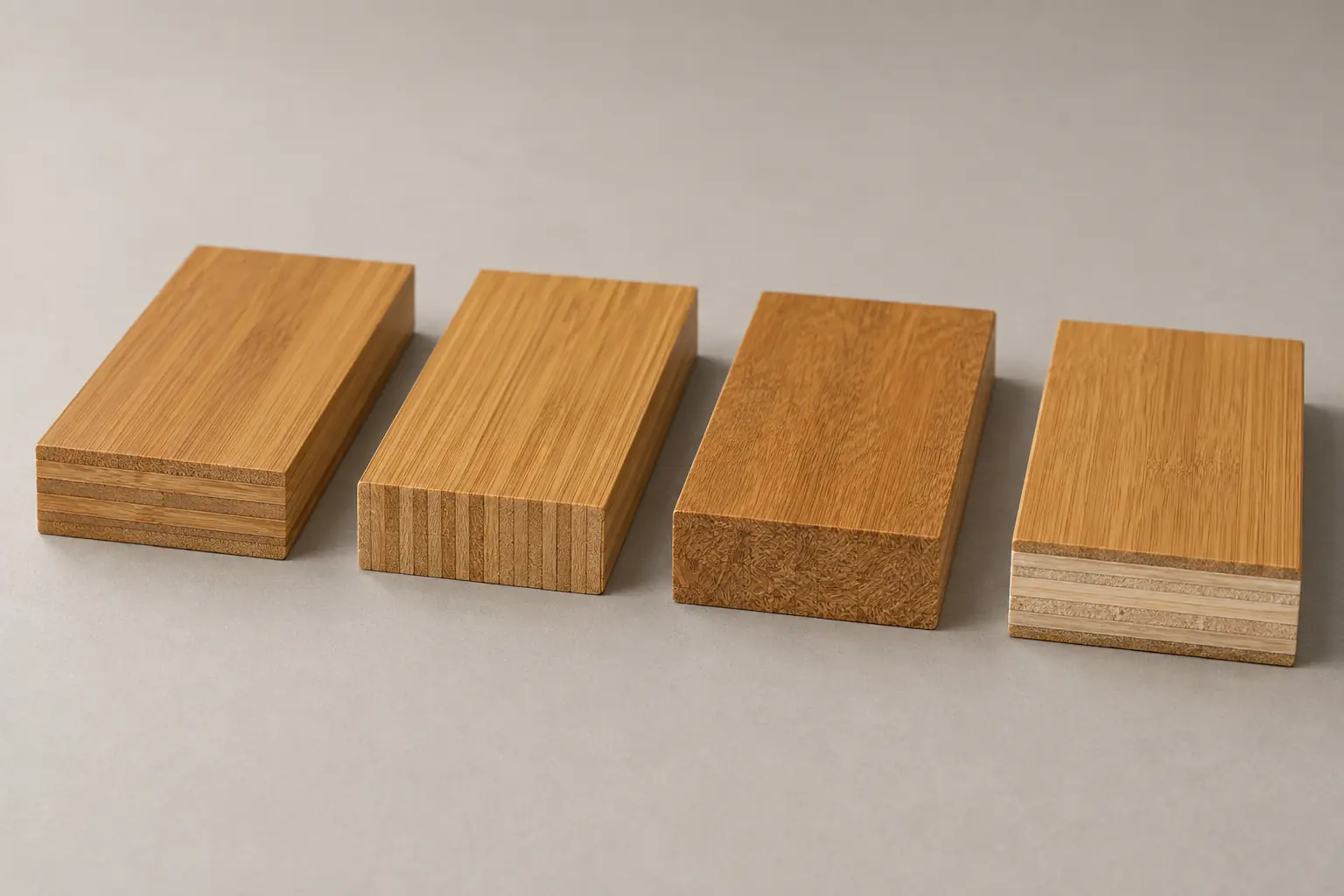
| Horizontal bamboo | Calibrated bamboo strips | Strips are laid with wide faces generally parallel to the surface and laminated | Strip thickness, color matching, glue coverage and layer alignment |
| Vertical bamboo | Calibrated bamboo strips | Strips are turned onto their narrow edges and bonded side by side | Edge dimensions, joint closure, straightness and color distribution |
| Strand-woven bamboo | Opened or crushed longitudinal fiber bundles | Strands are coated or impregnated with resin, oriented and compressed into dense blanks | Strand preparation, resin distribution, target density, pressing and cure |
| Engineered bamboo | Bamboo wear layer, core layers and backing | Layers are arranged as a balanced assembly and bonded | Wear-layer thickness, core quality, layer balance, glue lines and emissions classification |
These are general routes. A specific manufacturer may use multiple pressing stages, make large blanks before slicing, or purchase an intermediate component. Buyers should ask for a process map for the exact construction rather than assuming every factory uses the same sequence.
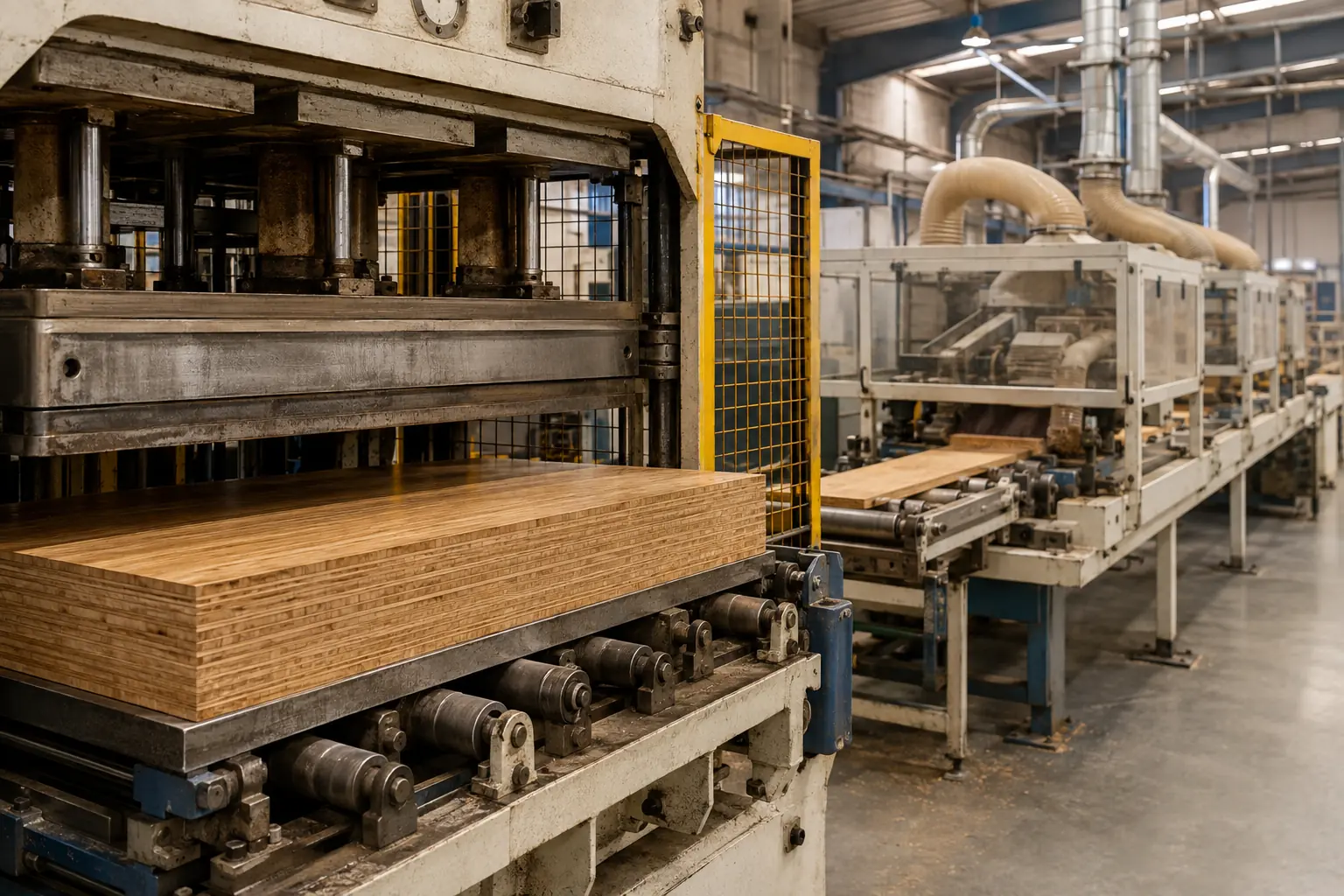
8. Post-press conditioning and calibration
Freshly pressed blanks need time to cool, cure and equalize. Conditioning helps reduce internal temperature and moisture gradients before final machining. The blanks may then be sawn, planed or sanded to a controlled thickness. Skipping adequate conditioning can increase the risk of later movement, inaccurate machining or surface defects.
9. Profiling the flooring plank
Calibrated blanks are cut into planks and machined with square edges, tongue-and-groove joints, click-lock profiles or another specified connection. Flooring-specific accuracy matters here: thickness, width, straightness, squareness and the geometry of the side and end joints affect how boards fit together.
A quality check can include trial assembly across several boards and both end and side joints. If a locking profile is proprietary, the buyer should also confirm authorization and the exact system covered by the quotation.
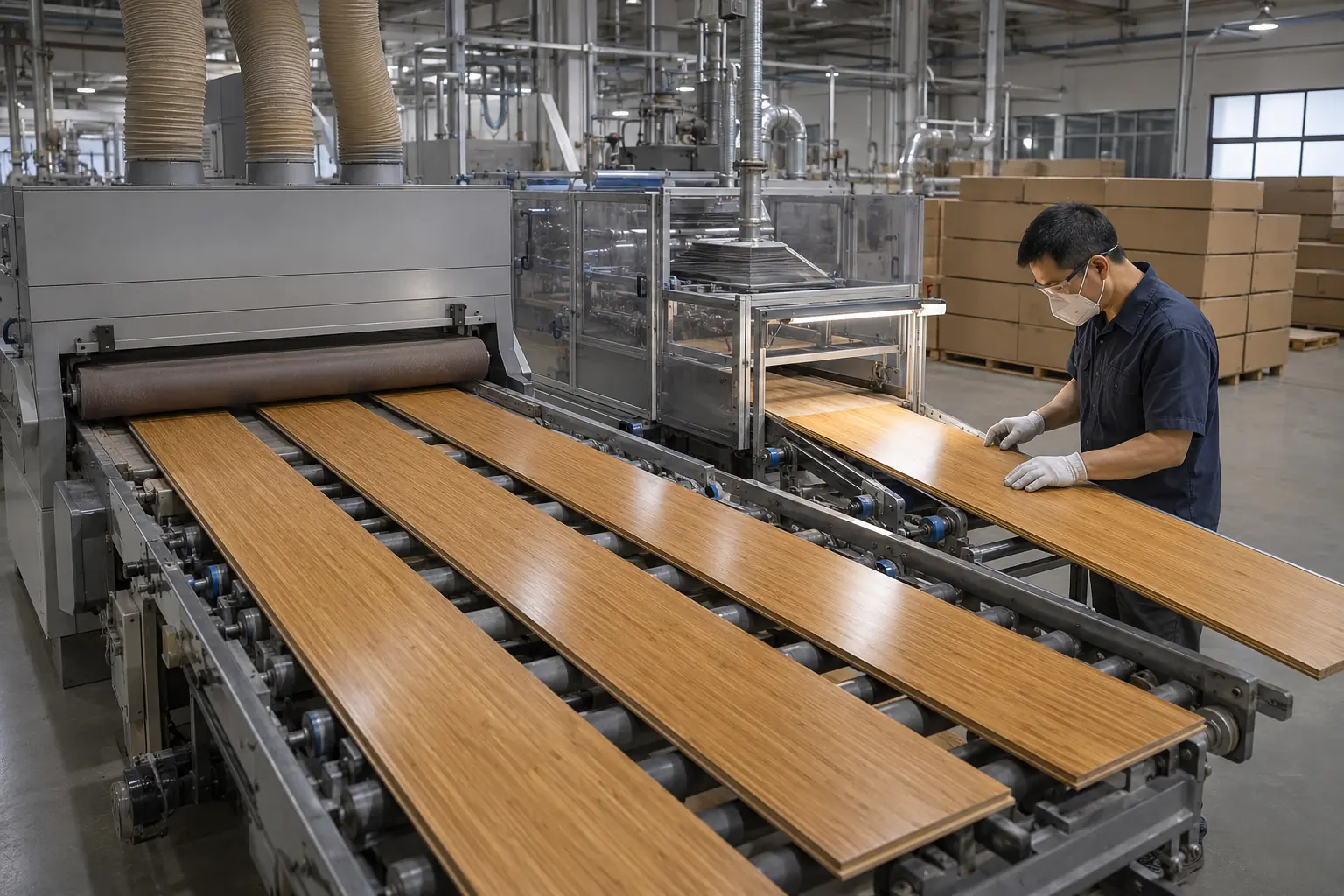
10. Sanding, staining and factory finishing
The profiled plank is sanded to prepare a consistent surface. Color may be adjusted with stain, while texture can be added by brushing or embossing if specified. Factory-finished products receive a coating system with primers, build coats and topcoats appropriate to the agreed product. UV curing is common in flooring, but coating chemistry, layer count, additives and cure parameters vary.
Claims such as “commercial grade,” “high wear” or “scratch resistant” need a defined test method and result. The number of coating layers alone does not prove performance. Buyers should compare a complete coating specification and product-specific test evidence.
11. Color grading, final inspection and packaging
Finished planks are graded for appearance and checked against the approved specification. Inspection can cover dimensions, flatness, straightness, edge damage, profile fit, surface contamination, sanding marks, finish defects, color range, moisture and carton contents. Bond quality, coating adhesion, wear, dimensional stability and emissions may be checked through production controls or product testing according to the contract and market.
Packaging should protect long, finished edges and limit exposure to moisture during storage and transport. Cartons need correct SKU, color, batch and quantity labels. Pallets, corner protection, wrapping and container loading should be designed for the shipment route rather than treated as an afterthought.
Quality Checks That Matter for Flooring
General bamboo-board quality controls are useful, but flooring adds requirements related to installation and repeated surface use. A buyer’s inspection plan may include:
- Raw-material identity, visible defects and batch traceability
- Moisture checks after treatment, before bonding and before packing
- Strip dimensions or strand-preparation consistency
- Adhesive identification, spread or resin content and cure records
- Blank density where relevant to the construction
- Overall plank length, width and thickness tolerances
- Flatness, bow, crook, twist and squareness
- Tongue-and-groove or click-lock dimensions and trial fit
- Glue-line integrity and delamination resistance under the agreed method
- Surface color, gloss, texture, sanding and coating defects
- Coating adhesion, hardness or wear performance under specified methods
- Dimensional stability and moisture-response testing when required
- Product-specific emissions or chemical reports for the destination market
- Carton, batch label, barcode, instructions and pallet verification
ISO 21629-1:2021 addresses bamboo flooring requirements and test methods, including characteristics beyond simple hardness. The applicable standards, editions and acceptance limits should be selected for the destination market and purchase contract; listing a standard in an article is not evidence that a particular product complies.
How Process Choices Affect the Finished Floor
| Process choice | What it can change | Buyer verification |
|---|---|---|
| Horizontal versus vertical lay-up | Visual grain, joint arrangement and blank construction | Section drawing, approved sample and glue-line requirements |
| Strand preparation and densification | Density, appearance, machining behavior and product performance | Process records and product-specific physical test results |
| Carbonization or staining | Color and, depending on treatment, material behavior | Approved range sample and comparative product data |
| Engineered core selection | Balance, dimensions, regulatory classification and installation behavior | Full layer specification, core documents and emissions evidence |
| Edge profiling | Installation method and joint fit | Profile drawing, license status where relevant and assembly check |
| Coating system | Gloss, appearance, cleanability and wear response | Coating specification and agreed test method |
Adhesives, Emissions and Market Requirements
Adhesive selection is part of the product design. Different resins require different process conditions and produce different bond and emissions profiles. A generic statement such as “eco glue,” “non-toxic” or “zero formaldehyde” is not a substitute for the adhesive specification and a report for the actual flooring construction.
For the United States, the regulatory question depends in part on whether a product contains a covered composite-wood component such as MDF, particleboard or hardwood plywood. The U.S. EPA guidance on composite wood products explains the federal framework. Buyers should determine how the specific bamboo flooring construction is classified and which testing, certification, labeling or recordkeeping requirements apply. Other destinations have their own rules.
FSC claims also require verification of the certificate holder, product scope and transaction claim. Bamboo flooring is a recognized FSC product category, but a factory or website logo does not automatically cover every floor or order. See our FSC bamboo certification guide for a buyer-focused verification checklist.
Common Oversimplifications to Avoid
- “Bamboo flooring is naturally waterproof.” Moisture performance depends on construction, adhesive, finish, joints, installation and exposure.
- “Strand-woven bamboo is always harder than hardwood.” Performance varies by product and test method; compare actual reports.
- “Carbonization makes bamboo stronger.” Heat treatment changes color and material properties, and the result depends on the process.
- “Solid bamboo means one solid piece.” Commercial solid bamboo flooring is usually assembled from strips or strands.
- “All engineered bamboo floors use the same core.” Core material, number of layers and balancing construction vary.
- “More coating layers always mean better wear.” Chemistry, film build, curing and test performance matter more than a layer count by itself.
- “All bamboo flooring is automatically sustainable.” Responsible sourcing and environmental claims require supply-chain and product evidence.
Frequently Asked Questions
How is bamboo flooring manufactured?
Bamboo culms are selected, split and prepared into strips or fiber bundles. The material is treated, dried and graded, then laminated, densified or assembled with an engineered core. Pressed blanks are conditioned, machined into flooring profiles, sanded, finished, inspected and packed.
What is manufactured bamboo flooring made from?
It may be made from laminated bamboo strips, resin-bonded bamboo fiber bundles or a bamboo wear layer combined with an engineered core. Adhesives and surface coatings are also part of the finished product.
What is the difference between horizontal and vertical bamboo flooring?
Both generally use prepared strips. Horizontal flooring places the wider faces of strips generally parallel to the visible surface, while vertical flooring places strips on their narrow edges. This changes the visual pattern and lay-up geometry.
How is strand-woven bamboo flooring made?
Bamboo is mechanically opened into longitudinal fiber bundles, dried, combined with resin, oriented and compressed into a dense blank. The blank is conditioned, cut, profiled, sanded and finished. The exact process and performance vary by manufacturer.
Does carbonization change bamboo flooring?
Yes. Carbonization changes color through heat and moisture and can also change material properties. Buyers should not assume it improves every characteristic; compare product-specific data and approve the color range.
Is all bamboo flooring manufactured in the same way?
No. Horizontal, vertical, strand-woven and engineered products take different production routes. Treatment, adhesive, pressing, conditioning, profiling and finishing systems also vary by factory and specification.
Use the Process to Ask Better Sourcing Questions
Understanding how bamboo flooring is manufactured helps a buyer move beyond a surface photo. The useful questions are construction-specific: what material enters the press, how moisture and bonding are controlled, how the profile is verified, which reports apply to the final SKU and how batches are graded and traced.
For a commercial comparison, continue with our guide to evaluating bamboo flooring manufacturers. Fujian Xianxu Bamboo & Wood Co., Ltd. provides B2B guidance for custom bamboo and wooden product programs. If a flooring inquiry is part of a broader sourcing brief, share the construction, dimensions, intended use, order quantity, destination and test requirements through our contact page. Product feasibility and the appropriate production route must be confirmed for the specific project before quotation.