

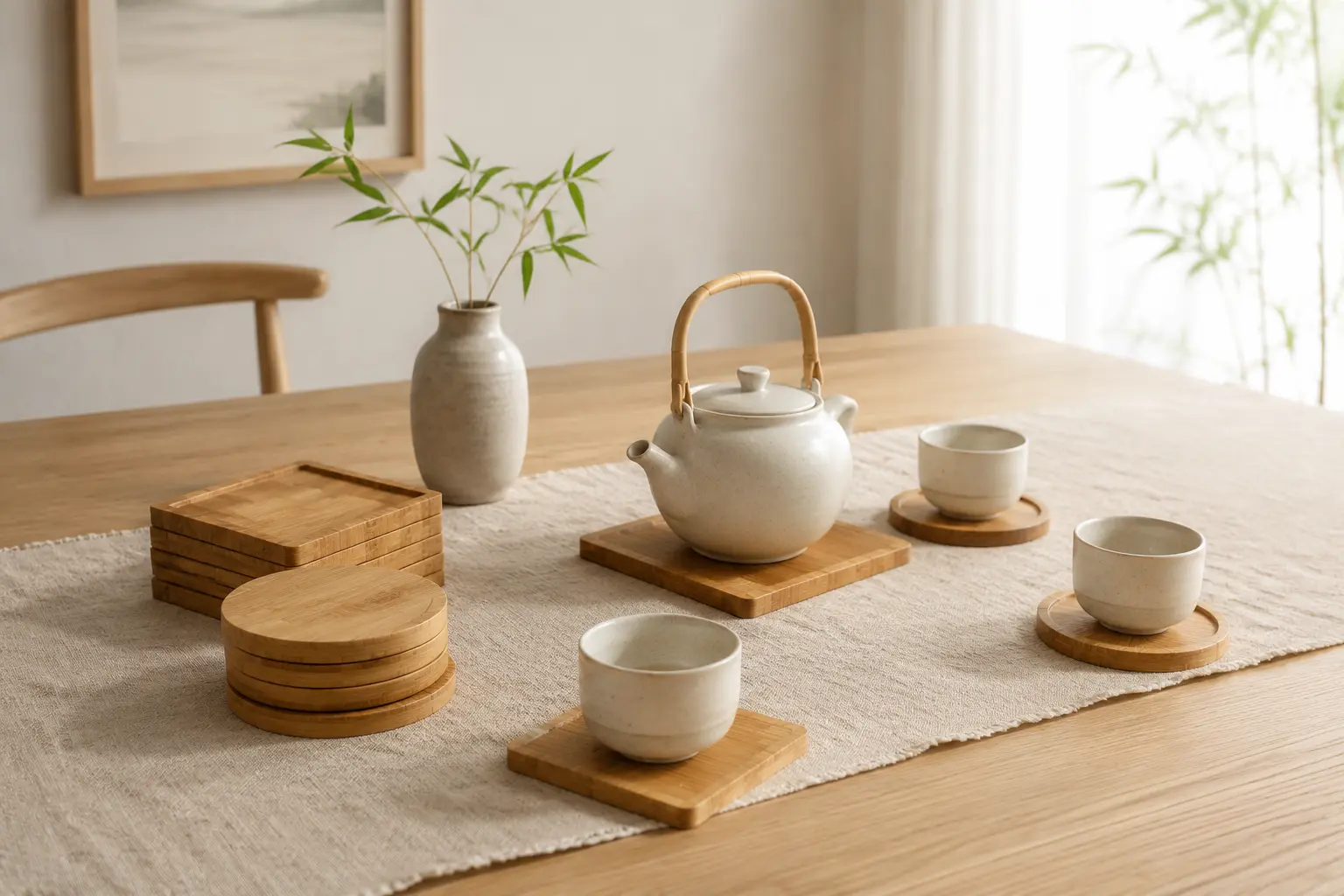
A well-designed bamboo tea coaster is a small product with a surprisingly broad role. It protects a serving surface from everyday contact, visually anchors a cup and helps a tea collection feel coordinated. For importers, homeware retailers, tea brands and hospitality buyers, it can also be an accessible add-on item: easy to combine with teaware, suitable for gift sets and flexible enough to support different materials, shapes and price levels.
However, “bamboo tea coaster” does not describe one construction. A solid laminated coaster, a flexible slatted design and a woven bamboo surface can look similar in a search result while behaving very differently in packaging, display and daily care. Buyers also need to separate a Japanese-inspired appearance from verified country of origin. This guide explains the main design directions, how to coordinate bamboo coasters and mat sets, which specifications belong in a request for quotation, and how to develop an OEM or private-label program without relying on unsupported product claims.

What Does “Japanese Bamboo Coaster” Mean in Product Sourcing?
In retail language, Japanese bamboo coaster often describes a visual direction rather than a manufacturing origin. Common cues include a low-profile shape, restrained geometry, visible natural texture, neutral colors and a calm table presentation. These elements can suit tea shops, modern homeware stores, hotel rooms and gift assortments. They do not, by themselves, prove that an item was made in Japan or follows a specific traditional craft method.
Accurate merchandising protects both buyer and supplier. If origin matters to the program, request country-of-origin documentation and define the labeling before production. If the product is manufactured elsewhere but uses this design language, descriptions such as “Japanese-inspired,” “minimal tea-table style” or “designed for a calm tea setting” are clearer. Avoid statements such as “traditional Japanese craft” unless the production method and origin can be documented.
Three Bamboo Coaster Constructions to Compare
Construction affects appearance, unit cost, dimensional consistency, packing density and cleaning instructions. A supplier should confirm the complete material composition—including adhesive, thread, backing, surface finish or hardware—not simply call every option “bamboo.”
1. Solid or Laminated Bamboo Coasters
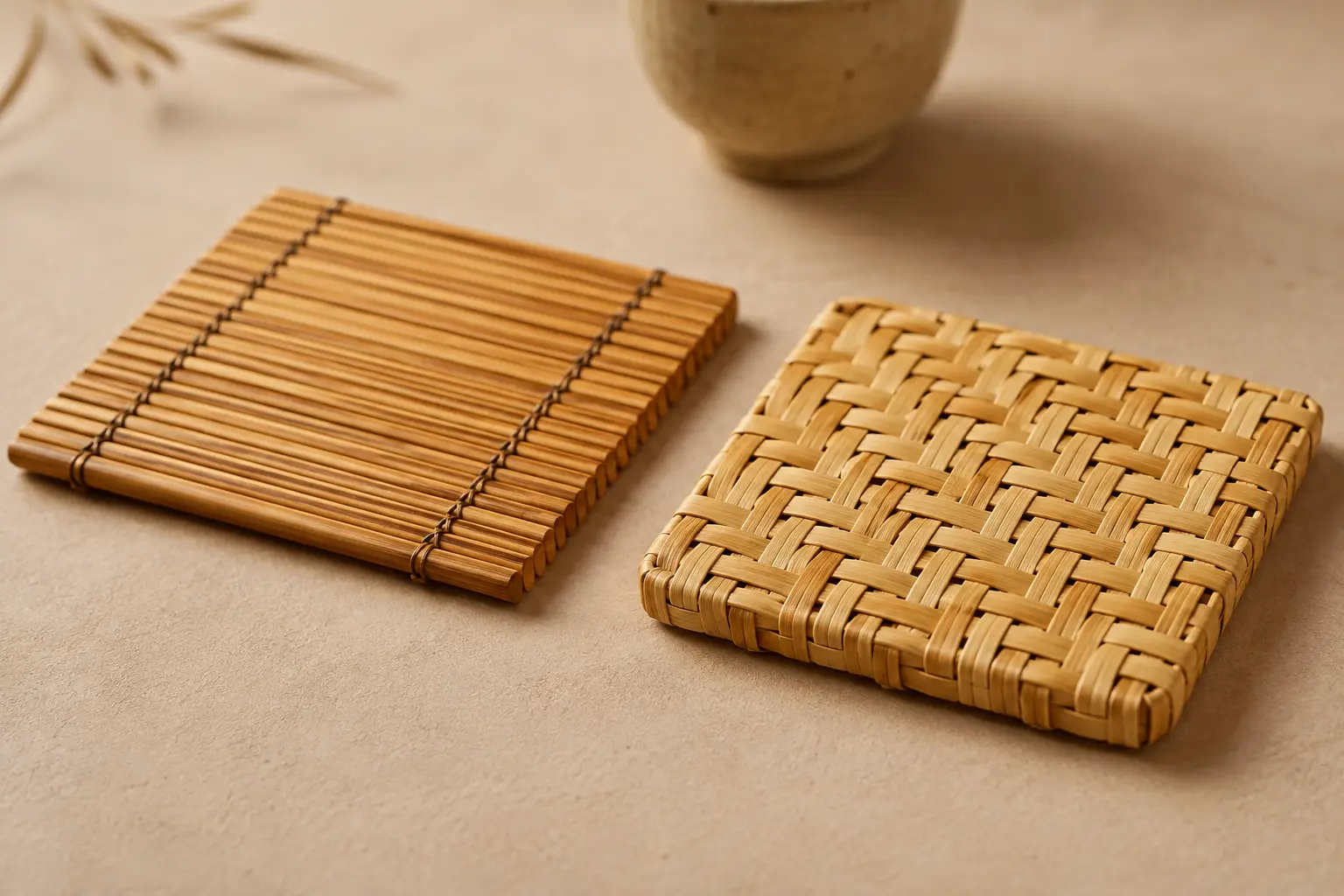
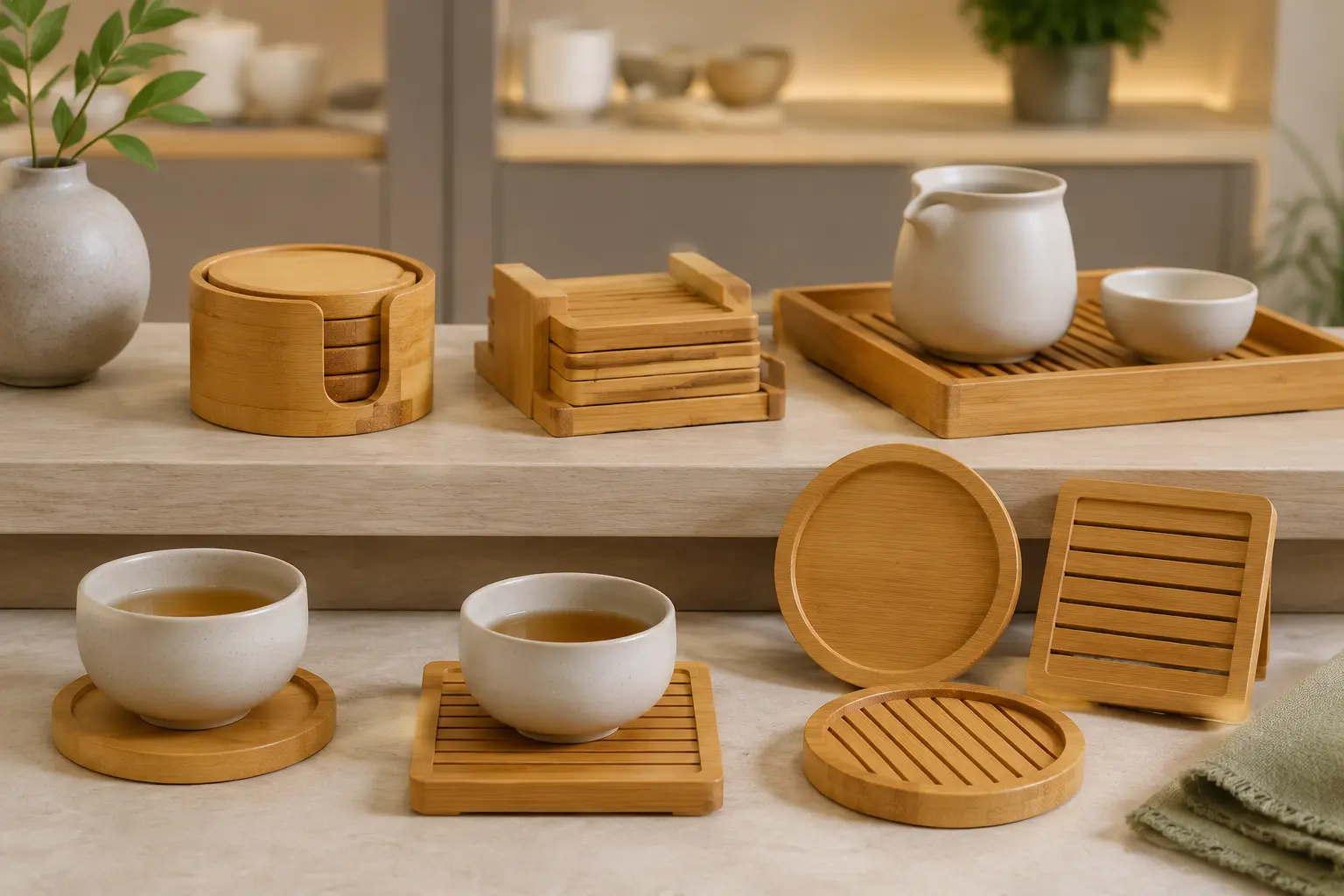
Solid-looking coasters are commonly produced from bamboo pieces or panels joined and machined into a stable form. They can be round, square or softly geometric, with flat faces that accommodate laser engraving or printed graphics. Routed rims, shallow recesses and rounded edges add detail, but every feature should be reviewed against the cup-base diameter and target thickness.
This construction is a strong choice for brand programs that need repeatable shapes, a smooth retail presentation and a matching holder. It may also provide the clearest surface for a subtle logo. Buyers should specify acceptable natural grain variation, edge profile, finish, flatness and whether a non-bamboo backing is required.
2. Slatted Bamboo Mat Coasters
A bamboo mat coaster uses narrow slats or sticks connected with thread or another joining method. Its linear rhythm creates a light, casual appearance and can coordinate naturally with a roll-up placemat. Some versions are flexible; others include a border or backing that makes them more structured. The open lines can be visually distinctive, but the joining points and cut ends deserve close inspection during sampling.
Ask how the slats are secured, whether the coaster remains square or round after packing, and how it should be dried after wiping. Do not assume an open structure will prevent moisture marks on every table. Performance depends on the design, finish, backing, liquid exposure and care.
3. Woven Bamboo Coasters
Woven designs use narrow bamboo strips or bamboo-containing elements to create a textured face. They can communicate craft and warmth, making them attractive for tea boutiques and hospitality concepts. Weave density, edge binding, backing material and dimensional tolerance are important because they influence visual consistency and cup stability.
A woven appearance should not automatically be described as handmade. Confirm the actual process before writing retail copy. For food-and-beverage presentation, sample the chosen cup on the finished coaster and check that the base sits securely without rocking.
How to Choose the Right Style for a Tea Collection
Begin with the teaware rather than the coaster alone. Measure the actual cup base, including any foot ring, then add enough usable surface for stable placement. A round coaster often softens angular trays and square packaging; a square coaster can echo straight-edged tea boxes and placemats. A mixed-shape set can work for a design-led brand, but it is harder to explain and replenish than one consistent format.
Natural bamboo tones can vary, and a darkened or colored finish changes the overall mood. Approve shade, grain range and sheen under the intended lighting. For multi-vendor assortments, send shared color references instead of relying on terms such as “light bamboo” without a standard.
Hotels should consider how staff will collect, wipe, dry and store the pieces. Retailers should evaluate shelf footprint, barcode placement, pack visibility and care instructions.
Coordinating Bamboo Coasters and Mat Sets
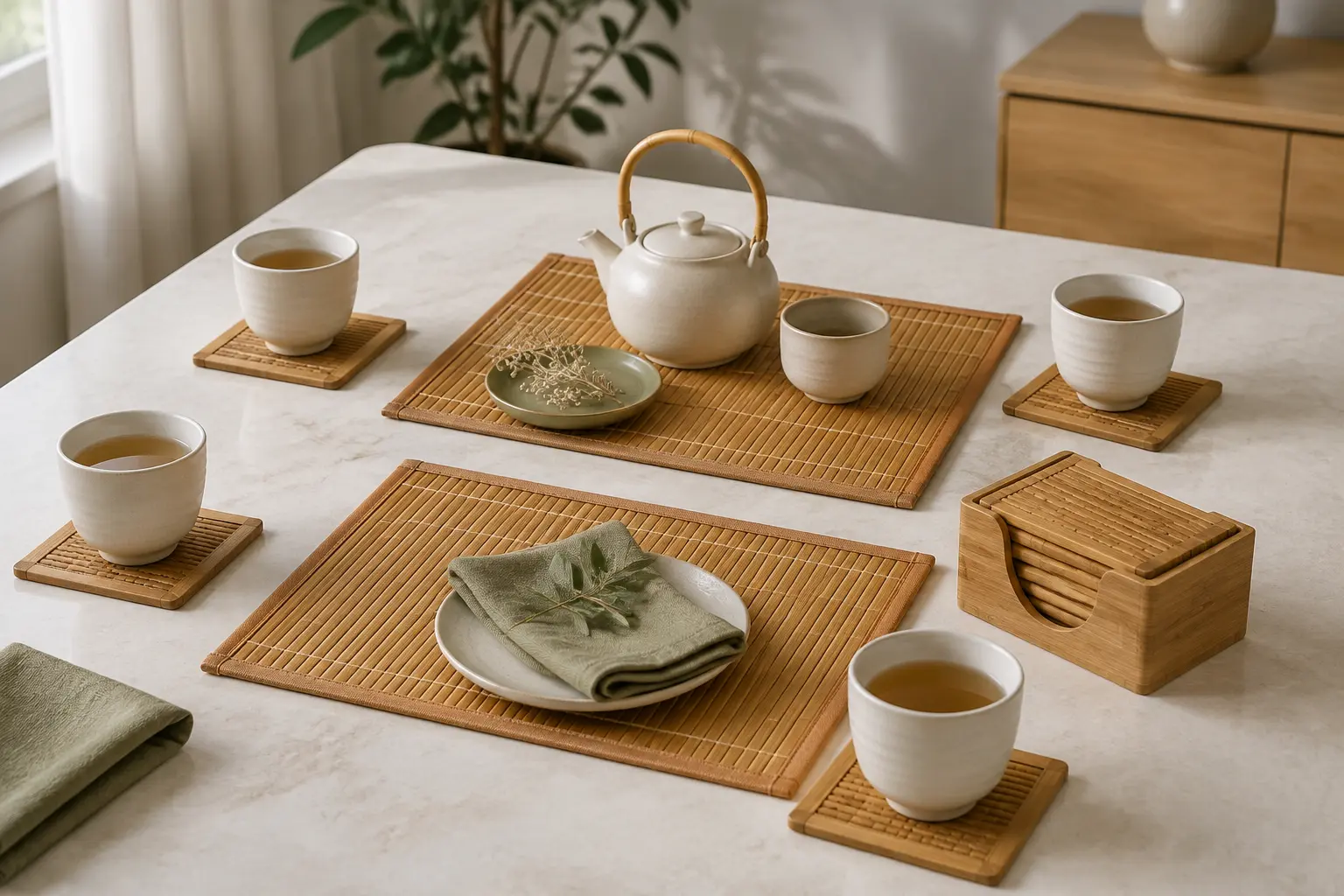
Bamboo coasters and mat sets give buyers a way to build a coordinated table story instead of selling a single low-ticket item. A range may include four or six coasters, a holder, two or four placemats, a tea tray, and optional napkin rings. The pieces can share the same bamboo tone and edge treatment while using different structures—for example, solid coasters with slatted placemats—to avoid a visually heavy presentation.
Confirm whether items will ship in one gift box or as separate SKUs. A combined set needs an insert that limits movement and surface contact; separate units need consistent naming, photography and color control. Also define whether “set” means coasters only or the full coaster-and-mat collection.
Tea-Serving and Merchandising Ideas
Tea brands may pair a four-piece set with ceramic cups, loose-leaf tea or a brewing guide. Homeware retailers can merchandise coasters beside trays and placemats. Hotels may use restrained designs in guest rooms or lounges, subject to their cleaning procedures.
For a Japanese-inspired display, use one or two ceramic colors, a simple textile and open space. Avoid unverified cultural language. Photography should show a correctly scaled cup on the coaster and include one clear construction detail.
Care Guidance for Bamboo Tea Coasters
Final care instructions must follow the tested finish and construction supplied for the order. As a general starting point, wipe spills promptly with a soft damp cloth, avoid prolonged soaking, and allow the coaster to dry fully in a ventilated position before stacking. Abrasive pads and harsh cleaners may affect a surface finish. Dishwashers should not be recommended unless the exact product has been evaluated and approved for that use.
Slatted and woven styles may retain moisture in joints or between strips, so drying guidance is especially important. A holder should allow pieces to be inserted only after they are dry. Include care information on the retail box, insert or product page, and ensure translations communicate the same limitations.
Specifications Wholesale Buyers Should Define
A useful RFQ makes alternatives comparable. Instead of sending only a reference photo, include the following:
- Construction: solid/laminated, slatted, woven, backed or unbacked.
- Material composition: bamboo components plus any adhesive, thread, coating, fabric, cork, silicone or other backing.
- Dimensions: diameter or length and width, thickness, corner radius and usable cup area.
- Shape and details: flat face, groove, rim, cutout, edge binding or holder design.
- Finish: color, sheen and surface specification; reference an approved sample.
- Set configuration: number of coasters, mats and holders per retail unit.
- Branding: artwork size, position, method and acceptable contrast.
- Packaging: belly band, box, sleeve, insert, barcode, warning and care copy.
- Quality criteria: dimensional tolerance, flatness, edge condition, weave consistency, color range and packing appearance.
- Commercial details: target quantity, destination, required delivery window and applicable market requirements.
Do not rely on a generic claim that bamboo is automatically food safe, waterproof, antibacterial or certified. Ask which parts are expected to contact drinkware or food, identify the destination market, and agree on the relevant material and product testing before mass production. Certification or chain-of-custody claims should appear only when the specific supply and documents support them; the FSC chain-of-custody overview explains the supply-chain scope behind an FSC claim.
OEM/ODM Options for Tea and Homeware Brands
OEM development can start with a standard coaster and add controlled changes such as dimensions, edge profile, surface color, logo treatment, holder and packaging. ODM work may go further by creating a coordinated collection around a brand’s cup shapes, seasonal palette or gift concept. In both cases, approving a physical sample is more reliable than choosing from a rendering alone.
Logo scale deserves restraint. A small laser-engraved mark may support a premium look, while a high-contrast printed graphic can suit events or promotional programs. The correct method depends on the surface structure and finish. Woven and narrow-slatted faces may need a label, tag, holder or package to carry branding cleanly.
For bamboo coaster tea gift programs, provide the supplier with the actual cup or a precise base drawing when possible. This helps determine the usable area, pack layout and visual proportions. Also specify whether the coaster will be sourced alone or combined with tea accessories from other factories, because consolidation and final packing responsibilities affect the project plan.
Sampling and Quality Control Before Bulk Production
A pre-production sample should be reviewed with the intended cup, mat, holder and packaging. Check dimensions at several points, surface feel, edge smoothness, visible adhesive, odor, logo position, stability and set consistency. For slatted designs, examine joint tension and alignment. For woven designs, check the edge binding, loose ends and repeatability of the pattern.
Agree on measurable acceptance criteria and an inspection plan before production. Packaging checks should include quantity, barcode readability, carton marking and protection against rubbing or movement. Any performance claim planned for retail copy should be supported by an appropriate test on the final specification, not inferred from a different bamboo product.
Frequently Asked Questions
Are bamboo tea coasters suitable for hot cups?
They are commonly used beneath tea cups, but suitability depends on the product construction, finish, cup temperature and duration of contact. Buyers should communicate the intended use and request evaluation of the final sample rather than assuming one temperature claim applies to every design.
Should I choose a holder with the coaster set?
A holder improves shelf presentation and keeps a set together, but it adds material, packing volume and cost. Confirm that coasters can be removed easily and stored only when dry. For promotional packs or low-price programs, a sleeve or band may be more appropriate.
Can a mat-style coaster match a bamboo placemat?
Yes. Shared slat direction, border color or bamboo tone can connect the products. Exact construction does not have to be identical. Sampling them together is the best way to check shade, scale and overall table balance.
Does “Japanese-style” mean made in Japan?
No. It normally describes an aesthetic unless origin is explicitly documented. Use accurate country-of-origin labeling and describe the visual inspiration separately.
What information is needed for a wholesale quotation?
Provide construction, dimensions, set quantity, finish, logo method, packaging, order quantity, destination market and timeline. Add any required tests or documentation at the quotation stage so the supplier can assess the correct specification and cost.
Develop Your Bamboo Tea Coaster Collection
The strongest collection begins with a clear use case and a precise specification. Decide whether the range needs the clean branding surface of a solid coaster, the linear character of a slatted design or the tactile look of a weave. Then align the coaster with teaware, mats, holders, packaging and the real care routine of the end user.
For broader shape, set-count and holder decisions, read our bamboo coasters buying guide. If your project needs logos, blanks or bulk packaging, continue with our custom bamboo coasters wholesale guide.
Fujian Xianxu Bamboo & Wood Co., Ltd. supports OEM/ODM development for wholesalers, retailers, importers, tea brands and hospitality buyers. Browse our bamboo and wood kitchenware collection, learn more about our manufacturing capabilities, or send your reference design, dimensions, set configuration, target quantity, destination market, branding files and packaging requirements through our contact page. We can review the brief and confirm which details require sampling before a production quotation.