

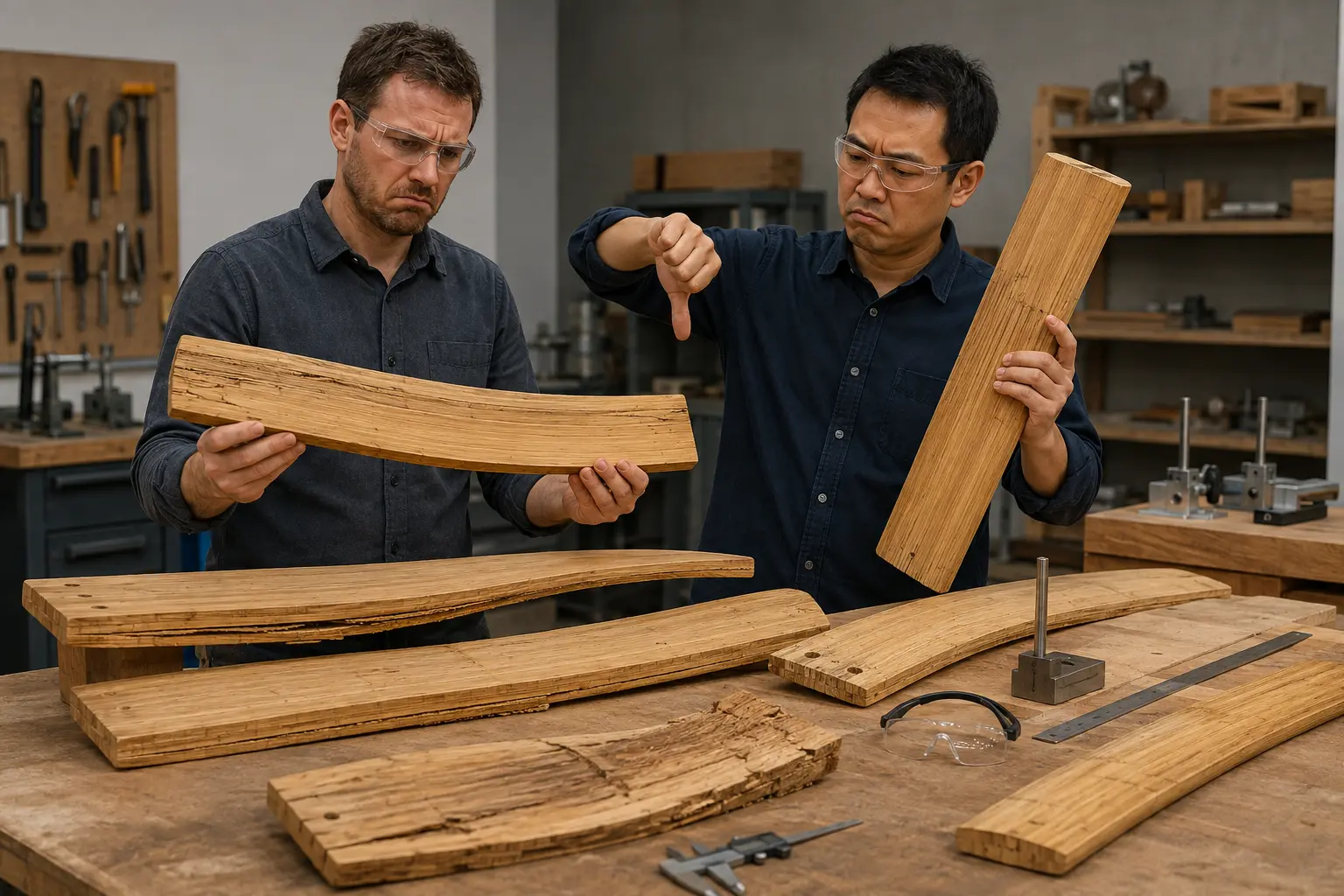
At first glance, solid bamboo ceiling fan blades may seem to combine a natural material with attractive interior design. Bamboo has a warm appearance and performs well in many stationary products, but a powered fan blade is a rotating structural component that must retain its geometry, mass distribution, attachment strength and balance throughout service.
For conventional commercial production, solid natural bamboo is generally impractical as the structural material for powered fan blades. Achieving adequate stiffness and a robust blade root requires a thicker section, making the blade too heavy for the intended fan system; reducing the thickness makes stiffness, fastener retention and split resistance worse. Natural variation also makes long-term geometry, matched mass and dynamic balance difficult to guarantee.
This conclusion is not a claim that every bamboo-based blade is physically impossible. Specialist fan manufacturers may use engineered bamboo airfoils with dedicated processing, mass matching, dynamic balancing and whole-appliance testing, while many products marketed with a bamboo appearance use only a finish or veneer over an engineered core. Neither is equivalent to a conventional solid natural bamboo blade.

The Short Answer: Why Solid Natural Bamboo Is Impractical for Powered Fan Blades
Four connected problems make solid bamboo fan blades unsuitable for conventional commercial production:
- Manufacturing precision: natural grain, nodes, curvature, density gradients and wall-thickness variations make repeatable blade geometry difficult to achieve.
- Weight and rotational inertia: a bamboo blade may require a thicker section to provide adequate stiffness and connection strength, increasing finished mass.
- Structural consistency: bamboo can be strong along its fibers but is more sensitive across the grain, around holes and at concentrated attachment points.
- Balance and validation: a powered fan requires closely matched blades and complete-system testing. Appearance and equal total weight alone cannot demonstrate safe long-term performance.
A handheld bamboo fan, folding fan, paddle fan or decorative wall fan does not face the same requirements because it is not continuously driven by a motor. Search results often group non-powered bamboo fans together with ceiling fans, but their structures and safety responsibilities are fundamentally different.
Why Manufacturing Precision Is So Difficult
Bamboo is naturally curved, hollow and variable
A bamboo culm is a tapered hollow tube, not a flat engineering board. It contains nodes, curved surfaces, changing wall thickness and a density gradient from the outside toward the inside. Its longitudinal fibers can provide impressive strength, but transverse properties, splitting resistance and connection behavior are different. Published research on bamboo culm geometry and mechanical-property variation documents substantial differences across the culm wall and along culm height.
These natural features are manageable in many household products. They become much more serious when several rotating blades must have nearly identical dimensions, stiffness, mass and center of gravity. Selecting visually similar bamboo pieces does not prove that their internal properties are equivalent.
A fan blade requires more than a flat outline
A powered blade needs a controlled airfoil or plate profile, thickness, pitch and mounting geometry. Even small differences can affect airflow, noise, vibration and the load transferred to the hub. Machining a wide, thin blade from natural bamboo while maintaining consistent grain orientation and avoiding local weak areas is extremely difficult.
CNC machining can reproduce an external shape, but it cannot remove natural differences inside the material. Splitting, flattening, joining and pressing bamboo strips can improve geometry, but these processes create an engineered laminated material rather than a simple solid natural bamboo blade. Adhesive selection, layup direction, pressing conditions and bond durability then become additional engineering variables that need specialist control and validation.
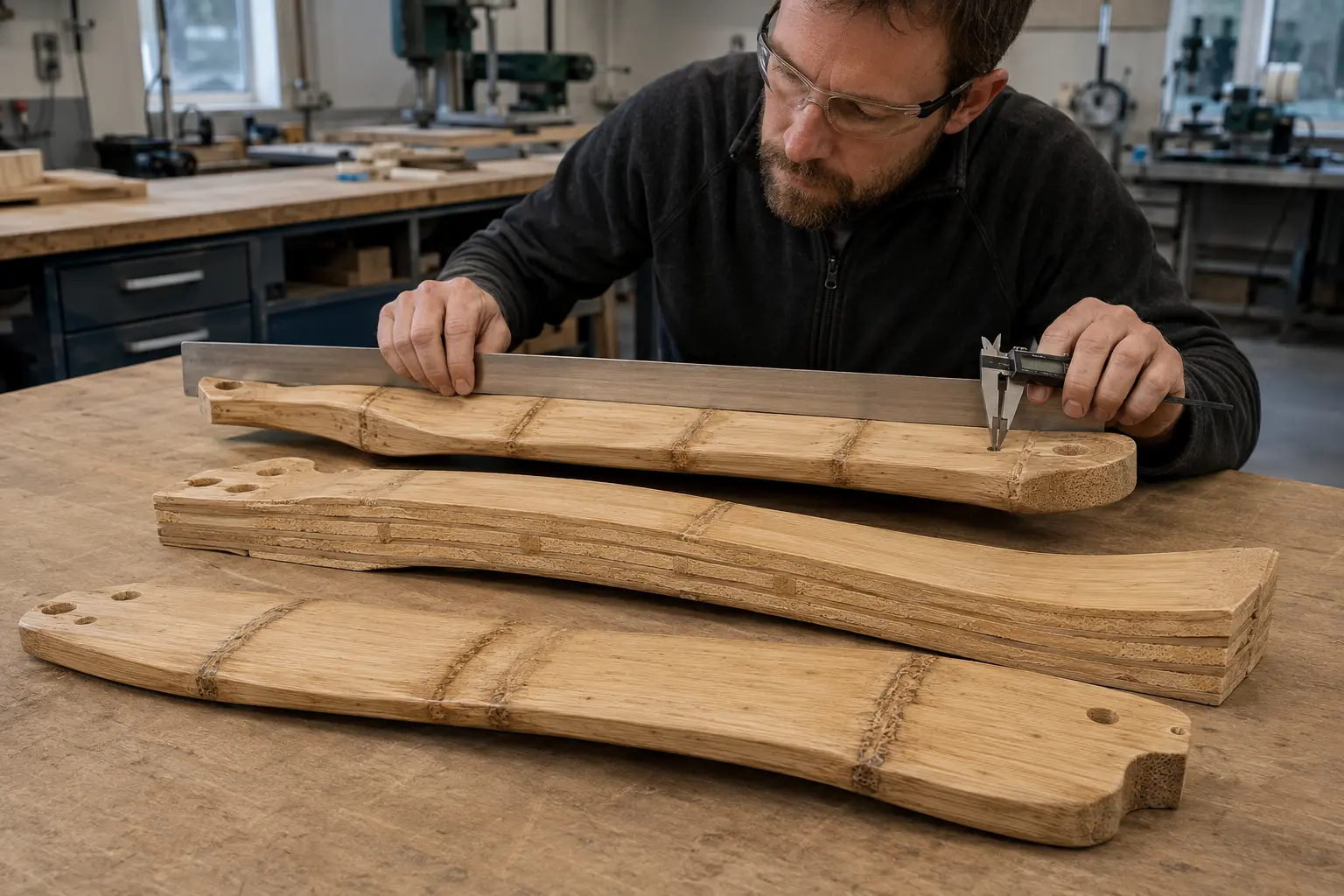
The Weight Problem Is Really a Stiffness Tradeoff
Bamboo is not automatically heavier than every wood, metal or composite. The practical problem is the section needed to achieve a usable blade. If a natural bamboo blade is made thin and light, it can become too flexible and leave too little material around the mounting holes. If it is made thicker to improve stiffness and provide a stronger root, the finished blade can become considerably heavier than a thin engineered fan-blade substrate.
Additional mass increases rotational inertia, especially when that mass is located farther from the hub. The motor may need more starting and stopping torque, while the blade root, hub, bearings, suspension and ceiling support must accommodate the resulting loads. At operating speed, added blade mass increases the centrifugal tensile load carried by each blade root and hub connection.
A heavy blade does not automatically damage a motor, because operating demand also depends on aerodynamic design. However, replacing lightweight blades with heavier bamboo parts without redesigning and validating the complete fan is not responsible engineering. The motor, bearings, hub, fasteners, blades and ceiling mount must be designed as one system.
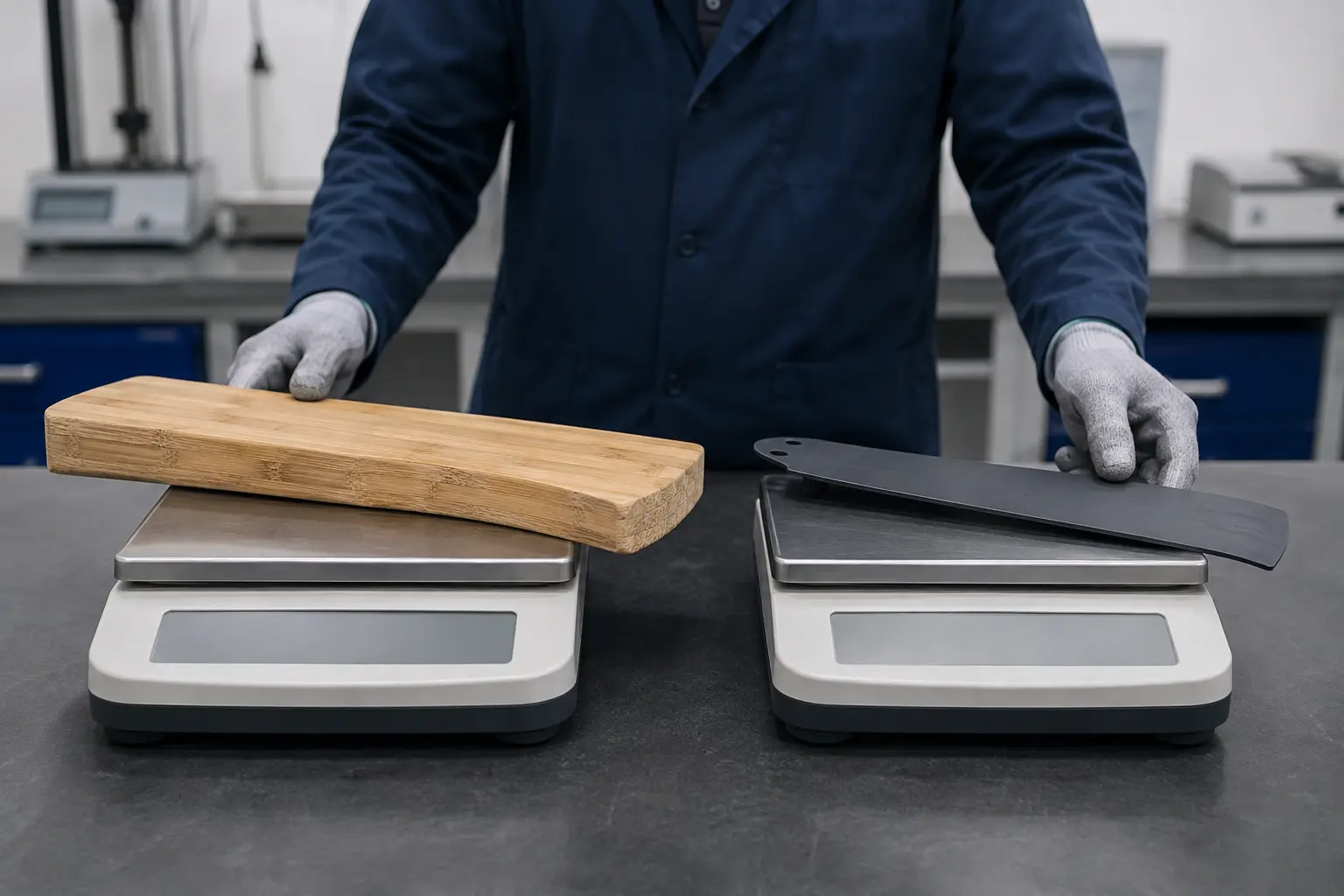
Why a Bamboo Blade May Not Be Sturdy Where It Matters
The blade root is a critical weak point
The root is the part of a fan blade connected to its bracket or hub. Mounting holes, slots, fasteners and changes in cross-section concentrate stress in this area. Bamboo's longitudinal fiber structure means that a drilled hole or notch can create a starting point for splitting, particularly when the part is thin or fastener pressure is not distributed correctly.
A simple bending test along the grain does not reproduce the combined loading at a rotating blade root. A blade may look strong during a static inspection yet behave differently after repeated starts and stops, prolonged operation, vibration, turbulent airflow and humidity cycling. Small cracks can begin near a hole, edge, node or bond line and enlarge over time.
General bamboo strength is not a blade guarantee
This does not mean that every bamboo component will inevitably break. It means that bamboo's general reputation for strength is not proof of predictable fatigue life, root integrity or blade retention. Depending on the design and target market, validation would typically include environmental conditioning, blade-retention and connection-strength evaluation, overspeed testing, vibration assessment and durability testing before a bamboo-based powered blade could be considered. Those requirements belong to specialist powered-appliance engineering and testing programs.
Blade failure is a real product-safety concern. A 2024 U.S. CPSC ceiling-fan recall, for example, described blades that could crack, break or detach and create an impact hazard. The example was not a bamboo product, but it shows why no blade material should be accepted without complete-system engineering and validation.
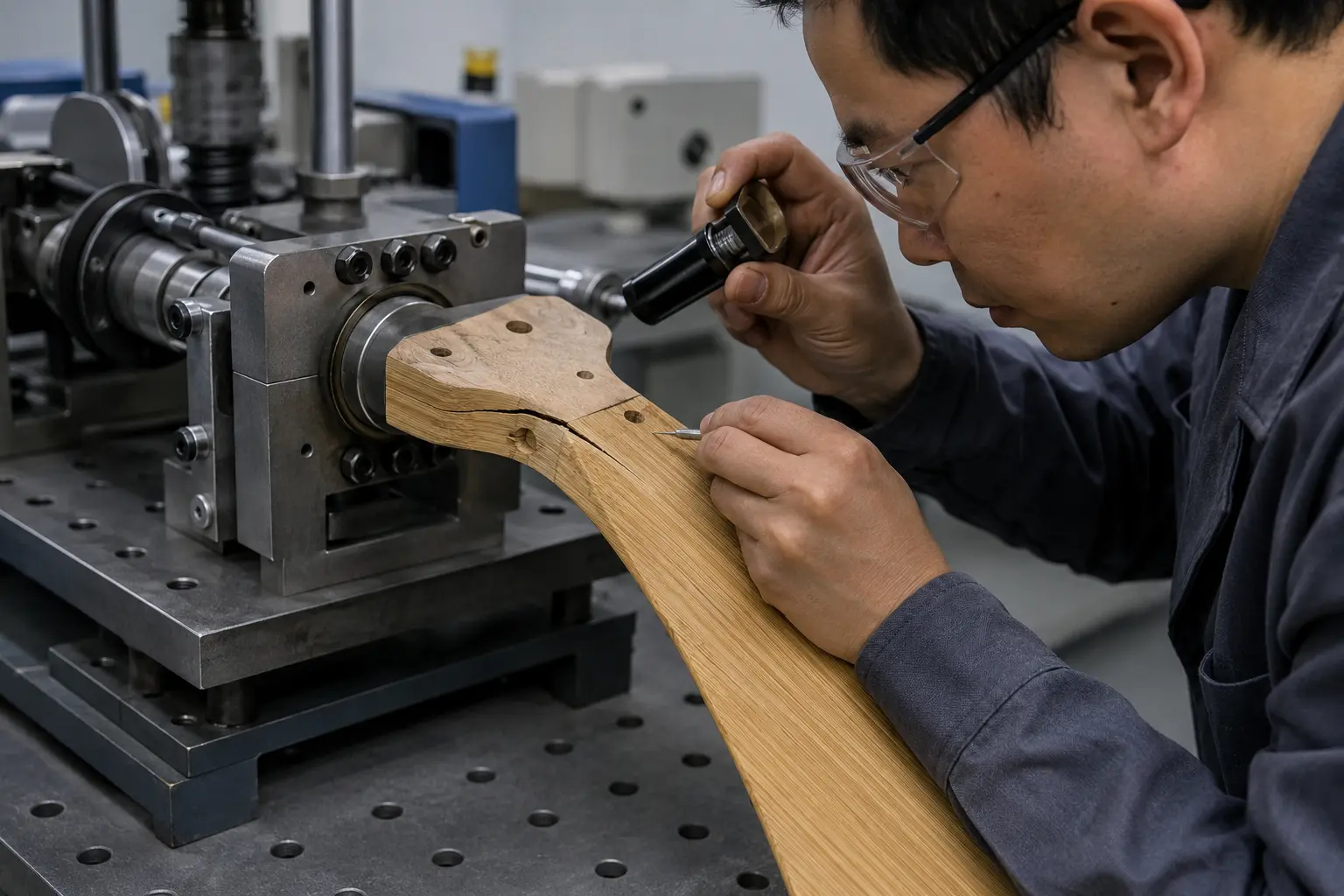
Moisture and Outdoor Exposure Make the Problem Worse
Bamboo is hygroscopic, so it exchanges moisture with the surrounding air. Because its structure is direction-dependent and graded, uneven moisture changes can produce shrinkage, swelling, twisting, cupping or warping. Experimental research on moisture-related deformation in bamboo reports twisting, warping and cupping when drying and shrinkage are uneven. A blade that appears straight and matched after machining may change after sea freight, warehouse storage or seasonal humidity cycles.
This matters because a fan uses several blades as a matched set. If one blade gains moisture differently, twists slightly or shifts its center of gravity, the complete rotor can become less balanced. Controlled drying, conditioning and sealing reduce risk, but they do not make natural bamboo insensitive to its environment.
The limitation is even more serious for a bamboo outdoor fan. Sunlight, humidity, condensation, heat, rain exposure and coating damage can accelerate surface checking, bond-line deterioration and dimensional movement. A clear coat or outdoor finish can slow moisture exchange, but it cannot change bamboo's grain direction, eliminate internal variation, reduce blade mass or reinforce an unsuitable mounting design.
An outdoor or damp-location claim also applies to the complete appliance—not just its blades. The motor, wiring, enclosure, fasteners, corrosion protection, hub, finish and mounting system all need to be designed and evaluated for the intended environment. Applying a weather-resistant coating to bamboo does not make a ceiling fan suitable for outdoor use.
Dynamic Balance Is Harder Than Matching Total Weight
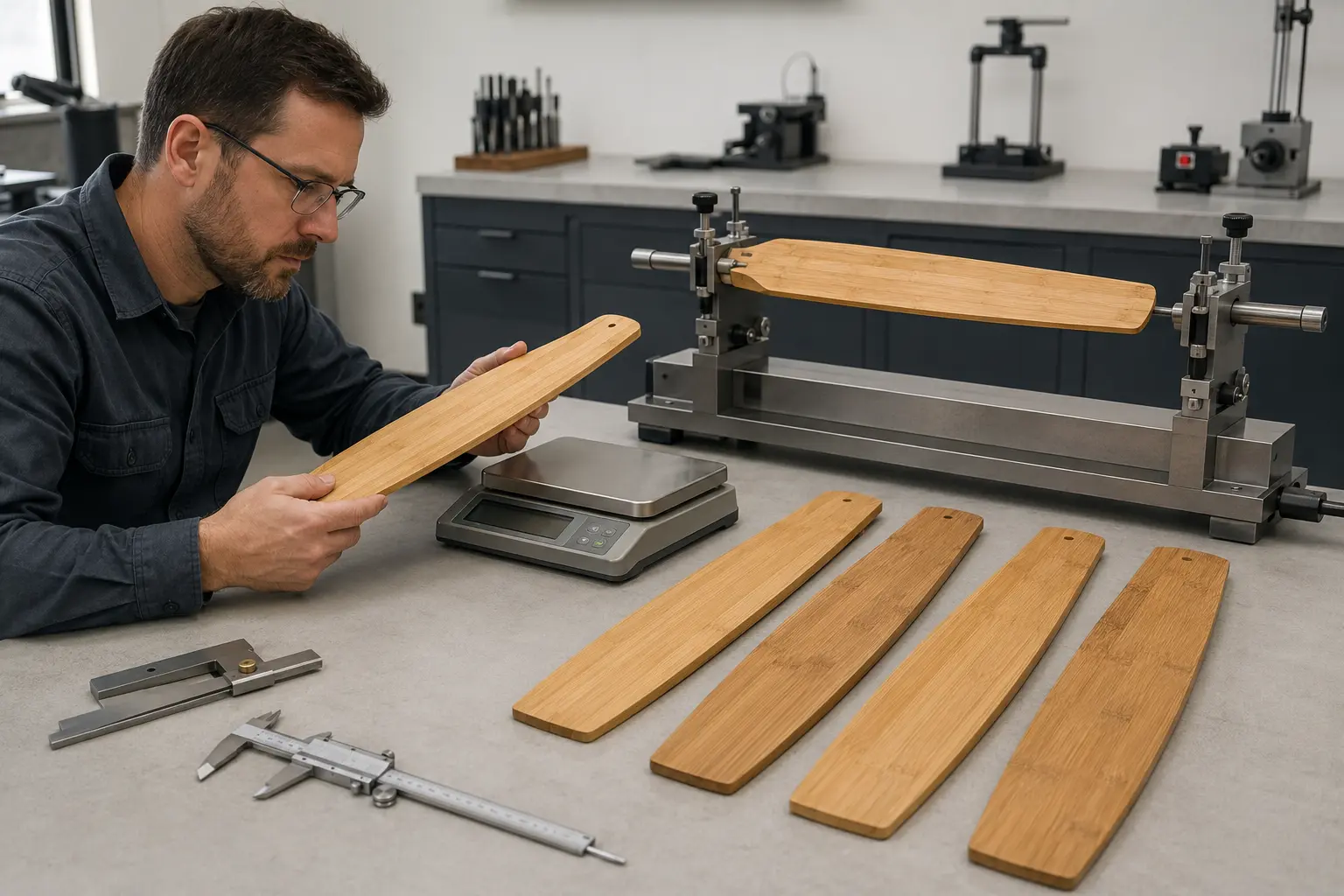
Good balance is not achieved simply by placing each blade on a scale. A matched set must control total mass, center of gravity, mass distribution along the blade, pitch, twist, stiffness and attachment position. Two blades can have the same total weight but behave differently if their weight is distributed differently.
Natural differences in bamboo density, nodes and moisture make this repeatability difficult. Sanding or adding coating to correct one blade can introduce another variation. Static matching may reduce an obvious imbalance while the complete rotating assembly still produces dynamic vibration at operating speed.
Vibration can cause noise, loosen connections and increase cyclic loads on blade roots, bearings, brackets and the ceiling mount. Fan-industry guidance such as AMCA Standard 204-20 treats balance quality and vibration as controlled engineering characteristics of the assembled fan. It should not be read as a universal certification requirement for every household fan, but it illustrates why a visual inspection is not enough.
Certification Applies to the Complete Fan
A powered fan is both an appliance and a rotating mechanical system. Requirements vary by sales market, installation type and intended environment. Relevant evaluation can include electrical safety, guarding, blade retention, abnormal operation, vibration, mechanical endurance, environmental exposure and mounting integrity. The safety framework for household and similar fans includes IEC 60335-2-80:2024, while UL 507 covers electric fans in the United States, including ceiling-suspended fans within its scope. Exact requirements depend on the target market and installation.
Material certificates or environmental claims do not replace appliance testing. FSC documentation, chemical testing or a coating report may be useful for a material supply chain, but none proves that a finished ceiling fan is safe. The complete design must be assessed under the applicable market requirements by qualified fan engineers and laboratories.
Taken together, repeatable geometry, matched mass, long-term dimensional stability, blade-root integrity, fatigue performance and complete appliance-safety compliance are difficult to guarantee with conventional solid natural bamboo. This makes it impractical for ordinary commercial powered-blade production.
Can a Bamboo-Look Fan Be a Better Alternative?
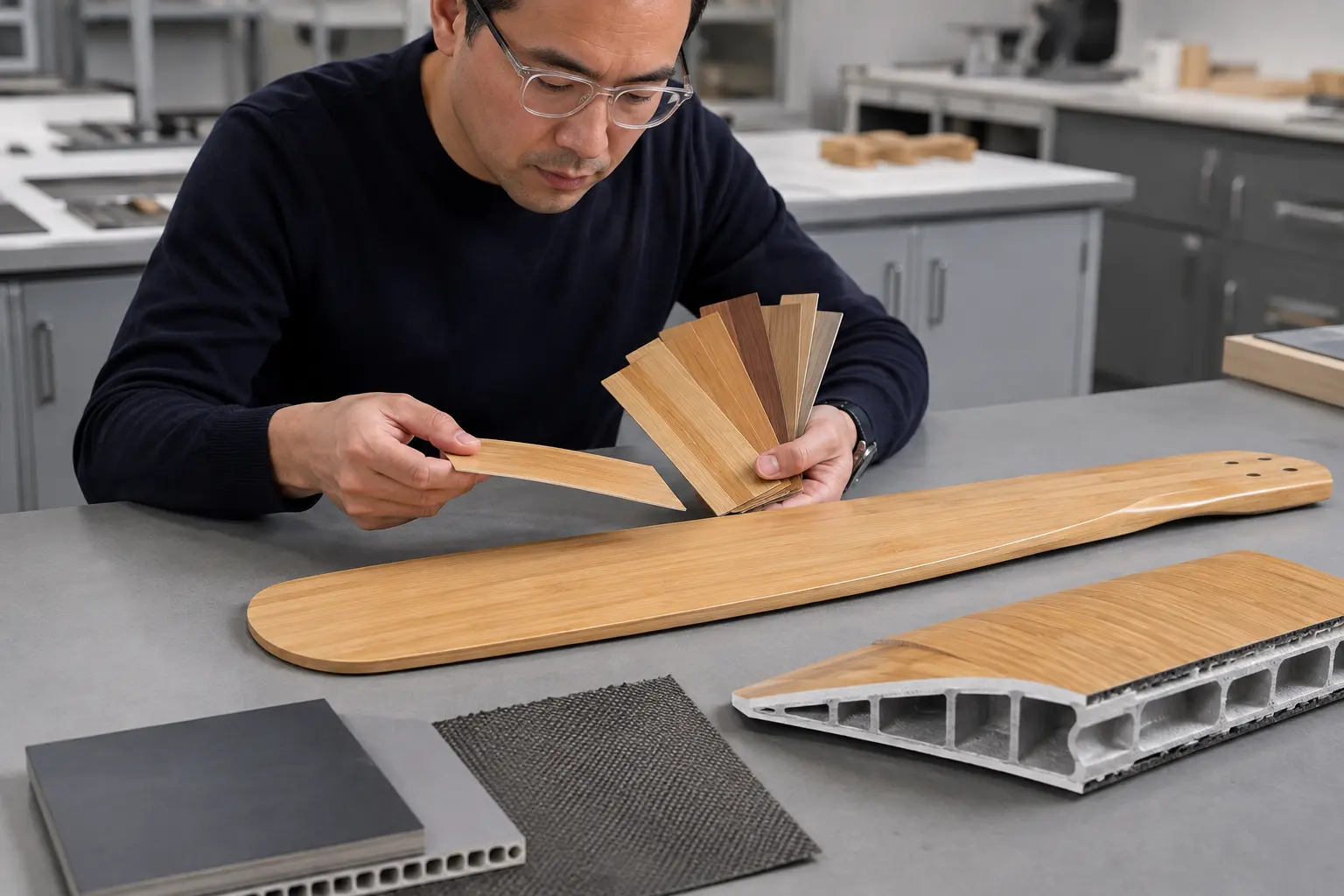
A bamboo-style fan can create a natural appearance without using solid bamboo as the primary rotating structure. A fan specialist may use an engineered core that has already been designed for the required mass, stiffness and connection system, then add a bamboo-look film, printed finish or carefully qualified thin veneer.
This approach does not automatically make a fan safe. The core, decorative layer, adhesive, edge sealing and complete rotor still require testing. It is also important to describe the product accurately: bamboo-look fan blades or bamboo-veneered blades should not be marketed as solid natural bamboo.
| Construction | Primary structure | Main consideration | Practical assessment |
|---|---|---|---|
| Solid natural bamboo blade | Natural bamboo carries the rotating load | Difficult to control geometry, mass, moisture response and root integrity | Impractical for conventional powered-blade production |
| Engineered laminated bamboo airfoil | Specially designed and bonded bamboo layers | Requires specialist layup, bonding, matching, balance control and complete validation | Requires specialist fan engineering and validation |
| Bamboo-look or bamboo-veneer blade | An engineered fan-blade core carries the load | Potentially feasible when designed and tested by a qualified fan manufacturer | Source from a qualified fan manufacturer and describe the material accurately |
| Handheld or decorative bamboo fan | Bamboo frame, paper, fabric or decorative panel | Non-powered and not subject to powered-rotor loads | A different product category |
Buyer Checklist for a Bamboo-Style Ceiling Fan
Before purchasing or sourcing a product described as a bamboo fan, ask the supplier to clarify:
- What material carries the structural load of the blade?
- Is “bamboo” a solid material, engineered laminate, real veneer, printed film or only a color description?
- How are finished blade mass, center of gravity, pitch and stiffness controlled?
- Has the complete blade set been dynamically balanced with the intended motor and hub?
- How are mounting holes and blade roots reinforced and tested?
- Has the design been conditioned and evaluated across the expected humidity and temperature range?
- Which complete-appliance standards apply in the target market?
- If sold as an outdoor fan, what evidence supports the intended damp or wet location?
A supplier should be able to explain these details without relying on vague statements such as “bamboo is naturally strong” or “the coating makes it waterproof.”
Frequently Asked Questions
Can bamboo be used to make a ceiling fan blade?
Specialized products may use highly engineered laminated bamboo airfoils, so it would be inaccurate to say that bamboo has never been used. However, conventional solid natural bamboo is generally impractical for repeatable powered-blade production.
Why can a solid bamboo blade become too heavy?
The blade may require additional thickness to maintain stiffness and leave enough material around its mounting points. This can increase total mass and rotational inertia compared with thinner engineered fan-blade materials.
If bamboo is strong, why is it unsuitable?
Bamboo's strength depends on grain direction, material selection and connection design. A rotating blade requires predictable performance around holes, edges and roots as well as along the fibers. General material strength does not guarantee fatigue resistance, balance or blade-retention performance.
Does laminated bamboo solve the problem?
Engineered lamination can improve shape and property control, but it creates a specialized structural system involving layer orientation, adhesives, pressing and bond durability. It still requires complete engineering and validation and is not the same as a simple solid bamboo blade.
Can a protective finish make bamboo blades suitable outdoors?
No coating can independently qualify a fan for outdoor use. It may reduce moisture exposure, but the complete appliance—including its electrical system, fasteners, motor, hub, blades and finish—must be designed and tested for the intended environment.
Are bamboo-look fan blades made from real bamboo?
Some use a thin real-bamboo veneer; others use printed film, laminate or a bamboo-colored finish. Buyers should request an exact material declaration and avoid assuming that “bamboo style” means solid bamboo construction.