


A large bamboo fan can turn an empty wall into a deliberate focal point without requiring a gallery of separate objects. Its radiating ribs introduce rhythm, its curved outline softens rectangular rooms, and its bamboo surface adds visible natural grain. The result can suit a calm residential interior, a hospitality feature wall or a retail display—provided that scale, construction and installation are planned together.
Search terms such as giant bamboo fan, oversized bamboo fan and large bamboo fan wall decor describe a broad visual idea, not one standardized product. Some pieces are functioning folding fans enlarged for display; others are decorative structures designed to remain open. This guide explains how to compare them, position them and write a useful sourcing brief.
This article covers decorative wall pieces, not powered wall-mounted fans. For motorized ceiling, wall and outdoor products, use the separate powered-fan buying guide because electrical ratings and installation requirements are different.

What Counts as Large Bamboo Fan Wall Decor?
A bamboo fan for wall display usually has bamboo ribs, guards or a bamboo frame combined with paper, fabric, woven material or another decorative leaf. “Bamboo fan” does not necessarily mean that every component is bamboo. Ask for a component-level material description if composition matters to your project.
Large wall pieces generally fall into three formats. A working folding model opens and closes around a pivot. A folding-look display keeps the familiar pleated silhouette but may use hidden reinforcement or a fixed opening angle. A rigid radial panel does not fold, even if it visually resembles a fan. None is automatically better; the right form depends on whether the piece must move, travel, withstand repeated handling or remain installed for years.
| Format | Best suited to | Questions to ask |
|---|---|---|
| Functional large folding fan | Temporary displays, visual merchandising and projects that value authentic opening movement | How is the pivot secured? How many opening cycles are expected? How is the leaf protected when folded? |
| Fixed folding wall fan | Permanent residential or hospitality installations with a classic fan silhouette | What fixes the opening angle? Where are the hanging points? Can hardware be concealed? |
| Rigid fan-shaped panel | High-traffic commercial walls where stability and easy installation matter | What is the backing structure? Is the panel flat? How will surface movement be managed? |
Choose Scale Before Choosing a Pattern
A dramatic wall fan should feel connected to the room rather than stranded in empty space. Begin by measuring the available wall after accounting for furniture, sconces, switches, sprinklers, vents, doors and sightlines. Record the fan’s fully open width and height, not its folded dimensions. Also confirm the depth at the central pivot and the projection of any mounting bracket.
For a fan placed above a console, bed or sofa, compare its width with the furniture grouping below. It does not need to match exactly, but the edges should feel visually anchored. A very narrow fan above a wide sofa may appear accidental; a fan extending beyond the furniture can dominate the room and interfere with nearby fixtures. Use painter’s tape or a paper template to test the open outline at full scale.
View it from the real approach
Stand where visitors first enter the room, not only directly in front of the wall. A large bamboo wall fan that looks balanced head-on may appear crowded from a corridor or disappear behind a pendant light. In restaurants and hotels, check seated and standing viewpoints. In retail, consider whether shelves, seasonal signs or customers will block the lower edge.
Leave breathing room around the outline
The top arc and outer tips create the strongest silhouette. Keep a visible margin between those points and the ceiling, corners or adjacent artwork. There is no universal spacing rule because ceiling height, wall color and fan proportions differ. A full-size template provides better evidence than a generic ratio.

Match the Fan to the Interior, Not a Trend Label
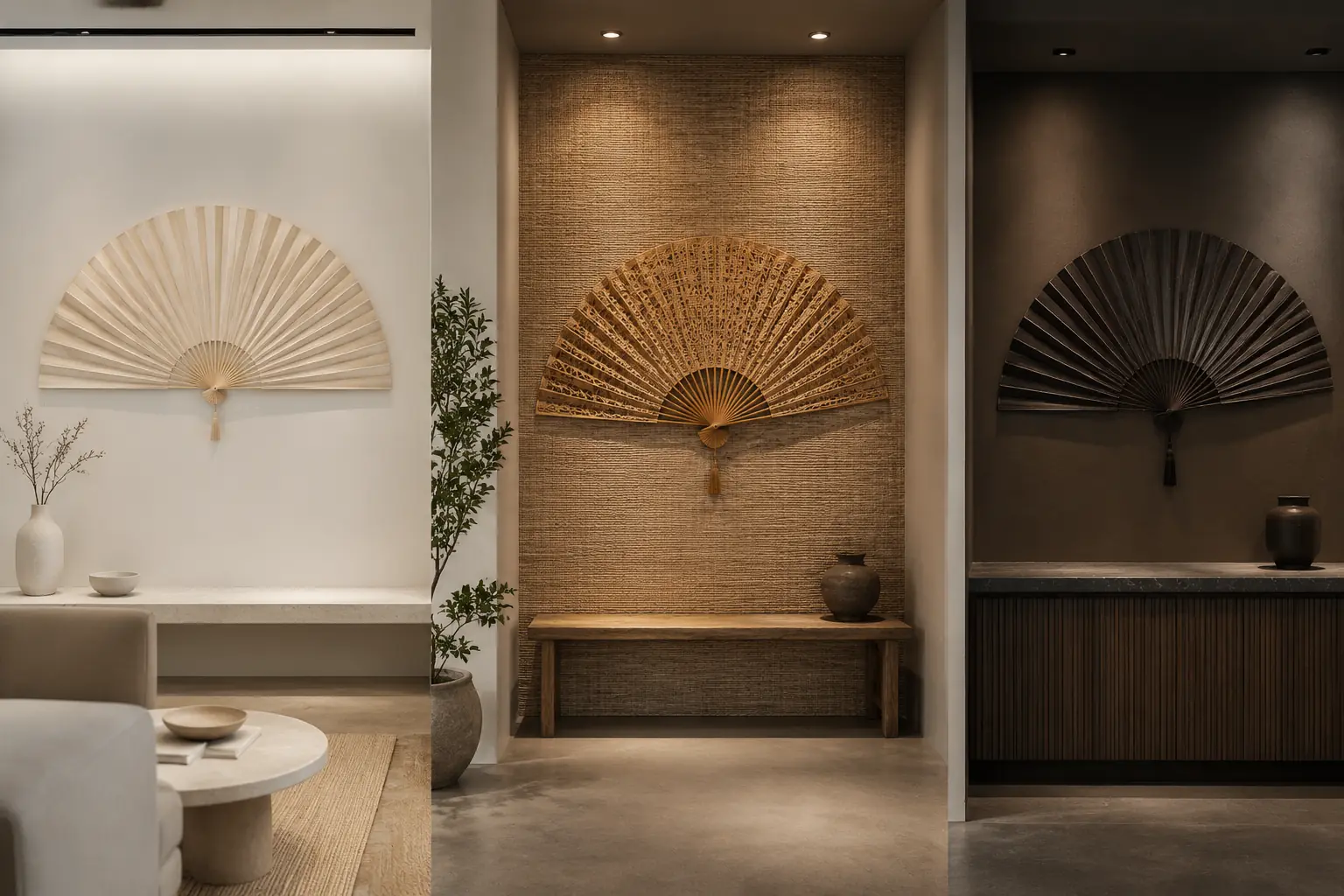
Natural bamboo fan wall hanging is often associated with “tropical,” “bohemian” or “Asian-inspired” rooms, but those labels can flatten very different design traditions. A more useful approach is to work from material, shape, color and surrounding architecture.
Quiet contemporary rooms
Choose a controlled palette, fine ribs and a low-contrast leaf. Pair the fan with plaster, pale timber, linen or matte stone. One large object usually has more impact than several small accessories competing for attention.
Warm natural interiors
A visible bamboo frame can connect with rattan, cane, oak and woven textiles, but perfect color matching is unnecessary. In fact, a small range of warm tones tends to look more authentic than several products stained to an identical orange. Keep the number of competing weave patterns limited so the radial fan remains legible.
Hospitality and commercial spaces
Restaurants, hotels and wellness spaces may use a large bamboo fan to establish mood from a distance. Here, durability, cleanability, fire-safety review and secure mounting are as important as appearance. Ask the project designer or local authority which documentation and treatments apply to the actual installation. Do not assume that a household decorative item is automatically approved for a public interior.
Retail and temporary event displays
A folding bamboo wall fan can create a portable backdrop if the leaf and pivot tolerate repeated setup. Specify a transport sleeve or crate, assembly instructions and a clear method for confirming that the fan is fully secured. A lightweight appearance is not evidence of low weight, so plan handling from the supplied dimensions and mass.
Select Color, Leaf Material and Surface Detail
The bamboo frame may be left close to its natural tone or finished in a darker color, depending on the agreed construction. Request a physical finish sample when color matters; screen images cannot show sheen, grain variation or how a finish responds to room lighting. Establish an acceptable range rather than expecting every bamboo strip to look identical.
Paper leaves can deliver crisp printed or painted designs but require protection from moisture and abrasion. Textile leaves may offer a softer surface and greater tear resistance, although fiber, weave and coating must be confirmed. Woven panels create texture but can collect dust and cast stronger shadows. A “silk look” is not the same as verified silk content, just as a natural-colored leaf is not proof of a specific fiber.
Use imagery with cultural care
If a design includes calligraphy, religious imagery, national symbols or motifs linked to a specific community, use qualified artwork and review its meaning. Random decorative characters can be incorrect, inverted or inappropriate. For a broadly natural interior, abstract brushwork, botanical forms or an unprinted leaf can provide visual interest without making a cultural claim.
Coordinate with the wall finish
High contrast emphasizes the fan’s geometry; low contrast emphasizes texture and shadow. Test the sample against the actual paint, stone or paneling. On a busy wallpaper, a solid leaf may read better than a detailed print. On a plain wall, rib spacing and the center pivot become prominent, so finish consistency matters.

How to Hang a Large Bamboo Wall Fan Safely
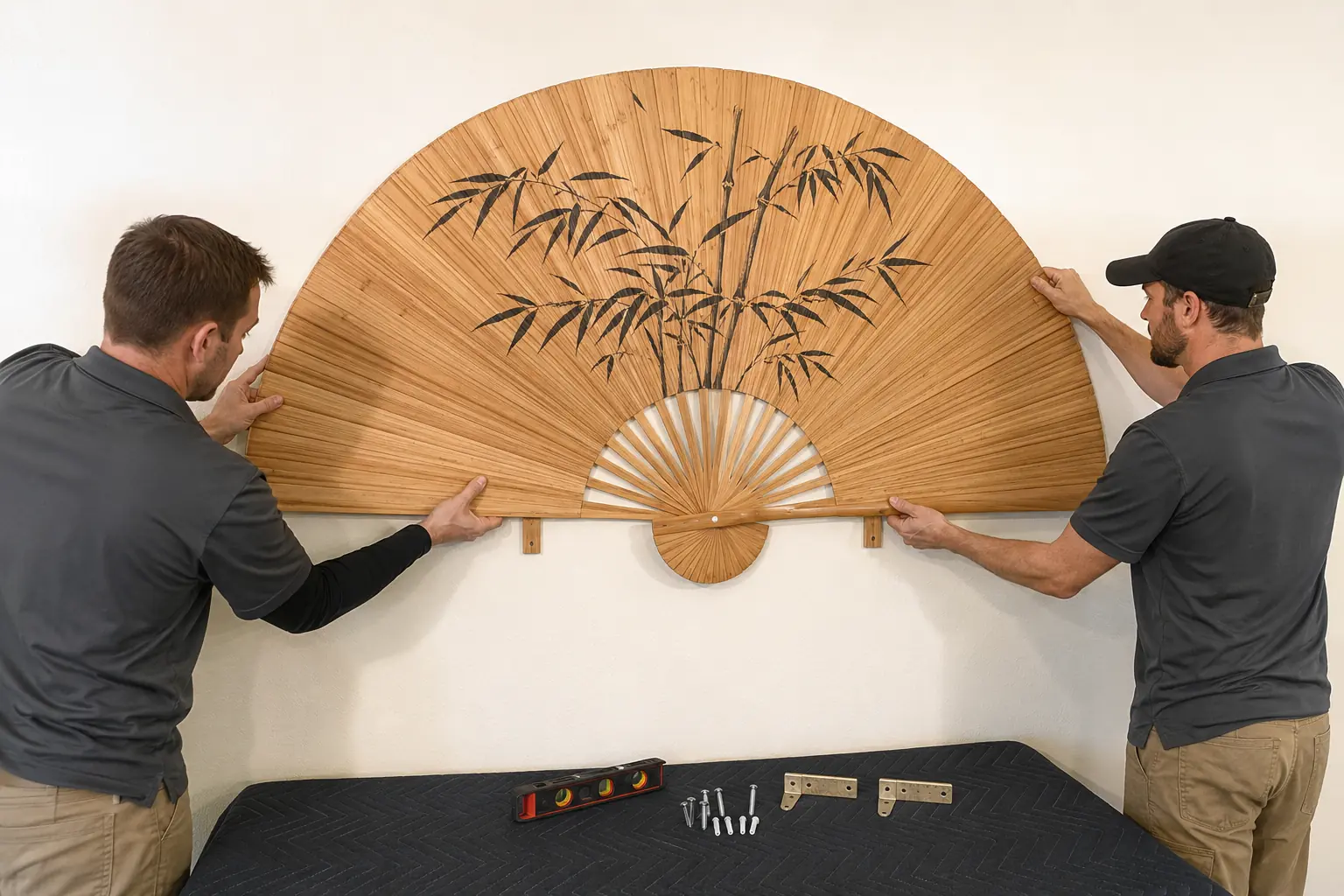
Installation begins with the product’s actual weight, back construction and designated hanging points. Never suspend a large fan from its decorative leaf, a thin rib or an improvised cord unless the supplier has designed and documented that method. Use hardware suitable for the wall substrate and local conditions. Drywall, masonry, timber framing and decorative wall panels require different anchors.
A practical installation sequence
- Inspect the product. Confirm that the pivot, guards, backing and hanging points are intact before lifting.
- Verify the wall. Locate framing, services and substrate; obtain professional advice when the wall construction is uncertain.
- Mark the center and outline. Use a level and full-size template to confirm height, symmetry and clearance.
- Install rated supports. Select fasteners for the substrate and calculated load, following the hardware maker’s instructions.
- Use more than one control point when designed for it. A primary support carries the load, while secondary points can prevent rotation or movement.
- Lift with adequate help. Protect the leaf and ribs; do not use them as handles unless specified.
- Check after installation. Confirm that the fan cannot close, slide or be easily pulled from the wall.
In earthquake-prone areas, public spaces, stairwells or locations above beds and seating, the consequence of failure is higher. Ask a qualified installer to assess restraint, hardware and placement. Keep the piece away from heat sources, open flame, active cooking grease, persistent condensation and strong air movement unless the product and installation have been designed for those conditions.
Care and Maintenance After Installation
Dust the fan gently with a soft brush, clean microfiber duster or low-suction tool fitted with a protective screen. Work from the center outward while supporting delicate areas. Do not pull across the pleats. Before using any damp method, identify the leaf material and finish; water that is harmless to one component may stain paper, lift pigment or raise bamboo fibers.
Direct sun can change the appearance of bamboo, paper, fabric and printed color over time. Strong heating or rapid humidity changes may also encourage movement, warping or adhesive stress. Place valuable or highly detailed pieces away from intense sunlight and monitor the room environment. In a commercial setting, include the fan in the routine facilities inspection: check mounting points, pivot security, dust accumulation, loose bindings and any contact damage.
Moving or storing a folding wall fan
Photograph the installed configuration before removal. Close a functional folding model only in the intended direction and without forcing resistant ribs. Interleave or wrap surfaces with suitable non-abrasive material, protect the guards and pivot, and store the fan flat or in the orientation recommended by the supplier. Keep installation hardware labeled with the corresponding piece.
What B2B Buyers Should Put in the Specification
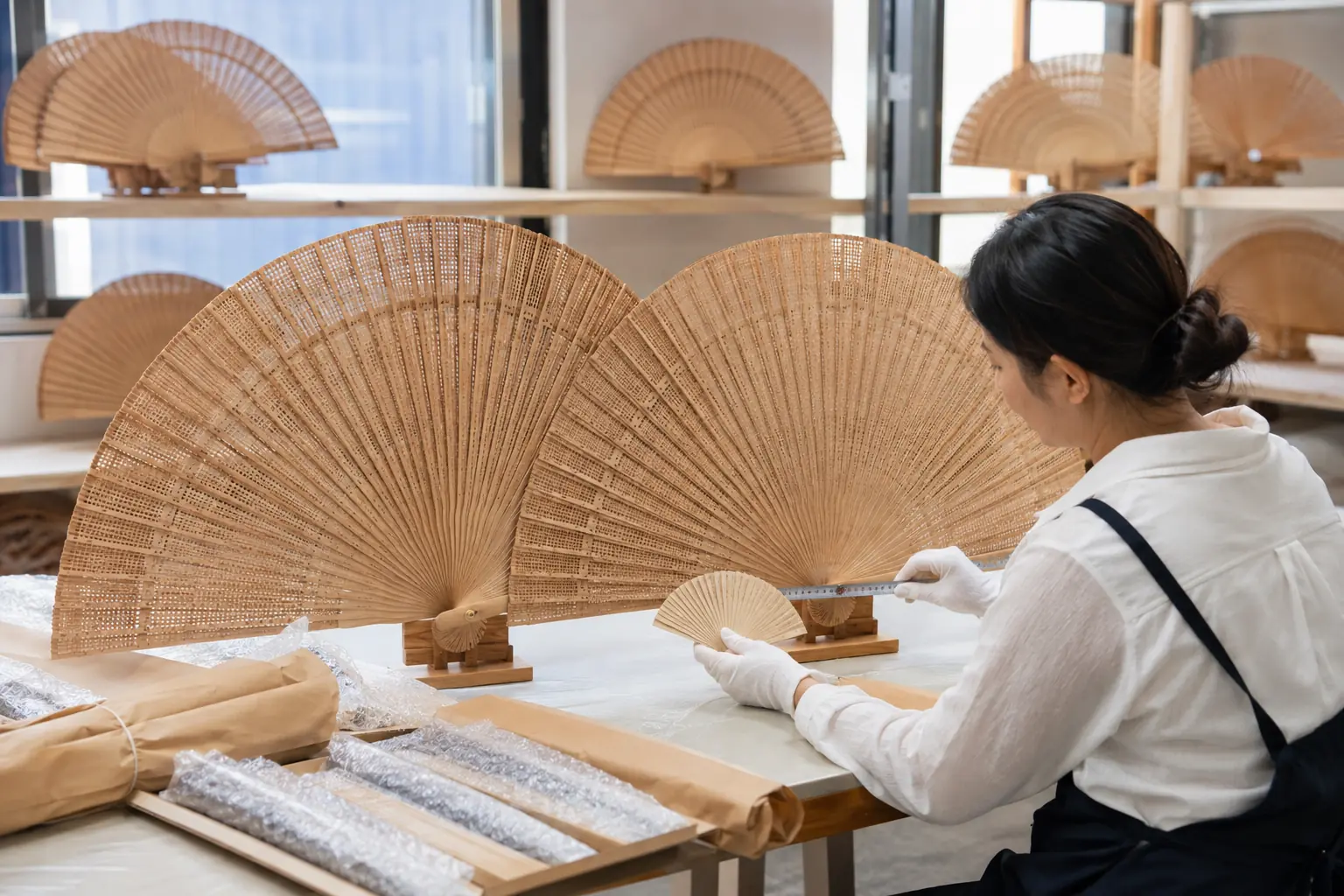
A clear RFQ for a large bamboo fan wall hanging should separate visual requests from measurable requirements. Include the fully open dimensions, folded dimensions if relevant, net weight, overall depth, functioning or fixed construction, component materials, surface finish, leaf material, artwork method, mounting points, hardware scope, intended environment, packing method, destination and required documentation.
Ask how natural variation will be represented in approval samples. If multiple fans will appear in one venue, define whether color range, grain direction and open angle should be closely coordinated. For printed artwork, provide a controlled file and specify orientation; the two sides of a fan are not automatically interchangeable.
| Review stage | Useful checks |
|---|---|
| Construction sample | Open dimensions, symmetry, pivot, rib spacing, backing and hanging-point strength |
| Finish and artwork sample | Bamboo color range, sheen, print orientation, edge quality and approved visual contrast |
| Packing trial | Protection for tips, guards, leaf and pivot; carton orientation; unpacking and repacking method |
| Pre-shipment review | Quantity, dimensions, appearance range, hardware, labels, instructions and agreed documentation |
Do not infer a minimum order, lead time, load rating or compliance status from a similar listing. These details depend on the chosen structure, customization, quantity, market and supplier confirmation.
Frequently Asked Questions
Is a giant bamboo fan always functional?
No. Some giant or oversized fans fold around a working pivot, while others are fixed decorative structures. Confirm the mechanism and intended use before ordering or attempting to move it.
How large should a bamboo fan be above a sofa or bed?
There is no universal size. Compare the fully open outline with the furniture grouping, ceiling, nearby fixtures and viewing distance. A taped full-size template is the most reliable planning tool.
Can I mount a large wall fan with adhesive strips?
Do not assume so. Mounting must account for the actual weight, center of gravity, wall substrate, designated attachment points and consequences of failure. Follow documented product and hardware guidance or use a qualified installer.
Can a bamboo folding wall fan be used outdoors?
Only when the supplier confirms that the complete construction, finish, leaf, adhesives, hardware and artwork suit the intended exposure. A bamboo component alone does not make the finished fan weather resistant.
How should a natural bamboo fan be cleaned?
Begin with gentle dry dusting. Identify all materials and finishes before applying moisture or cleaner, test in an inconspicuous area when appropriate, and follow the supplier’s care instructions.
What should a hospitality buyer request with a sample?
Request confirmed dimensions and weight, component materials, mounting details, finish range, care guidance, packing method and the documentation required for the intended public-space installation.