

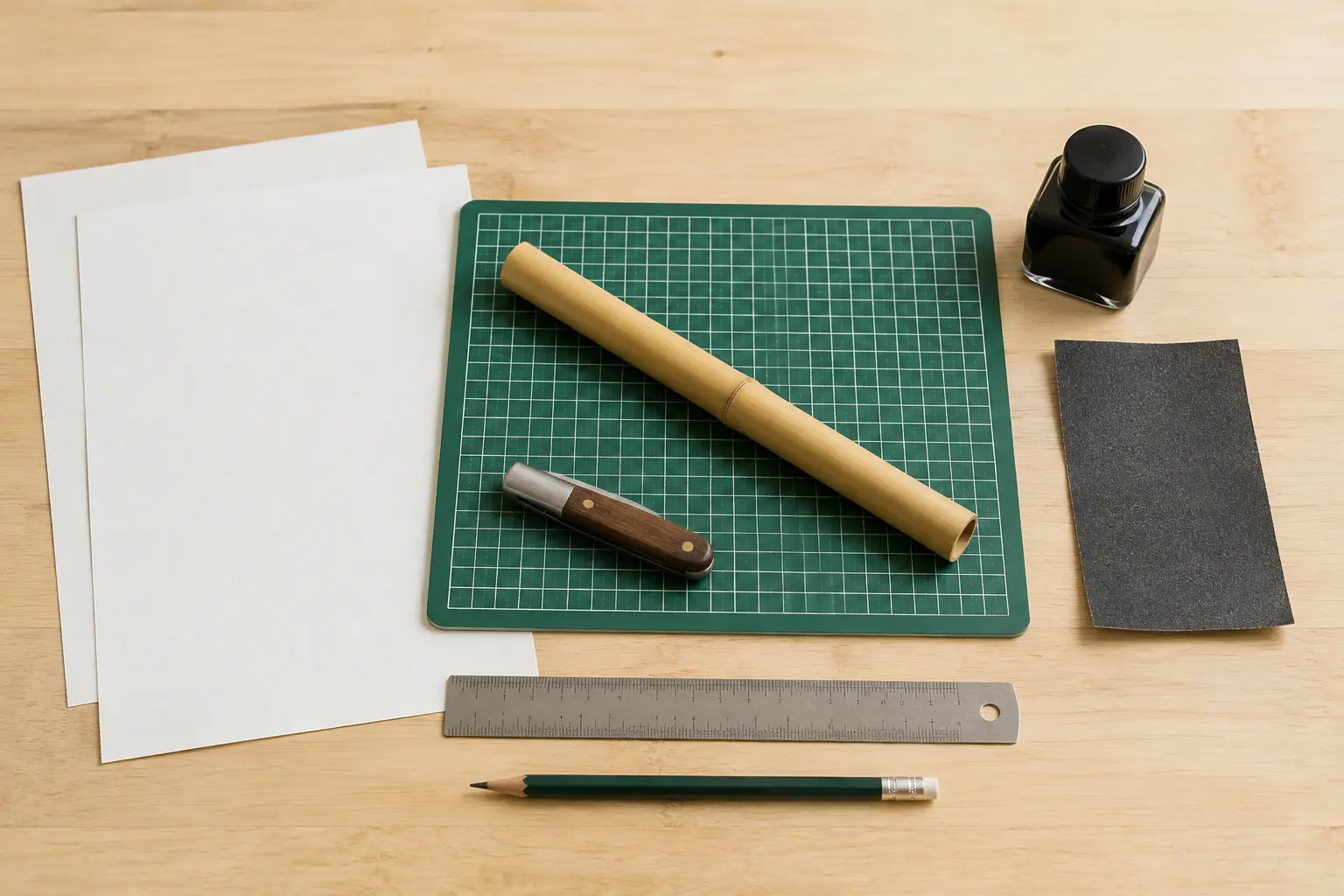
A bamboo reed pen turns a hollow stem into a responsive mark-making tool. A broad edge produces crisp calligraphic strokes, while a pointed or asymmetric tip creates expressive drawing lines. Good results depend on sound bamboo, careful nib shaping and a controlled dip-and-stroke rhythm.
This bamboo pen tutorial covers preparation, writing, cleaning and troubleshooting. Search phrases such as “how to use bamboo calligraphy pen,” “how to use bamboo dip pen” and “how to write with bamboo pen” all point to the practical questions answered below: how to load ink, find the correct angle and control each stroke. The guide is for artists, workshop organizers and product buyers who want to understand the tool before evaluating samples.

What Is a Bamboo Reed Pen?
A bamboo reed pen is a dip pen made by cutting one end of a bamboo tube into a nib. Unlike a fountain pen, it normally has no continuous internal ink feed. The writer dips the tip, removes excess and writes until the small reserve is depleted. Its hard surface feels direct and slightly textured.
The terms “reed pen” and “bamboo pen” are sometimes used interchangeably, although traditional reed pens may be made from other hollow plants. A handmade bamboo tool is also different from a bamboo-bodied ballpoint pen. Buyers should therefore identify the writing system—not just the barrel material—when reviewing a product description.
Choose the nib style before you begin
- Broad edge: useful for Roman, Arabic-inspired and other broad-nib lettering styles.
- Pointed or narrow tip: suited to sketching, contour lines and small lettering, but it will not behave exactly like a flexible metal nib.
- Angled edge: can make a preferred writing angle more comfortable for a specific hand or script.
There is no single universal profile. For a class or retail kit, consistency across nib width, cut angle and overall length matters more than copying one historical form.
Tools, Materials and Safety
Use a dry bamboo section that is straight, free from visible splits and comfortable to hold. Final dimensions should follow the user and intended stroke width. You will also need a stable cutting mat, sharp craft knife, fine sandpaper, ruler, pencil and suitable drawing or calligraphy ink. A fine saw can shorten thicker bamboo.
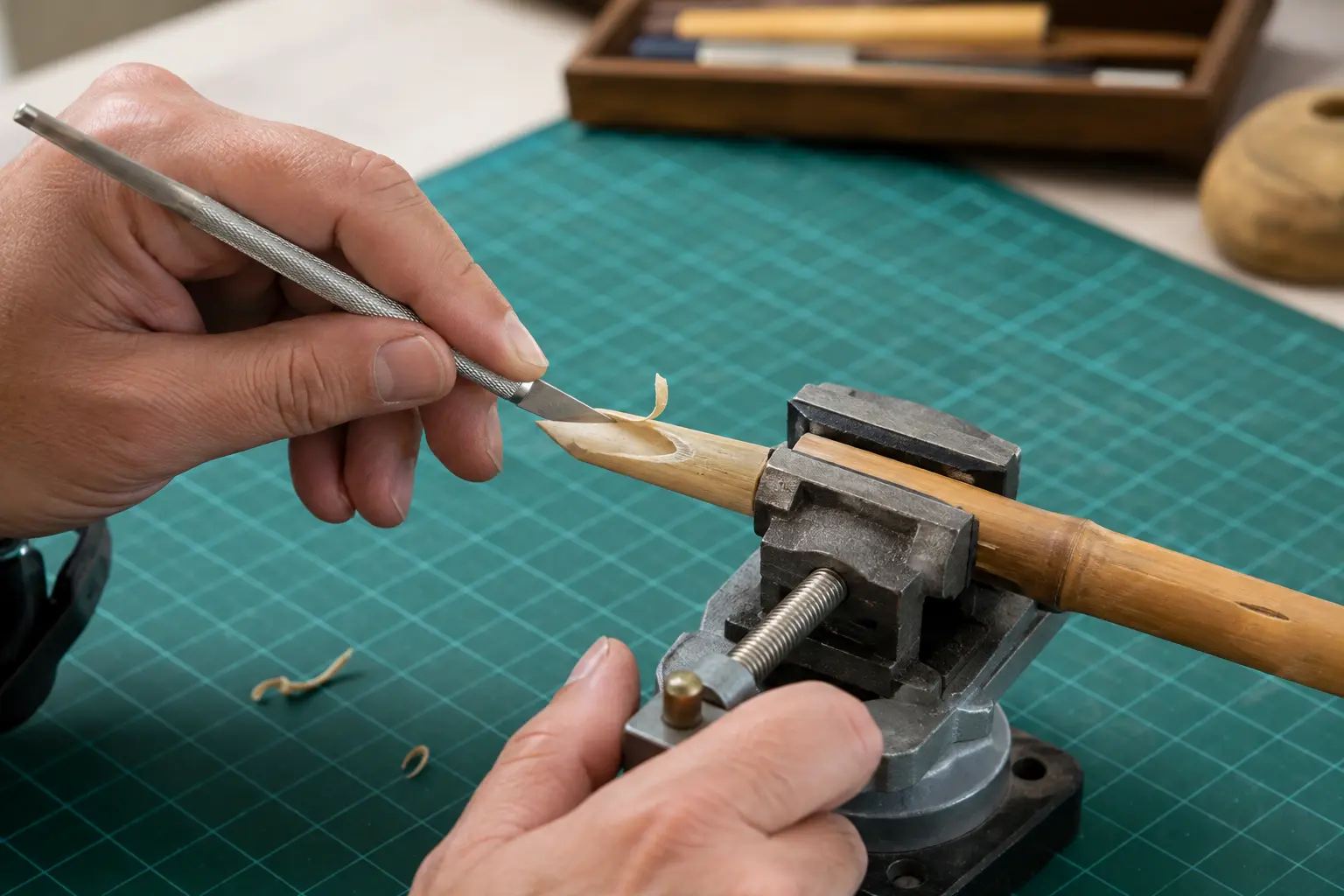
How to Make a Bamboo Pen Step by Step
1. Prepare and inspect the blank
Cut a comfortable length and smooth both ends. Inspect the wall around the intended nib for cracks, insect damage or weak fibers. A node near the grip can add character, but it should not create an uncomfortable ridge or interfere with the area being carved. Wipe away dust before marking the cut.
2. Mark the nib face
Choose the end with the most even wall. Draw a long, shallow taper on one side. A gradual taper supports the tip better than a short, abrupt notch. Mark the final writing edge, remembering that it is easier to remove a little more material later than to restore an over-cut nib.
3. Carve the taper
Place the bamboo flat and stable. With light cuts directed away from your fingers, shave the outer surface toward the tip. Reposition the blank instead of twisting into an unsafe angle. Inspect symmetry and wall thickness frequently; the nib should remain firm.
4. Open and flatten the writing face
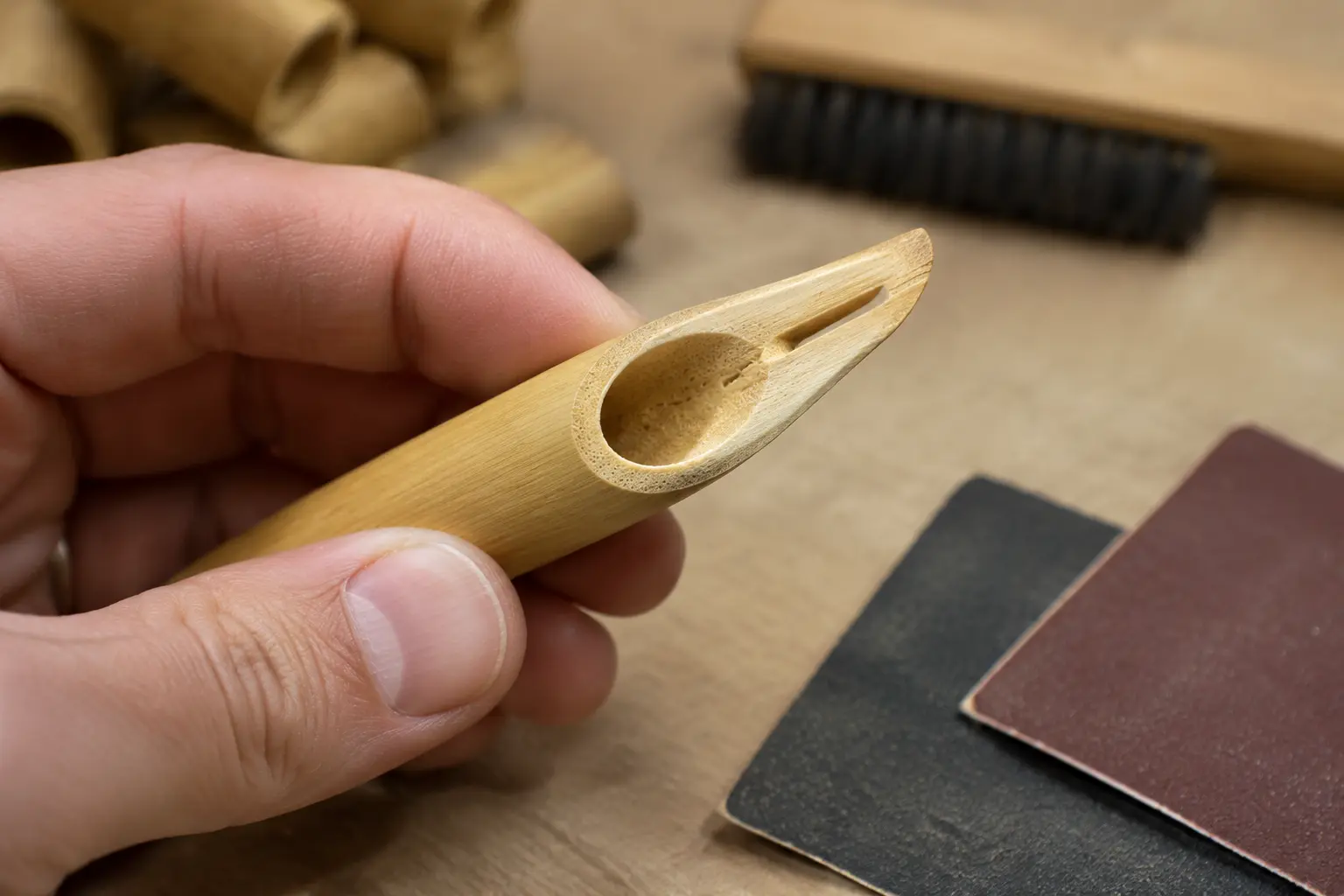
Trim the desired broad, narrow or angled edge. Remove loose internal fibers, then flatten the underside for predictable paper contact. Refine in small increments with fine sandpaper and test often; excessive polishing can round the corners.
5. Add a slit or ink reservoir only if appropriate
A short central slit can help ink travel toward the edge, and a shallow inner cavity may hold a small additional supply. Both operations weaken the nib if made too deep. Start conservatively. For an introductory workshop, a simple unslit broad nib can be easier and safer to produce. Avoid forcing a blade into the hollow tube, where splitting can occur unexpectedly.
6. Smooth, clean and test
Remove splinters from the grip and mouth of the pen. Brush or wipe away all sanding dust before dipping. Make several dry strokes to check for snagging, then test with a small amount of ink. Refine one variable at a time: edge flatness, corner sharpness, slit opening or writing angle.
How to Use a Bamboo Reed Pen
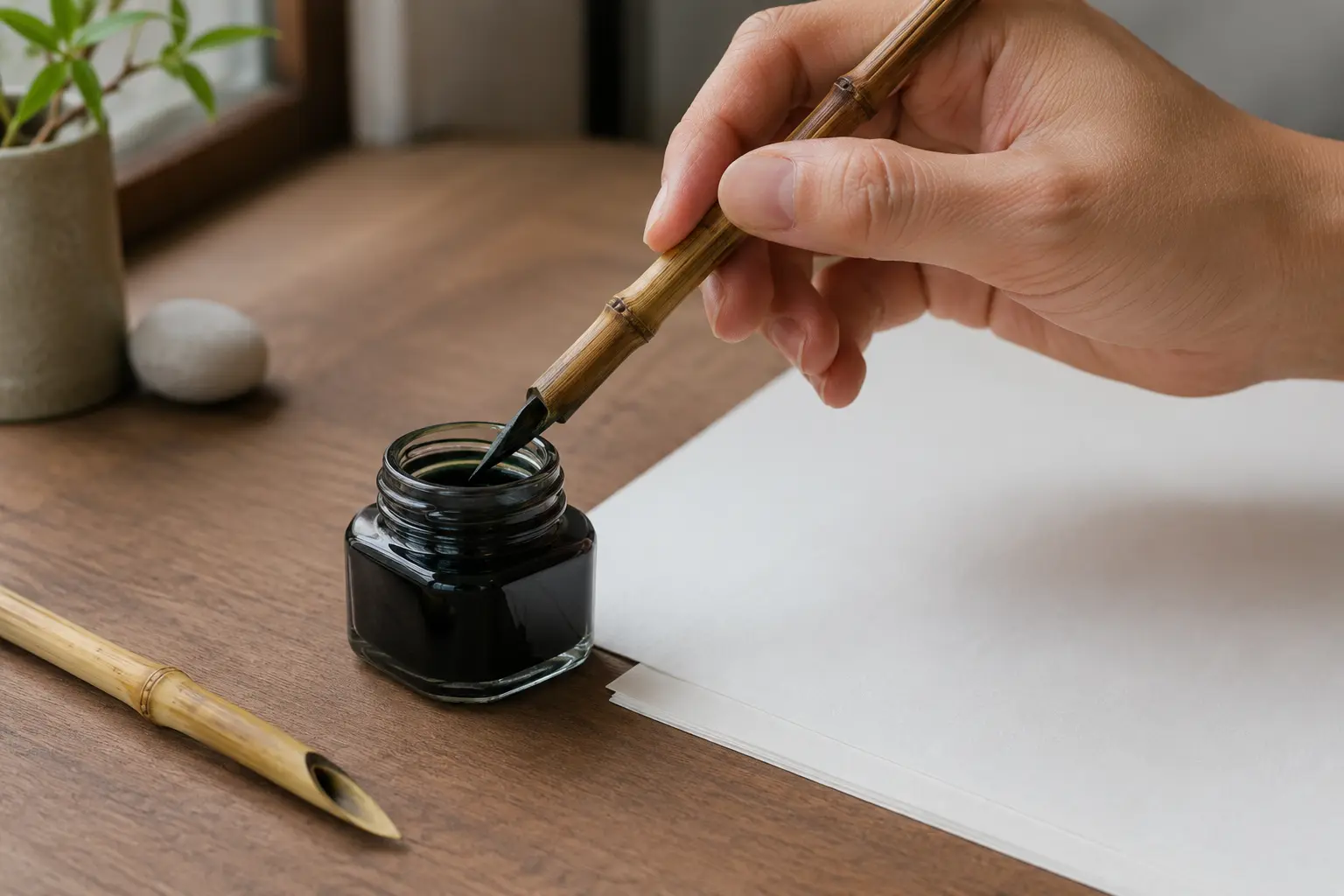
People asking “bamboo pen how to use?” can begin with the same habits used for most dip pens: test the ink, make a shallow dip, remove excess, maintain a stable angle and recharge before the stroke becomes dry. The following bamboo pen instructions provide a repeatable starting point.
1. Select compatible ink and paper
Use ink sold for dip-pen calligraphy or drawing. Very thick ink may not leave the nib readily; very thin ink may run, feather or fall from the pen. Mix or dilute only according to the ink maker’s directions. Start with smooth, reasonably ink-resistant practice paper. Paper labeled as bamboo writing paper may refer to fiber content, branding or a product category, so its actual behavior still needs a writing test.
2. Dip only the working end
Stir the ink gently if its instructions require it. Dip the nib far enough to wet the writing edge and any small reservoir, but avoid immersing the grip. Touch the nib lightly to the inside rim of the container to remove a hanging drop. Keep the container on a stable surface and close it when the session ends.
3. Find the contact angle
Hold the pen at a moderate angle to the paper rather than vertically. Place the full edge down and pull a short line. If only one corner touches, rotate the pen slightly or inspect whether the nib face is uneven. For broad-edge calligraphy, keep the nib angle relatively consistent while the direction of the stroke changes.
4. Pull before you push
Freshly carved fibers are more likely to catch when pushed sharply across paper. Begin with deliberate pulling strokes. Use light pressure; bamboo is comparatively rigid, so force usually increases snagging rather than creating useful flex. Recharge the nib as soon as the line loses saturation instead of pressing harder.
How to Write with a Bamboo Pen
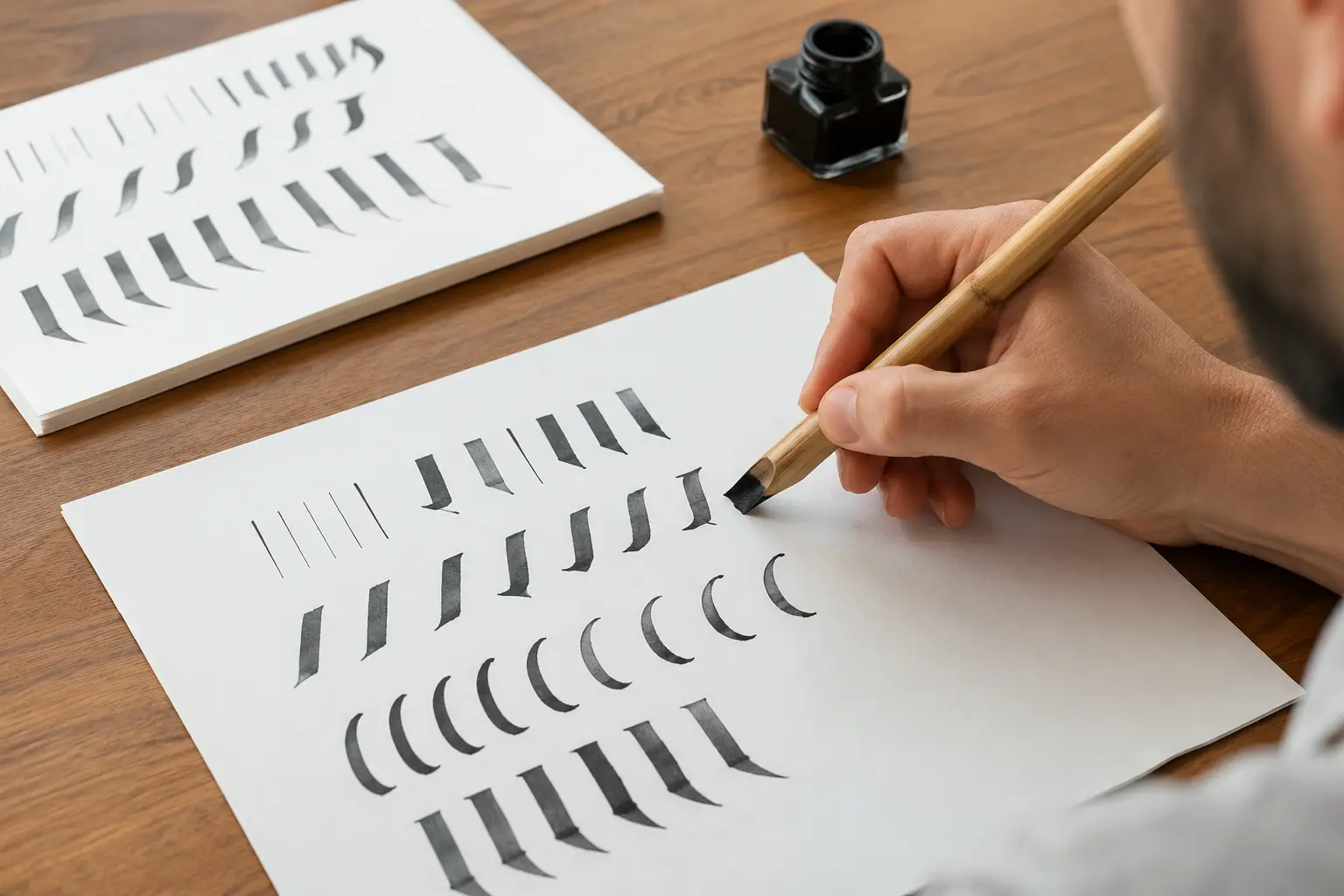
Learning how to use a bamboo calligraphy pen is mainly an exercise in rhythm. Practice horizontal lines, vertical lines, curves and boxes while watching how the fixed nib angle changes line width. Lift between complex stroke groups to reset the edge.
For drawing, vary direction and speed rather than relying on pressure alone. The broad edge can alternate between a thin corner line and a wide face stroke. Slightly uneven ink delivery can be part of the character, but uncontrolled blobs usually indicate over-dipping, a damaged edge or an unsuitable ink consistency.
A ten-minute practice routine
- Make one row of parallel downstrokes with the same nib angle.
- Make one row of thin corner strokes without rotating the pen unintentionally.
- Connect wide and thin strokes in repeated curves.
- Write a short word, noting how many letters one dip produces.
- Draw a small object using the broad face for shadow and the corner for detail.
Record the ink, paper and nib width beside each test. That simple sample log is useful for artists and for B2B buyers comparing prototypes from different production runs.
Cleaning, Drying and Storage
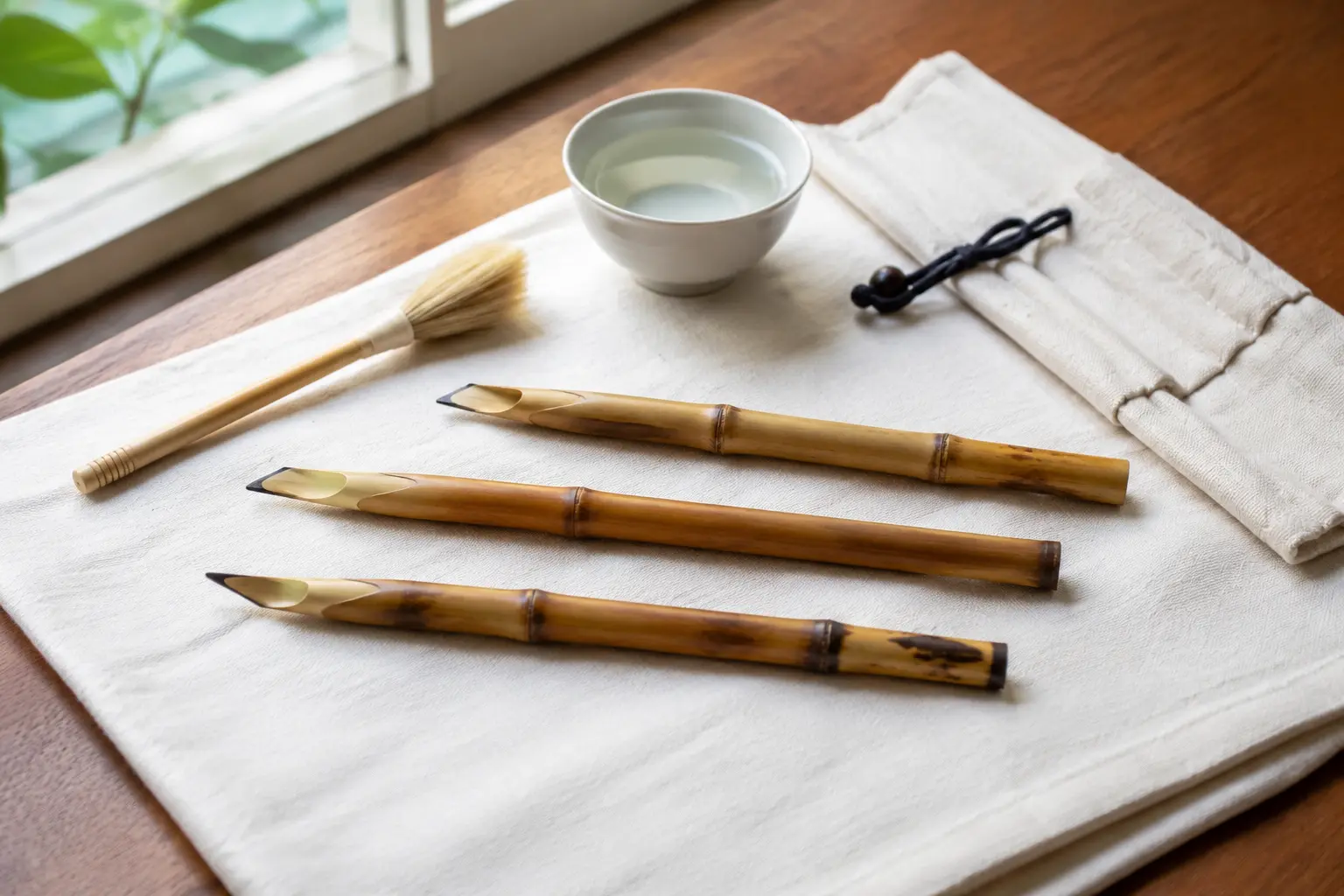
Clean promptly, following the ink manufacturer’s advice. For water-cleanable practice ink, rinse only the nib with cool or lukewarm water and wipe with a lint-free cloth. Do not soak the bamboo body: moisture can raise fibers or distort the tube. Waterproof, acrylic or shellac-based ink may need a dedicated cleaner; confirm compatibility first.
Dry the pen horizontally in a ventilated place away from direct heat. Check the slit for dried residue and use a soft brush if necessary. Store the fully dry tool in a protective sleeve or tray where the nib cannot strike hard objects. Before a long storage period, make sure there is no ink trapped inside the hollow stem.
Troubleshooting Common Bamboo Pen Problems
| Problem | Likely cause | Practical response |
|---|---|---|
| Ink blobs at the start | Over-dipping, a drop under the nib or ink that is too fluid for the paper | Remove excess on the container rim, test on scrap paper and verify ink-paper compatibility. |
| Ink will not flow | Dried residue, a closed slit, insufficient dipping or ink that is too thick | Clean the nib, inspect it in good light and follow the ink maker’s adjustment guidance. |
| One edge skips | Uneven writing face or incomplete paper contact | Adjust the holding angle first; if needed, refine the edge minimally on fine abrasive paper. |
| Paper catches or tears | Splinter, sharp burr, pushing stroke or excessive pressure | Stop using the pen, smooth the defect, then resume with light pulling strokes. |
| Nib begins to split | Slit too deep, thin walls, impact or repeated wet-dry stress | Retire or shorten the damaged nib; do not force a widening split back together. |
What B2B Buyers Should Check in a Bamboo Pen Sample
A handmade test explains the principle, but commercial evaluation needs a repeatable specification. Ask the supplier to confirm the writing system, nib profile and width, finished length, surface treatment, ink compatibility, accessories and packing. Review multiple samples.
Functional checks can include grip comfort, visible splinters, straightness, edge consistency, initial blobbing, stroke length per dip, cleaning access and protection of the nib in transit. If the product is intended for children, classrooms or public workshops, obtain an appropriate safety and compliance review for the actual product and market. Do not treat a general material statement as evidence that a finished item meets a specific requirement.
Frequently Asked Questions
Can any piece of bamboo become a reed pen?
No. Choose dry, intact bamboo with an even wall and no visible cracking or damage. A weak or irregular section can split during carving or produce an unreliable nib.
How far should I dip a bamboo pen?
Wet the writing edge and any shallow reservoir, not the grip. The exact depth depends on the nib design, so begin with a shallow dip and test on scrap paper.
Can a bamboo dip pen use fountain pen ink?
Some combinations may work, but flow and paper behavior vary. Use an ink intended or confirmed for the application, and test the specific nib, ink and paper together. Never return test ink to the original bottle if it may have been contaminated.
Why does my bamboo pen scratch the paper?
The edge may have a burr, only one corner may be touching, or you may be pushing with too much pressure. Stop, inspect the nib, correct the angle and smooth defects conservatively.
How long does a bamboo reed pen last?
There is no universal lifespan. Bamboo condition, nib thickness, ink chemistry, cleaning, storage and writing pressure all affect service life. Replace a pen that develops a hazardous splinter or unstable split.